Sharing the road City tries to find the right balance in regulating personal e-vehicles
Read this article for free:
or
Already have an account? Log in here »
To continue reading, please subscribe:
Digital Subscription
One year of digital access for only $1.44 a week*
- Enjoy unlimited reading on winnipegfreepress.com
- Read the E-Edition, our digital replica newspaper
- Access News Break, our award-winning app
- Play interactive puzzles
*Billed as $5.77 plus GST every four weeks. After 52 weeks, price increases to the regular rate of $19.95 plus GST every four weeks. Offer available to new and qualified returning subscribers only. Cancel any time.
To continue reading, please subscribe:
Add Free Press access to your Brandon Sun subscription for only an additional
$1 for the first 4 weeks*
- Enjoy unlimited reading on winnipegfreepress.com
- Read the E-Edition, our digital replica newspaper
- Access News Break, our award-winning app
- Play interactive puzzles
*Your next Brandon Sun subscription payment will increase by $1.00 and you will be charged $17.95 plus GST for four weeks. After four weeks, your payment will increase to $24.95 plus GST every four weeks.
Read unlimited articles for free today:
or
Already have an account? Log in here »
Patty Wiens was already a cycling enthusiast when she got an electric bicycle in early 2023, but she didn’t realize how much it would transform the way she got around Winnipeg.
She started riding throughout winter and stopped relying on her vehicle. Eventually, she sold her car.
“It’s not a replacement for a bike,” she said. “It’s a replacement for a car.”
Wiens, who has been dubbed the “Bike Mayor of Winnipeg” by a global cycling advocacy organization, said her e-bike is a cheaper and more environmentally friendly way to get around the city, especially as the cost of living mounts.
MIKAELA MACKENZIE / FREE PRESS Patty Wiens, the "Bike Mayor of Winnipeg" says her e-bike is a cheaper and more environmentally friendly way to get around the city.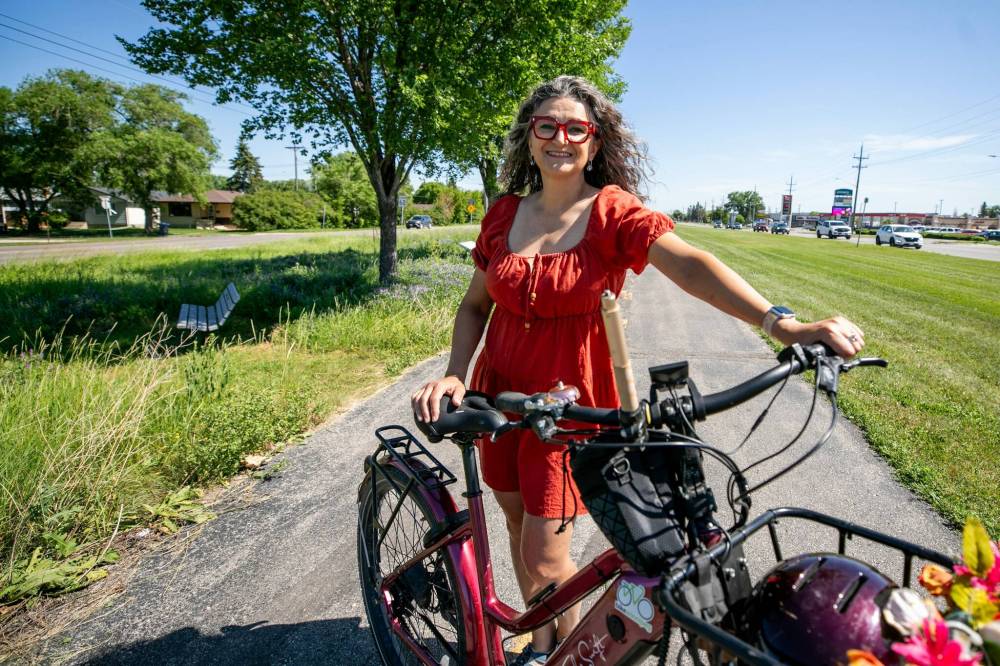
Not everyone is as effusive about e-bikes as Wiens.
Many Winnipeggers have stories of being startled by e-bike riders who silently whip by them on active transportation paths, or helmetless e-scooter riders, often with a passenger clinging to their backs, zipping down sidewalks. One municipal leader has said their popularity has led to a “Wild West” mentality on city streets.
As more people turn to e-bikes and other personal electric vehicles, including e-scooters, e-skateboards and e-unicycles, there is consensus that regulations are needed for how they operate on Winnipeg streets and pathways.
The province is preparing new rules that will introduce speed limits, helmet requirements and other restrictions after receiving complaints that the lack of regulation has created unsafe conditions.
“It’s not a replacement for a bike… It’s a replacement for a car.”
Coun. Janice Lukes, the chair of Winnipeg city council’s public works committee, said such changes are greatly needed to control the vehicles, which operate in a free-for-all.
“There are serious hazards. I see, all of the time … two kids on an electric bike or electric scooters (with) no helmets. Head injuries have skyrocketed,” Lukes said.
The Canadian Institute for Health Information has reported the number of hospitalizations linked to e-scooters in Canada has surged by 32 per cent, to 498 in 2023-24 from 375 in 2022-23 .
Dr. Brian Rowe, an emergency physician and professor at the University of Alberta, said emergency departments in the Edmonton area have recorded a steady rise in e-scooter injuries since rental scooters arrived in 2019.
Most injuries are orthopedic, including fractures and dislocations that can require surgery. About 15 per cent of patients admitted to hospital have significant head injuries.
Rowe said he supports regulations such as mandatory helmets, age restrictions and speed limits, but believes legislation needs to be backed by enforcement.
“Head injuries have skyrocketed.”
“Education can only do so much,” Rowe said. “Provincially, they should probably have wider, more detailed legislation, but also some teeth. Because as far as I know, there has been no surveillance or enforcement of any of the rules.”
Some Winnipeg residents say they’ve witnessed unsafe riding firsthand.
Bobi Stupack said her husband saw a teenager crash after taking one hand off the handlebars of his e-scooter.
“He stopped to help, so did another witness,” Stupack said. “The other witness took him to a hospital due to head injury symptoms and a broken thumb. He didn’t have a helmet on, like so many others fail to do.”
Others say the actions of some e-bike and e-scooter users should not define everyone who relies on them.
Adam Borchert uses an e-bike because of a disability and said it has become an important part of his well-being.
“It has made a massive improvement to my independence and quality of life,” he said.
MIKAELA MACKENZIE / FREE PRESS Bikes and Beyond Winnipeg owner Brett Zagozewski says e-bike sales tripled at the store last year.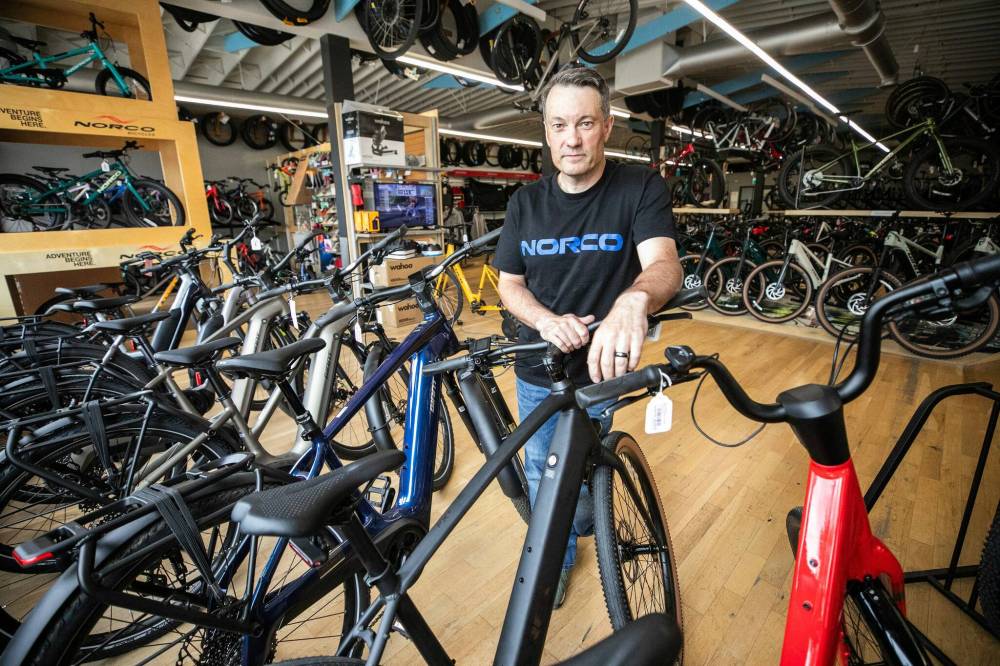
Robert Ryan said he loves what his e-bike offers.
“For someone like me in my 50s, it’s much easier on my knees, and I can be out exploring places I wouldn’t normally ride,” Ryan said. “I’m a pretty cautious and safe rider and haven’t really had any close calls.”
Demand has steadily increased for legal e-bikes — those that are limited to a maximum assisted speed of 32 kilometres an hour. Brett Zagozewski, the owner of Bikes and Beyond Winnipeg, said e-bike sales tripled at the store last year.
Zagozewski said e-bikes were once more popular among older riders, but the customer base has expanded across all age groups.
“We certainly remind people, like anything that you want to operate, whether it’s an e-bicycle or a pedal bicycle, you should operate it with proper etiquette.”
Under current Manitoba’s Highway Traffic Act rules, e-bikes are treated similarly to traditional bicycles. To qualify as an e-bike, they must have working pedals, a motor no larger than 500 watts and they must not provide electric assistance above 32 km/h. The minimum age to operate one is 14.
Like traditional bicycles, e-bikes are permitted on roads, bike lanes and designated multi-use paths. They are not allowed on sidewalks, and riders are required to wear helmets.
The provincial fine schedule includes a $113 ticket when an e-bike rider is caught without wearing a helmet or riding underage or riding on a sidewalk with an oversized rear wheel.
E-scooters and other personal electric vehicles are in a different position. The province passed legislation in June to bring devices such as e-scooters, e-skateboards, self-balancing scooters and electric unicycles under the Highway Traffic Act in a new category called “personal electric vehicles.” However, those rules have not yet taken effect.
Riders will need to be at least 16 years old to operate electric vehicles such as scooters and skateboards.
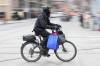
MIKE DEAL / FREE PRESS A rider on an e-scooter, left, makes his way along Assiniboine Avenue Tuesday afternoon.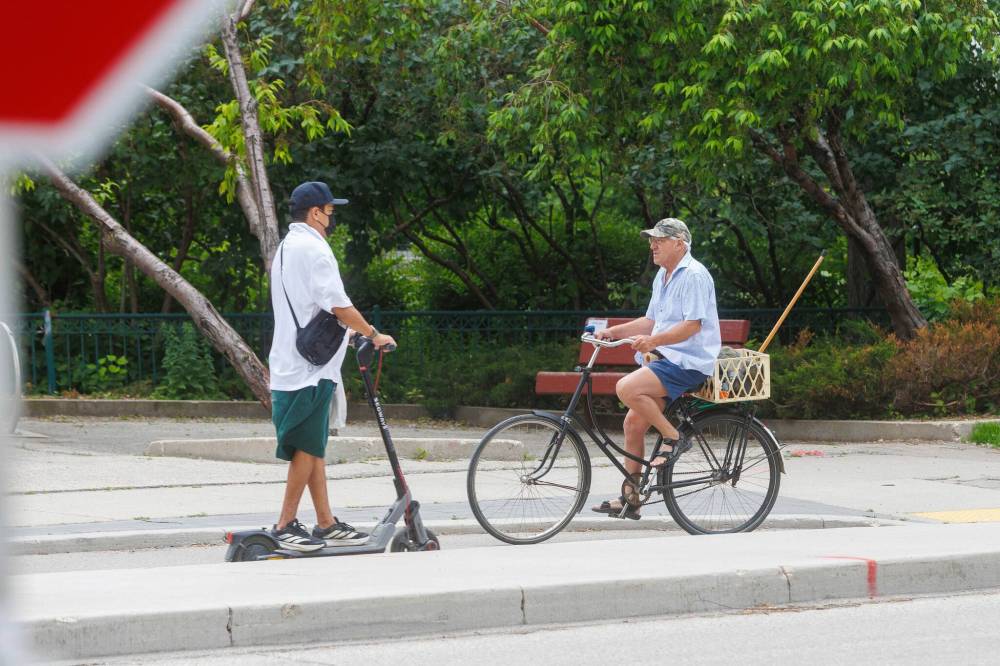
All riders of personal electric vehicles will be required to wear a helmet, stay off sidewalks (except where noted otherwise) and are restricted from carrying a passenger. Exceptions include sidewalks designated as multi-use paths for both cycling and walking.
Riders will be capped at an operating speed of 25 km/h, and they won’t be allowed on highways with speed limits greater than 50 km/h.
A provincial spokesperson said the penalties for breaking those rules are still being determined. The date when the changes will take effect was not provided.
Transportation Minister Lisa Naylor said in an interview that setting the minimum age at 16 aligns with most other communities and reflects an age when riders should be able to understand and follow the rules of the road.
“My focus is always on keeping Manitobans … safe on our roadways … The kinds of things that we’ve been hearing across the provinces are (about) folks using these on walking paths or sidewalks, going at quite high speeds and sometimes creating a lot of risk for people using those pathways,” said Naylor.
“At the same time, we know that a lack of helmet use for those types of vehicles does lead to a lot of health expenses and, of course, trauma for kids or adults who hit their heads when they fall off these things.”
One cycling advocate supports capping the speed limit but isn’t convinced helmets should be made mandatory.
“I think you’re better off promoting helmets rather than legislating helmets … The fear is that there’s a tendency when you legislate helmets … that you promote the fear side of things rather than the benefit,” said Mark Cohoe, executive director of Bike Winnipeg.
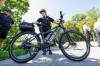
MIKAELA MACKENZIE / FREE PRESS To qualify as an e-bike, a vehicle must have working pedals and a motor no larger than 500 watts.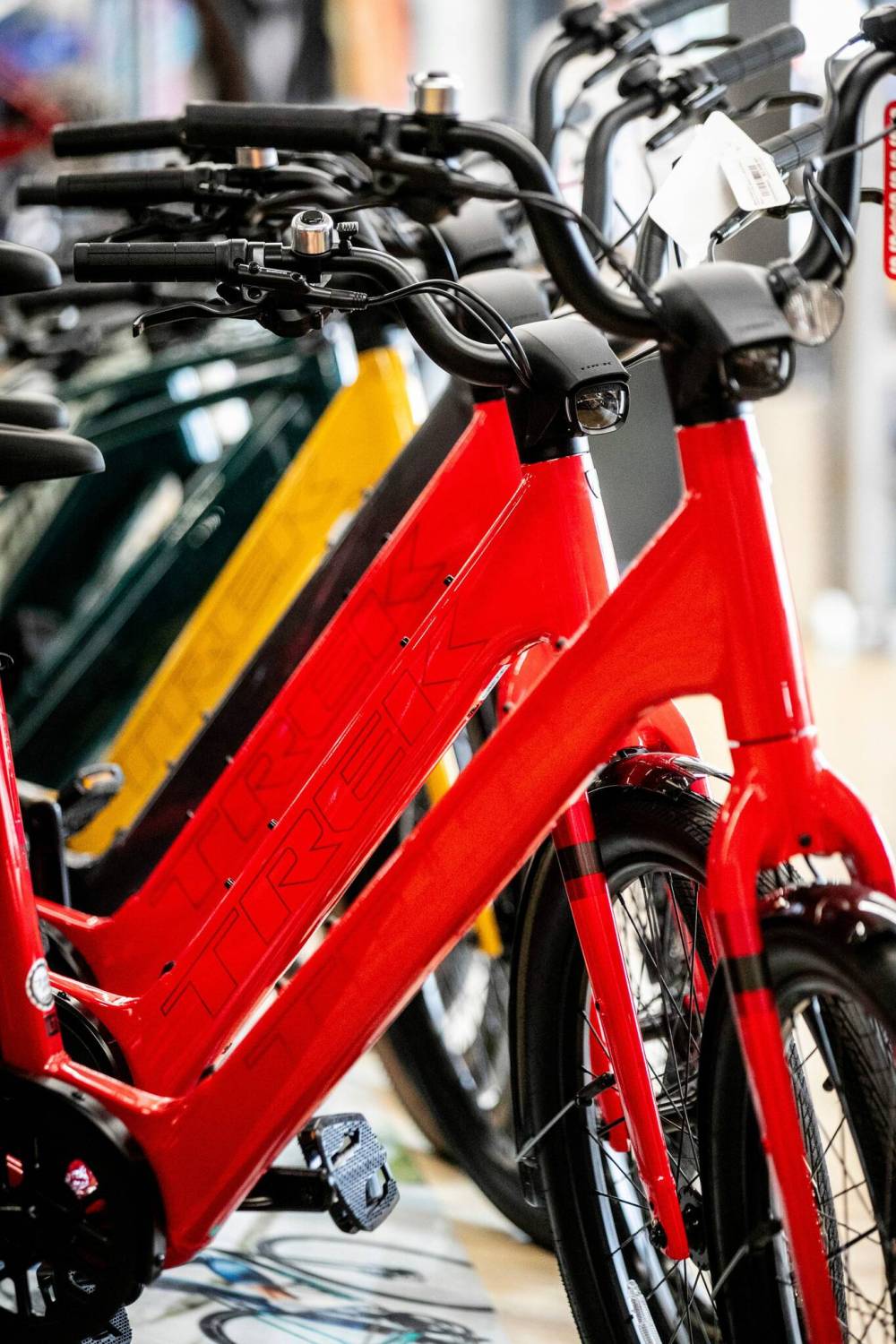
Cohoe said that could make the vehicles seem more dangerous and deter some people from using the environmentally friendly transportation option. He said head injuries from collisions with motor vehicles are still possible when a helmet is worn.
Rowe, the emergency physician, said helmet laws should apply to all active transportation devices.
“I’ve seen that dozens, hundreds of times — people not wearing a helmet … they can have a lifelong injury,” he said. “Most of the people who wear a helmet, yeah the helmet might crack and they might get an abrasion somewhere, but they’re not (left) disabled.”
Cohoe also believes federal rules may be needed to regulate the power, size and weight of e-bikes that are allowed for use in Canada.
Zagozewski said there are a lot of non-certified e-bikes on city streets that are going faster than 32 km/h. Those vehicles should be categorized as mopeds and not allowed on sidewalks, he said.
Wiens is also concerned by the dangers the illegal bikes pose.
“I still get passed by these illegal e-motorcycles,” Wiens said. “They’re not even e-bikes; they’re just throttling it and zooming past me. And it’s kind of concerning; it’s kind of scary.”
The City of Morden implemented its own bylaw on e-bikes, e-scooters and e-skateboards in June, which makes helmets mandatory, allows just one rider (per single-person device), bans riding on sidewalks and boulevards and requires the vehicles to travel close to the right-hand curb of the road in the same direction as traffic. The regulations also require the vehicles to be equipped with a headlight and rear light or reflector when used during dusk or when it’s dark. Any infraction comes with a $50 fine, and in cases of flagrant repeated abuse, the vehicle may be impounded.
Lukes said it would be more challenging for Winnipeg to carve out specific rules, since its population of more than 800,000 has so many trails, including bike routes that include both dedicated active transportation paths and roads shared with motor vehicles.
MIKAELA MACKENZIE / FREE PRESS E-bikes must not provide electric assistance above 32 km/h.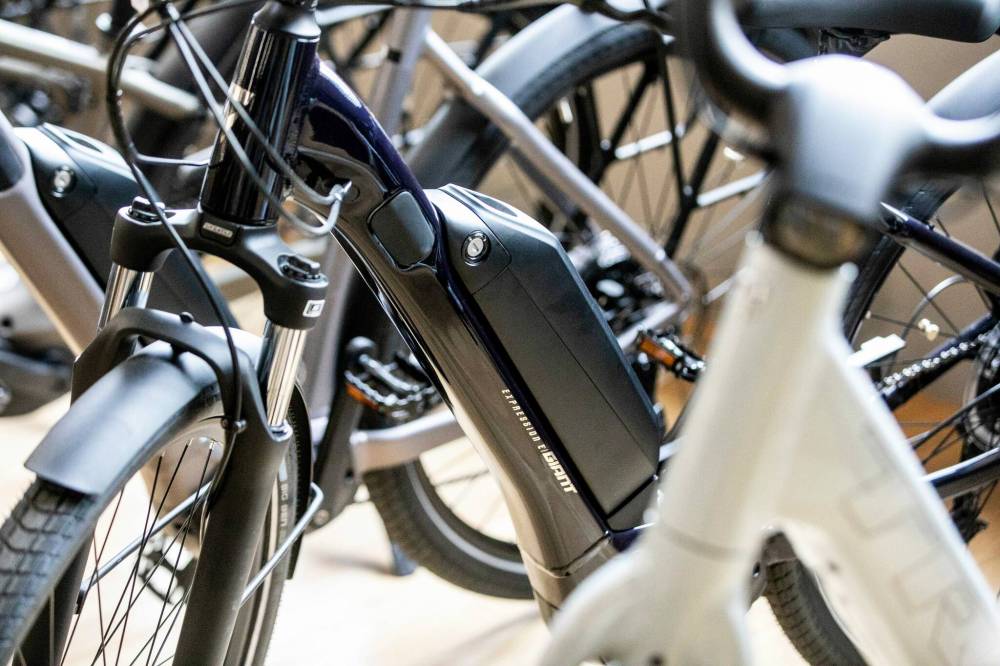
“We have a lot more to look at than Morden does and we want to fall in line with provincial legislation … We’ve got thousands of vehicles on the roads,” the councillor said.
Lukes supports the provincial rules and believes the city will find a way to adapt them to its environment and infrastructure. But because of the city’s size and population, enforcement will be a challenge, she said.
Winnipeg’s public service is expected to make recommendations to city council on how best to regulate personal electric vehicles later this year or early next year, city public works spokesperson Julie Dooley said in an email.
“There are some aspects of (the legislation) that need to be addressed in a Winnipeg context, which is a more complicated operating environment for e-bikes than smaller communities,” wrote Dooley.
Wiens said the goal is to increase the number of people who use them safely and create a city in which all road users, including drivers, are mindful of each other.
“We need education everywhere, because when we’re on a multi-use path, we need to prioritize pedestrian safety, right? Ring a bell, slow down.”
— With files from The Canadian Press
joyanne.pursaga@freepress.mb.ca
zoe.pierce@freepress.mb.ca

Joyanne is city hall reporter for the Winnipeg Free Press. A reporter since 2004, she began covering politics exclusively in 2012, writing on city hall and the Manitoba Legislature for the Winnipeg Sun before joining the Free Press in early 2020. Read more about Joyanne.
Every piece of reporting Joyanne produces is reviewed by an editing team before it is posted online or published in print — part of the Free Press‘s tradition, since 1872, of producing reliable independent journalism. Read more about Free Press’s history and mandate, and learn how our newsroom operates.
Our newsroom depends on a growing audience of readers to power our journalism. If you are not a paid reader, please consider becoming a subscriber.
Our newsroom depends on its audience of readers to power our journalism. Thank you for your support.
Related Articles
Bike-to-school day initiative features fun pit stops across city, encourages families to ride