

Spinning his way to the podium
Winnipegger Bairos-Novak medals at wheel gymnastics worlds
Advertisement
Read this article for free:
or
Already have an account? Log in here »
To continue reading, please subscribe:

Digital Subscription
One year of digital access for only $205*
- Enjoy unlimited reading on winnipegfreepress.com
- Read the E-Edition, our digital replica newspaper
- Access News Break, our award-winning app
- Play interactive puzzles
*First annual payment billed as $205.00 + GST for one year. This annual subscription will automatically renew at $233.00 + GST every 52 weeks (10% off the regular annual price of $259.35). Offer available to new and qualified returning subscribers only. Cancel any time.
To continue reading, please subscribe:
Add Free Press access to your Brandon Sun subscription for only an additional
$1 for the first 4 weeks*
- Enjoy unlimited reading on winnipegfreepress.com
- Read the E-Edition, our digital replica newspaper
- Access News Break, our award-winning app
- Play interactive puzzles
*Your next Brandon Sun subscription payment will increase by $1.00 and you will be charged $17.95 plus GST for four weeks. After four weeks, your payment will increase to $24.95 plus GST every four weeks.
Read unlimited articles for free today:
or
Already have an account? Log in here »
Steven Bairos-Novak has always had a knack for participating in the more unconventional side of sports. He has since added wheel gymnastics to that list.
The Winnipegger has always been an athlete but not consistently in the same sport. In high school, he was deemed too short to play basketball and while that was one dream crushed at a young age, he pivoted to start something new.
“My dad wanted me to do a sport and he knew another parent of a pole vaulter, so he got me started. I fell in love with pole vault,” Bairos-Novak said.
Starting in Grade 10, he trained at Winnipeg Optimist Athletics, learning the world of track and field. Coincidentally, recent athlete-builder inductee of the Sports Manitoba Hall of Fame — Wayne McMahon — was one of his coaches, alongside Scot Dressler.
“He deserves it,” Bairos-Novak remarked regarding McMahon’s recent achievement. “When Scot wasn’t around, he would help out and taught me a few other track and field sports.”
ACHILLE ABBOUD PHOTO Winnipegger Steven Bairos-Novak took bronze in the overall men’s cyr wheel competition and silver for the men’s cyr wheel artistic division earlier this month at the IRV World Championships in Gottingen, Germany.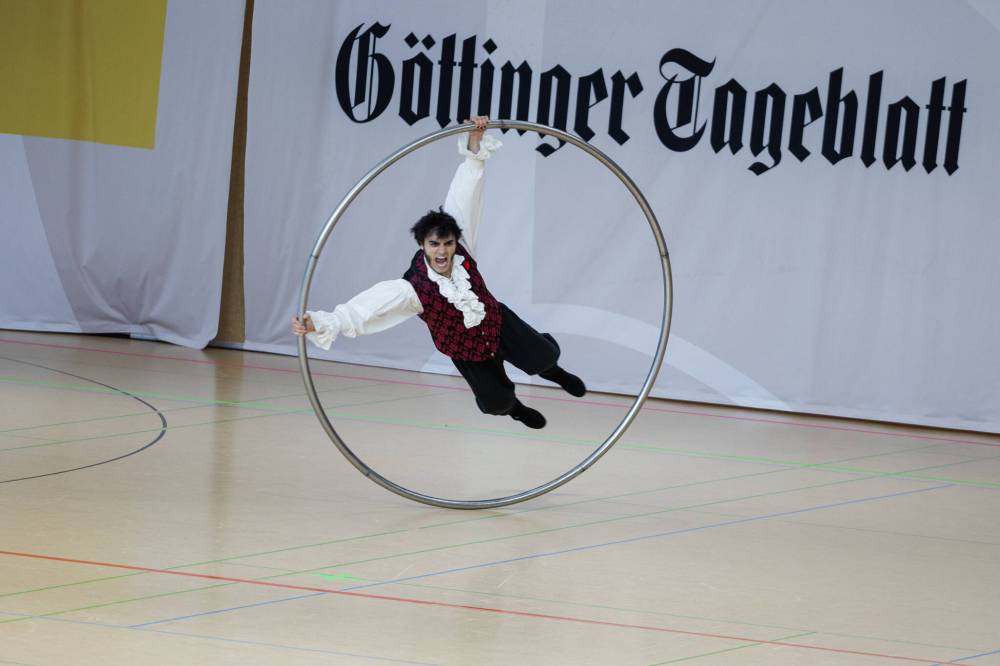
McMahon showed Bairos-Novak decathlon, the sport that involves 10 different events over two days. Bairos-Novak continued to pursue pole vault — one of the decathlon’s 1o events — into his university career while studying computer sciences at the University of Manitoba. Although he described his university career not being the most successful, it gave him skills that has helped in his current sport.
“For pole vault, my coach taught me a decent amount of gymnastics. I think that really helped just being comfortable upside down,” he explained.
After completing his undergrad, Bairos-Novak decided it was time to pursue a new dream of studying abroad.
“My university has a lot of random sports and wheel gymnastics was one of the crazier ones, I was like, ‘that looks hilarious and cool’. So, I gave it a shot.”
“I just wanted to try living in Europe. I had been to Berlin (Germany) when I was a teenager and thought it was super cool,” he said.
And while he’s not living in a big city such as Berlin, he’s still enjoying life in the northern hemisphere in Aachen, Germany.
“It’s right on the edge of Germany. There’s an intersection between Germany, the Netherlands and Belgium. And we can actually walk there from the city,” he explained.
Bairos-Novak is nearly finished his masters degree in mechanical engineering at the RWTH Aachen University — one of the oldest and largest universities in Germany.
ACHILLE ABBOUD PHOTO A former pole vaulter at the University of Manitoba, Winnipegger Steven Bairos-Novak said he fell in love with wheel gymnastics the moment he tried the sport.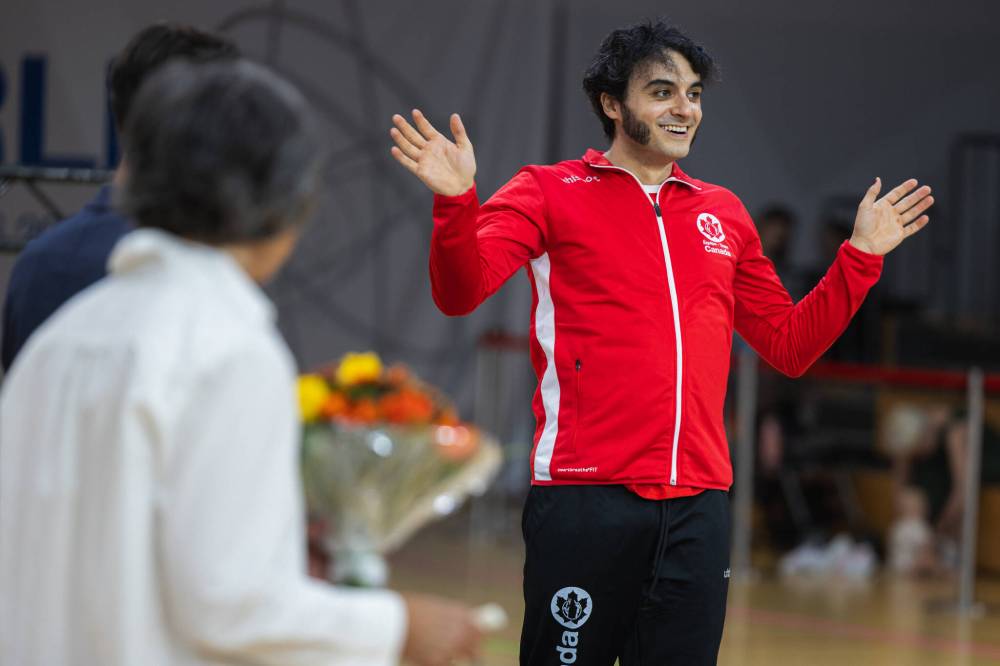
“At the start of the semester there’s a sports registration. My university has a lot of random sports and wheel gymnastics was one of the crazier ones, I was like, ‘that looks hilarious and cool’. So, I gave it a shot,” Bairos-Novak explained. “As soon as I tried it, I just loved it. It was surreal.”
Three years later, he’s still doing it. It’s safe to say it stuck.
Like the majority of sports, it wasn’t something that could be picked up instantaneously. It took practice, and lots of it.
“There’s a really sharp learning curve at the start,” he said, explaining that the wheel can often have a mind of its own and can be tricky to navigate.
“For most people it takes three months to be able to do the basic step where you’re just rocking back and forth between your feet. It took me four or five months,” he chuckled.
But Bairos-Novak wasn’t deterred from the long process at the beginning. He continued to learn the sport and what it entails — including taming the wheel.
“Once you get past that it unlocks a world of possibilities. After that, it’s a ton of fun,” he said.
“There are three other guys who started at the same time as me… It’s been really great having this group and new friends.”
His training team at his gymnastics club ATA help push him farther than he ever imagined. Having a healthy competitive atmosphere within the club not only challenges Bairos-Novak to improve his German, but also his skills.
“There are three other guys who started at the same time as me,” he said. “When one of us learns a new move, all the others soon learn it after because we give each other tips. It’s been really great having this group and new friends.”
If you’re not aware of wheel gymnastics, you’re not alone. Although it’s most popular in Germany, it is still a widely unknown sport, though one that is slowly growing internationally.
Here’s a basic breakdown: Athletes provide their own wheel for competitions which vary in size. There are two different types of wheels — a gym wheel and a cyr wheel. The gym wheel is used more for beginners while the cyr wheel is used in higher levels in which Bairos-Novak competes in. The athlete uses the wheel to complete moves, broken into six categories with the competitor needing to complete five of them; big spiral, coin spin, element combination, spin, turns/twist, and waltz.
ACHILLE ABBOUD PHOTO Winnipegger Steven Bairos-Novak takes to the podium after winning bronze in the men’s overall cyr wheel competition at the IRV World Championships in Gottingen, Germany.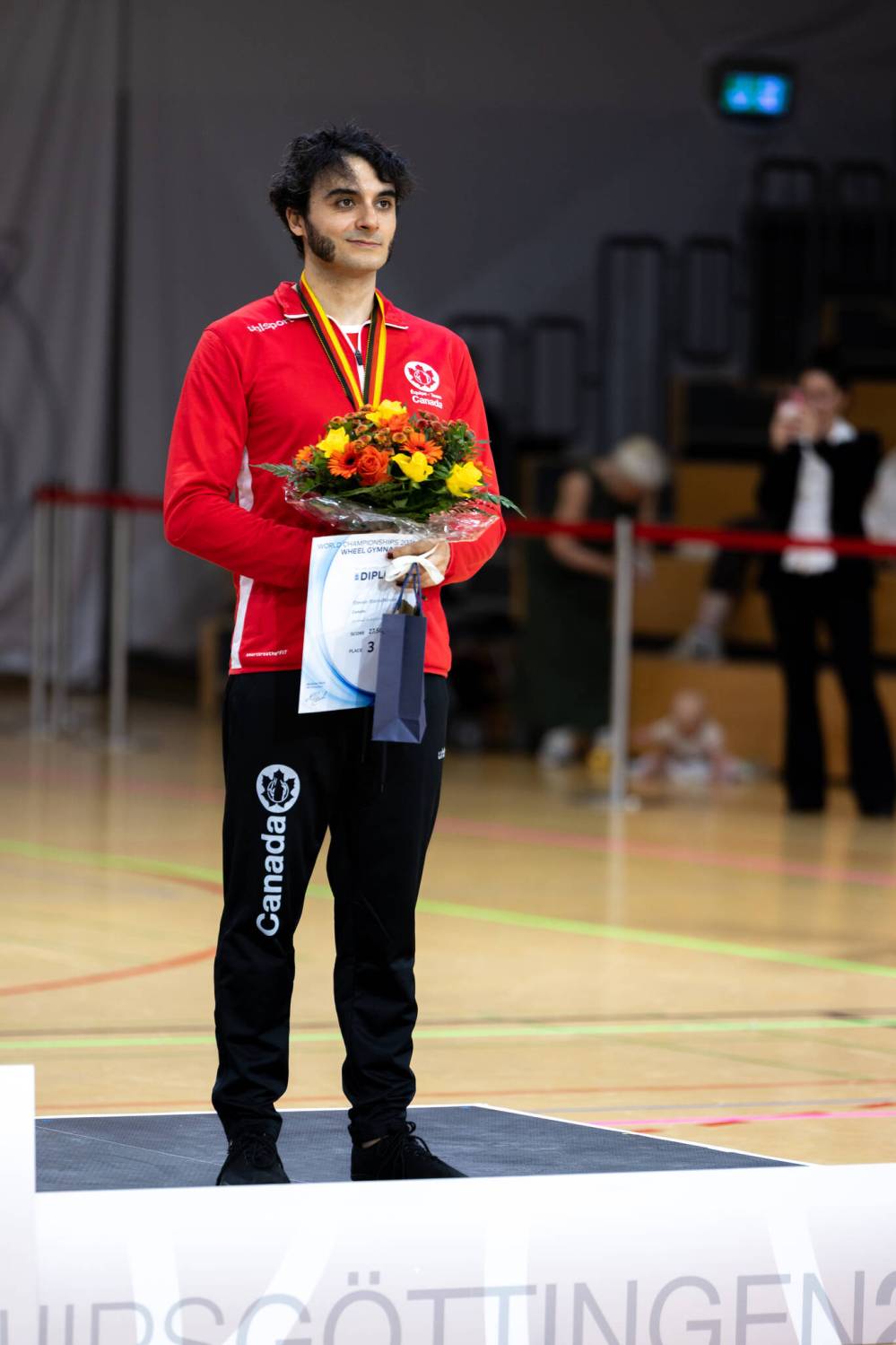
In the technical program, athletes need to complete a series of 10 different moves back-to-back (meaning they can’t put their feet down in between moves). If your transitions are too long between moves, you receive deductions.
In the artistic program, also known as the free program, the athlete is given just that — freedom to perform their 10 moves in any which way. It is set to music and a maximum time frame of 3:15 minutes. This category allows them to put on a routine with the music, costumes, dancing, and acting to create a performance.
“It’s a mix of dancing and gymnastics. It’s just so fun that we get to show all these different facets at once, it’s like a different triple threat just without the singing,” Bairos-Novak explained.
All moves and elements are then ranked on a difficulty scale from 0.0-0.5, the higher end being the hardest.
At the wheel gymnastics IRV World Championships that were held June 29 to July 5 in Gottingen, Germany, Bairos-Novak placed bronze in the overall men’s cyr wheel competition and silver for the men’s cyr wheel artistic division despite his limited experience in the sport. He was given a 0.32 on his technical routine and a 0.38 on his artistic.
“I haven’t been competing super long, my first was about a year and a half ago, the (International) German Gymnastic Festival,” Bairos-Novak added. “I had a funny incident where at one part I was trying to spin my wheel and I accidentally took it in my hand and threw it across the floor. I’m glad that doesn’t happen anymore.”
“I love how low impact the sport is.”
Now having competed on a much larger scale, he sees where this sport could take him. The first place winner, Hauke Narten from Germany, is a local legend in the sport who made history by being the first athlete to achieve a perfect difficulty score at such an event. Narten, a competitor who will be turning 41 this year, has become an inspiration to Bairos-Novak knowing that his new found hobby doesn’t have a nearby expiration date.

“I love how low impact the sport is. (For) pole vault, you have to jump with all your might on your knees and it breaks them down after a while. Whereas wheel gymnastics you’re kind of always rolling — the wheel takes away some of the impact,” Bairos-Novak said.
“I feel like I’m not beating myself up as much and I have a lot of hope to continue doing it as I get older.”
Bairos-Novak’s future plans are to finish his degree and continue to grow in this sport. The next World Championships will take place a little closer to home in Chicago, Ill., an event Bairos-Novak is looking forward to. In the meantime, his goals are to continue his studies and learn some new moves along the way.
And hopefully nailing down the one-handed coin spin and cartwheel.
grace.penner@winnipegfreepress.com