

Building bridges for the next generation
‘He’s just the most welcoming and inclusive person’
Advertisement
Read this article for free:
or
Already have an account? Log in here »
To continue reading, please subscribe:

Digital Subscription
One year of digital access for only $205*
- Enjoy unlimited reading on winnipegfreepress.com
- Read the E-Edition, our digital replica newspaper
- Access News Break, our award-winning app
- Play interactive puzzles
*First annual payment billed as $205.00 + GST for one year. This annual subscription will automatically renew at $233.00 + GST every 52 weeks (10% off the regular annual price of $259.35). Offer available to new and qualified returning subscribers only. Cancel any time.
To continue reading, please subscribe:
Add Free Press access to your Brandon Sun subscription for only an additional
$1 for the first 4 weeks*
- Enjoy unlimited reading on winnipegfreepress.com
- Read the E-Edition, our digital replica newspaper
- Access News Break, our award-winning app
- Play interactive puzzles
*Your next Brandon Sun subscription payment will increase by $1.00 and you will be charged $17.95 plus GST for four weeks. After four weeks, your payment will increase to $24.95 plus GST every four weeks.
Read unlimited articles for free today:
or
Already have an account? Log in here »
Change has been the motivation behind Clayton Sandy’s work for decades.
A member of Sioux Valley Dakota First Nation, Sandy is an Indigenous knowledge keeper, cultural advisor and community advocate. His work has taken him into newcomer organizations, schools, hospitals and workplaces across Manitoba, where he teaches Indigenous history, mentors youth and helps build relationships between communities.
Sitting down for an interview with the Free Press, Sandy arrived with a busy calendar in hand, a reflection of the many projects and initiatives that continue to fill his days as he works to create change for future generations.
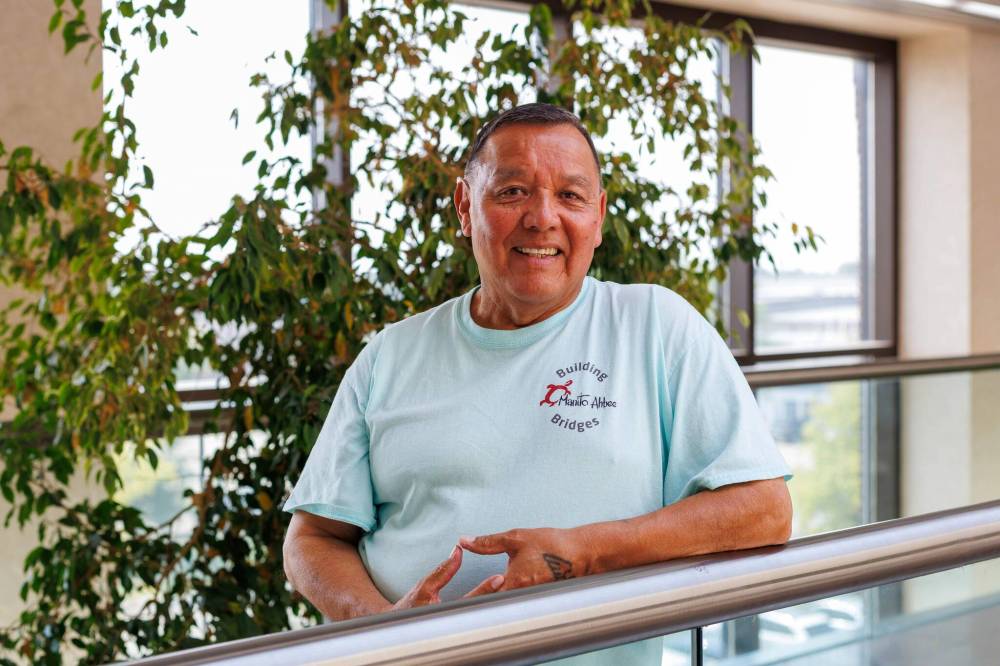
“I have two boys and I have five grandchildren. The racism I put up with was really bad,” Sandy said. “And I don’t want my grandchildren to put up with that garbage.”
“There’s 100,000 of us Indigenous people (in Winnipeg), we’re all doing the same thing. We’re all trying to make a difference and we’re trying to contribute.”
Sandy’s own family history is connected to many of the issues he now teaches others about.
His parents and older siblings are residential school survivors and Sandy is also a survivor of the ’60s Scoop.
He said his family experienced discrimination in multiple ways, including after his father signed up to serve in the military during the Second World War.
“When my father signed up to go to war in 1941, he lost his status,” Sandy said. “He wasn’t even allowed to go home to the reserve to stay with his parents. So we grew up around army bases and he stayed in the service.”
Sandy regained his own status through Bill C-31, legislation that restored status to many First Nations people who had lost it under earlier provisions of the Indian Act.
“It seemed like we were always fighting for something all the time,” he said.
“But one thing I think our mother instilled in us was to help people that can’t help themselves.”
That lesson became the foundation of Sandy’s career.
After moving to Winnipeg at 18, Sandy said he spent several years trying to find his footing. He drifted for a time, got into trouble a few times and eventually met a mentor named Peter, who helped open doors for him.
Sandy went on to spend nearly four decades in Manitoba’s public service, beginning as a cartographer in geological mapping before working in seven provincial departments, including natural resources, energy and mines, labour, family services and education and training.
“I think most of my career has been helping people.”
He also spent two years on secondment at Stony Mountain Institution working on the national aboriginal gang initiative.
“I think most of my career has been helping people,” Sandy said.
Helping others, however, did not mean his own path was easy.
“The first 20 years of my career, it was difficult to stay in government because racism was so bad,” he said. “Like I had a difficult time staying in departments.”
Despite those challenges, Sandy continued building a career centred on creating opportunities for others, particularly Indigenous youth. He spent years helping students transition from school into the workforce before sharing his own experiences at Truth and Reconciliation conferences across Canada.
Retirement in 2016 did not mean slowing down for Sandy.
From 2016 to 2020, he served as Indigenous ambassador for Circles of Reconciliation in which he trained more than 150 facilitators while continuing to mentor youth and educate Manitobans about Indigenous history.
He also met Hani Ataan Al-Ubeady, director of Immigration Partnership Winnipeg, at a powwow at Brokenhead Ojibway Nation. The conversation introduced him to a community he knew little about.
“Before 2016, I didn’t know any newcomers. I started getting to learn about their journey and how difficult it is.”
As he began working with newcomer organizations, Sandy said he found himself hearing stories that felt familiar.
“The more people I got to know, the more I realized their stories are a lot like Indigenous stories,” he said. “A lot of them never get to go home again; they never get to see their parents again. They’ve lost siblings, had hardships and a lot of trauma, and that’s what we go through.”
Today, Sandy works with more than 10 newcomer organizations to introduce families to Indigenous history, traditions and teachings while helping to create opportunities for relationships to grow.
“All they ever see is the homelessness on the street and all that,” Sandy said. “They don’t realize that there’s 100,000 of us that are out there doing really well.”
He said many newcomers arrive knowing little about the history between Indigenous Peoples and Canada.
“They don’t know what residential schools are, they don’t know about ‘60s Scoop, they don’t know nothing about that, but they just make assumptions all of a sudden,” he said.
“But one thing I find that really connects me with newcomers is the racism they face. I’ve always faced it. So we’re really understanding that we should start doing things together.”
That philosophy now shapes much of his work.
“The more people I got to know, the more I realized their stories are a lot like Indigenous stories.”
Through the Building Bridges committee, a group focused on creating connections between newcomer and Indigenous communities, Sandy is helping to organize a series of learning events leading up to the Manitou Ahbee Powwow in October, where 750 newcomer families are expected to attend.
The powwow, which runs from Oct. 30 to Nov. 1 at Winnipeg’s downtown arena, is expected to draw more than 30,000 people.
In the days leading up to the powwow, the committee is organizing a trades fair, a mini powwow with community organizations, a multicultural celebration and a day focused on racism in sport.
One of the organizations involved is Mosaic Newcomer Family Resource Network, which has partnered with Sandy for about six years to introduce newcomer families to the powwow and Indigenous culture.
Val Cavers, executive director of Mosaic, said Sandy’s work resonates because of the way he approaches people.
“He’s so open and non-judgmental that everybody just syncs with him,” Cavers said. “He’s just the most welcoming and inclusive person.”
About 40 newcomer women are also taking part in ribbon skirt-making workshops to create skirts to wear to the powwow. Last year, participants made Indigenous vests for men and this year Sandy asked organizers to include ribbon skirts for young girls.
His powwow protocol guide has also been translated into 11 languages to help newcomers understand how to respectfully attend the gathering.
“People with very limited English are still expressing how important they thought it was,” Cavers said. “It’s always been really, really impactful.”
Another project Sandy has dedicated time to is the Turtle Island Project.
“The more people I can reach out and educate, the better.”
The project took Sandy and his collaborators two and a half years to create. The four-hour educational exercise teaches participants about Indigenous history in Canada, from first contact through the lasting impacts of colonization.
It centres around a 40-foot by 30-foot blanket shaped like a turtle, with 13 removable educational sections that guide participants and organizations through different parts of that history.
Last year alone, Sandy led about 70 workshops in Winnipeg and he said sessions are already booked into March.
For those wanting to continue learning, Sandy offers land-based training, where participants move through stations focused on teepee teachings, traditional medicines, beading, smudging and bannock making.
Sandy has continued his work with Indigenous youth through an internship program at St. Boniface Hospital, which gives First Nations, Métis and Inuit students from River East Transcona School Division first-hand experience in health care while earning high school credits.
The program is expanding, with future internships planned through St. Boniface Research and the Manitoba Museum.
“The more people I can reach out and educate, the better,” Sandy said.
At the end of an hour-long conversation with the Free Press, Sandy glanced at the time.
He was on his way to pick up his grandson before heading to a meeting with Winnipeg Mayor Scott Gillingham about bringing a daycare to St. Boniface Hospital.
There’s always more work to do.
zoe.pierce@freepress.mb.ca