

Toronto’s alternative crisis response model deemed a success
Winnipeg has met with Ontario counterparts to discuss methodology

Advertisement
Read this article for free:
or
Already have an account? Log in here »
To continue reading, please subscribe:

Digital Subscription
One year of digital access for only $205*
- Enjoy unlimited reading on winnipegfreepress.com
- Read the E-Edition, our digital replica newspaper
- Access News Break, our award-winning app
- Play interactive puzzles
*First annual payment billed as $205.00 + GST for one year. This annual subscription will automatically renew at $233.00 + GST every 52 weeks (10% off the regular annual price of $259.35). Offer available to new and qualified returning subscribers only. Cancel any time.
To continue reading, please subscribe:
Add Free Press access to your Brandon Sun subscription for only an additional
$1 for the first 4 weeks*
- Enjoy unlimited reading on winnipegfreepress.com
- Read the E-Edition, our digital replica newspaper
- Access News Break, our award-winning app
- Play interactive puzzles
*Your next Brandon Sun subscription payment will increase by $1.00 and you will be charged $17.95 plus GST for four weeks. After four weeks, your payment will increase to $24.95 plus GST every four weeks.
Read unlimited articles for free today:
or
Already have an account? Log in here »
A Toronto emergency response program that helped inspire Winnipeg’s proposed alternative crisis response model has already expanded city-wide, just four years after launching as a pilot project.
The Toronto Community Crisis Service, launched in 2022, has become the city’s fourth emergency service, providing a 24-7, community-based response to people experiencing mental health crises. The service has handled nearly 50,000 calls through 911 and 211, dispatched mobile crisis teams to more than 41,000 incidents, made more than 11,600 referrals to health and social services and resolved the majority of eligible 911 calls without police involvement.
Winnipeg Mayor Scott Gillingham last week proposed creating a similar “fourth crisis response pathway” that would allow 911 calls that aren’t violent or criminal in nature to be transferred to community-based crisis teams.
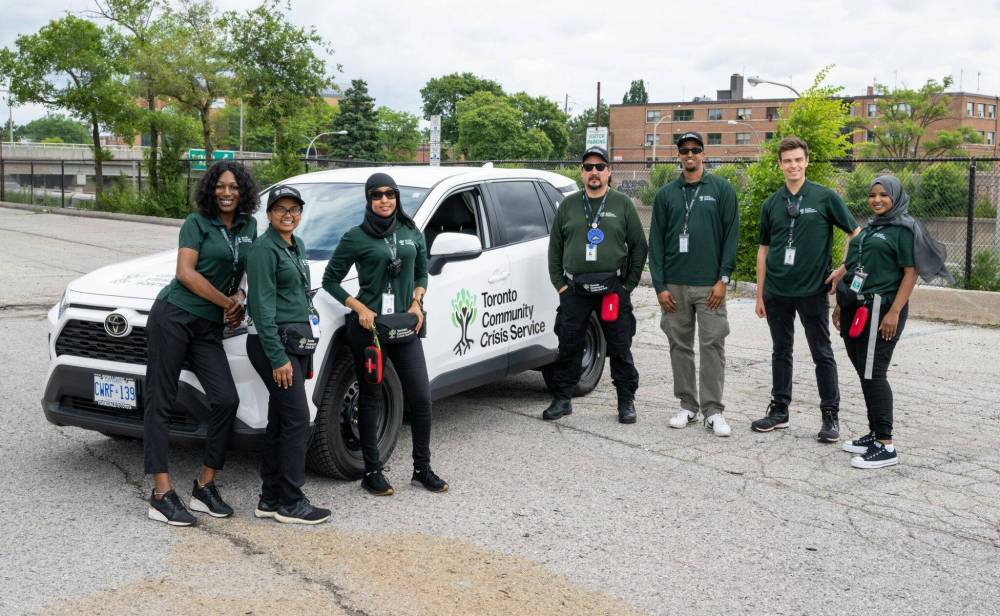
CANADIAN MENTAL HEALTH ASSOCIATION TORONTO
The Toronto Community Crisis Service, launched as a pilot program in 2022 and expanded across the city four years later, is clearly differentiated from police or other emergency services.
Under the proposal, which has support from both the Winnipeg Police Service and the Winnipeg Fire Paramedic Service, a centralized crisis dispatch and co-ordination hub would receive triaged calls and match them with citywide response teams, staffed in part through existing community organizations, including the Downtown Community Safety Partnership and The Link’s mobile crisis teams. The goal is to divert appropriate calls away from the WPS and WFPS.
“I see the parallel in the positioning there in Winnipeg,” Dilya Niezova, Toronto’s community development manager and manager of the city’s Alternative Safety Response Unit, told the Free Press, adding that city officials from Winnipeg met with their Toronto counterparts to discuss Toronto’s service.
Niezova said Toronto’s program grew out of years of advocacy from community organizations, with the Black Lives Matter movement in 2020 accelerating conversations about rethinking crisis response.
“It brought forward some really important conversations about how crisis response could better prioritize health, safety and equity,” Niezova said.
Consultations with community groups, people with lived experience, police and paramedics all pointed to the same conclusion: there was a need for a health-led, community-based response to mental health crises.
The pilot launched in 2022 and, after demonstrating success, was expanded across the city by Toronto council. At the end of 2025, the city also introduced a dedicated crisis response team for its subway system.
In 2025, Toronto’s 911 service received about 1.6 million calls, including roughly 27,000 related to mental health.
Of those, Niezova said, 4,482 calls were diverted to the crisis response service, with about 88 per cent resolved without police involvement. Just 2.3 per cent ultimately required emergency services, such as paramedics or police, because the situation escalated.
By 2031, the city hopes to divert 10,000 calls annually.
“We have never really positioned Toronto Community Crisis Service as a service that can handle every single mental health crisis call,” Niezova said. “There are some that will still need other emergency services. What we’re trying to do is create some space and pathway here for those ones that would benefit much more from a non-police led response, a more help-focused response.”
Niezova added that Toronto has been promoting its 211 line, including with a campaign called Make the Right Call, encouraging people to contact 211 for mental health-related calls.
She said the service also includes followup support through case management, referrals and connections to community resources — an approach that is also built into Winnipeg’s proposed model.
Niezova said an independent evaluation by the Centre for Addiction and Mental Health, the country’s largest mental health teaching hospital, concluded that its service is “effectively reaching its intended population.”
“It’s providing safe and appropriate crisis response … clients are having a good experience and they’re valuing the experience that they’re having,” she said. “And that community partners and first responders are also co-ordinating services in an effective way.”
Toronto fully funds the program, budgeting more than $37 million for it in 2026. Winnipeg has estimated its proposed service would cost about $6 million to launch, but the city is asking the province to help fund it, though Gillingham wouldn’t say what the monetary ask is.

The province would not comment on the proposal earlier this week.
A third-party report from Pensa Consulting concluded that 3,855 Winnipeg Police Service calls — or nearly 8,000 hours of officer time — and 6,356 Winnipeg Fire Paramedic Service calls could be redirected to a community response model annually.
WPS Chief Gene Bowers said his service handles around 20,000 well-being checks a year, or about 53 per day.
City council will consider the proposal in September.
scott.billeck@freepress.mb.ca
Scott Billeck is a general assignment reporter for the Free Press. A Creative Communications graduate from Red River College, Scott has more than a decade’s worth of experience covering hockey, football and global pandemics. He joined the Free Press in 2024. Read more about Scott.
Every piece of reporting Scott produces is reviewed by an editing team before it is posted online or published in print — part of the Free Press‘s tradition, since 1872, of producing reliable independent journalism. Read more about Free Press’s history and mandate, and learn how our newsroom operates.
Our newsroom depends on a growing audience of readers to power our journalism. If you are not a paid reader, please consider becoming a subscriber.
Our newsroom depends on its audience of readers to power our journalism. Thank you for your support.
Scott Billeck is a general assignment reporter for the Free Press. A Creative Communications graduate from Red River College, Scott has more than a decade’s worth of experience covering hockey, football and global pandemics. He joined the Free Press in 2024. Read more about Scott.
Every piece of reporting Scott produces is reviewed by an editing team before it is posted online or published in print — part of the Free Press‘s tradition, since 1872, of producing reliable independent journalism. Read more about Free Press’s history and mandate, and learn how our newsroom operates.
Our newsroom depends on a growing audience of readers to power our journalism. If you are not a paid reader, please consider becoming a subscriber.
Our newsroom depends on its audience of readers to power our journalism. Thank you for your support.
Related Articles
Mayor backs new way to handle 911 mental health, addiction calls

Advertisement Advertise With Us
Advertisement Advertise With Us