

PCs say Hutterite colonies singled out by Bill 21
Advertisement
Read this article for free:
or
Already have an account? Log in here »
To continue reading, please subscribe:

Digital Subscription
One year of digital access for only $205*
- Enjoy unlimited reading on winnipegfreepress.com
- Read the E-Edition, our digital replica newspaper
- Access News Break, our award-winning app
- Play interactive puzzles
*First annual payment billed as $205.00 + GST for one year. This annual subscription will automatically renew at $233.00 + GST every 52 weeks (10% off the regular annual price of $259.35). Offer available to new and qualified returning subscribers only. Cancel any time.
To continue reading, please subscribe:
Add Free Press access to your Brandon Sun subscription for only an additional
$1 for the first 4 weeks*
- Enjoy unlimited reading on winnipegfreepress.com
- Read the E-Edition, our digital replica newspaper
- Access News Break, our award-winning app
- Play interactive puzzles
*Your next Brandon Sun subscription payment will increase by $1.00 and you will be charged $17.95 plus GST for four weeks. After four weeks, your payment will increase to $24.95 plus GST every four weeks.
Read unlimited articles for free today:
or
Already have an account? Log in here »
SOURIS — Members of Hutterite colonies in the province took aim at the NDP government’s proposed changes to drinking water legislation during a public meeting Thursday in Souris.
The meeting was hosted by Progressive Conservative MLA Colleen Robbins (Spruce Woods) to hear from rural residents about their concerns over Bill 21, which the government says will improve oversight on wells and other water systems in the province.
“There’s not enough clarity, but I feel that the overreach that this bill will bring is not clearly defined, and it could have a lot of negative consequences,” attendee Gilbert Hofer, a member of Green Acres colony near Wawanesa, said after the meeting, which drew about 20 people.
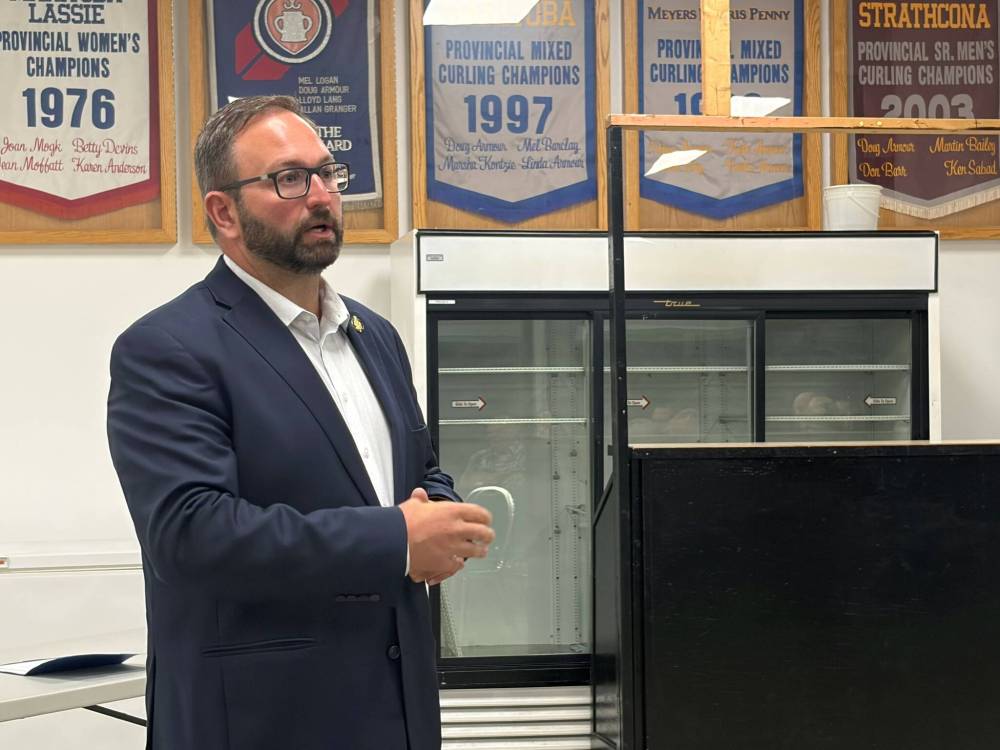
Alex Lambert / Brandon Sun
La Vérendrye MLA Konrad Narth wants a carveout for Hutterites from the proposed drinking water legislation.
The legislation would allow public health officers to designate the type of water source based on its intended use, water quality and use duration rather than solely the number of connections it has.
The PCs held up the legislation in the spring to consult with the public.
Community wells traditionally haven’t needed chlorination and attendees feared legislation could change that.
Speakers said they are already testing their well water and it’s coming back with a negative result, so they shouldn’t have to chlorinate it.
“If you don’t have bacteria, I mean, why do the treatment?” one attendee said.
Another speaker cited “the whole burden of putting in the system, the monitoring and all the rest.”
PC agriculture critic Konrad Narth said he wants to see carveouts in the legislation for certain water users, like Hutterite colonies and agricultural bulk fill sites.
Hutterite colonies, he said, are being singled out in the legislation and he accused urban NDP MLAs of not understanding the water systems in rural Manitoba.
“Water is used and distributed in a unique way to what maybe members are accustomed to in Winnipeg,” Narth, the MLA for La Vérendrye, said after the meeting.
“This is a good opportunity to further organize those groups that will be negatively impacted if this legislation goes through.”
Narth said it doesn’t make sense to include Hutterite colonies in the legislation.
Environment and Climate Change Minister Mike Moyes, in an interview with the Brandon Sun later in the day, said there is a lot of “fear-mongering” going on about the bill and the legislation is in fact the “opposite” of how Narth is characterizing it.
“What we’re actually doing is we’re right-sizing the amount of oversight on different systems based on risk in collaboration with public health. And so it actually gets rid of a lot of red tape for a lot of different locations,” Moyes, the MLA for Riel, said.
The legislation will allow for more flexibility around the designation of sites as semi-public water systems, he said.

“Rather than putting a very small system as a public system and all of the oversight that goes into that, it allows them to put in a more flexible oversight program by designating it as a semi-public,” Moyes said. “So, it’s actually helpful to a lot of these smaller water systems.”
Moyes said the flexibility is important so officials can look at a variety of different factors, instead of just hookups.
“If is it a vulnerable population that’s going to be drinking this water on a daily basis — for example, a hospital, a school, a seniors home, things of that sort — then there needs to be greater oversight,” he said.
A carveout for Hutterite colonies is “problematic” and wouldn’t keep people safe, he said, adding that carveouts for agricultural purposes are already in place.
— Brandon Sun