

HSC weapons scanners effective, needed at other hospitals: nurses union

Advertisement
Read this article for free:
or
Already have an account? Log in here »
To continue reading, please subscribe:

Digital Subscription
One year of digital access for only $205*
- Enjoy unlimited reading on winnipegfreepress.com
- Read the E-Edition, our digital replica newspaper
- Access News Break, our award-winning app
- Play interactive puzzles
*First annual payment billed as $205.00 + GST for one year. This annual subscription will automatically renew at $233.00 + GST every 52 weeks (10% off the regular annual price of $259.35). Offer available to new and qualified returning subscribers only. Cancel any time.
To continue reading, please subscribe:
Add Free Press access to your Brandon Sun subscription for only an additional
$1 for the first 4 weeks*
- Enjoy unlimited reading on winnipegfreepress.com
- Read the E-Edition, our digital replica newspaper
- Access News Break, our award-winning app
- Play interactive puzzles
*Your next Brandon Sun subscription payment will increase by $1.00 and you will be charged $17.95 plus GST for four weeks. After four weeks, your payment will increase to $24.95 plus GST every four weeks.
Read unlimited articles for free today:
or
Already have an account? Log in here »
The AI weapons scanners at Health Sciences Centre have detected close to 2,000 items since they were installed at Manitoba’s largest hospital.
From March 6, 2025 to the beginning of this month, a total of 1,973 items had been flagged by the scanners and identified for further review, Shared Health said this week.
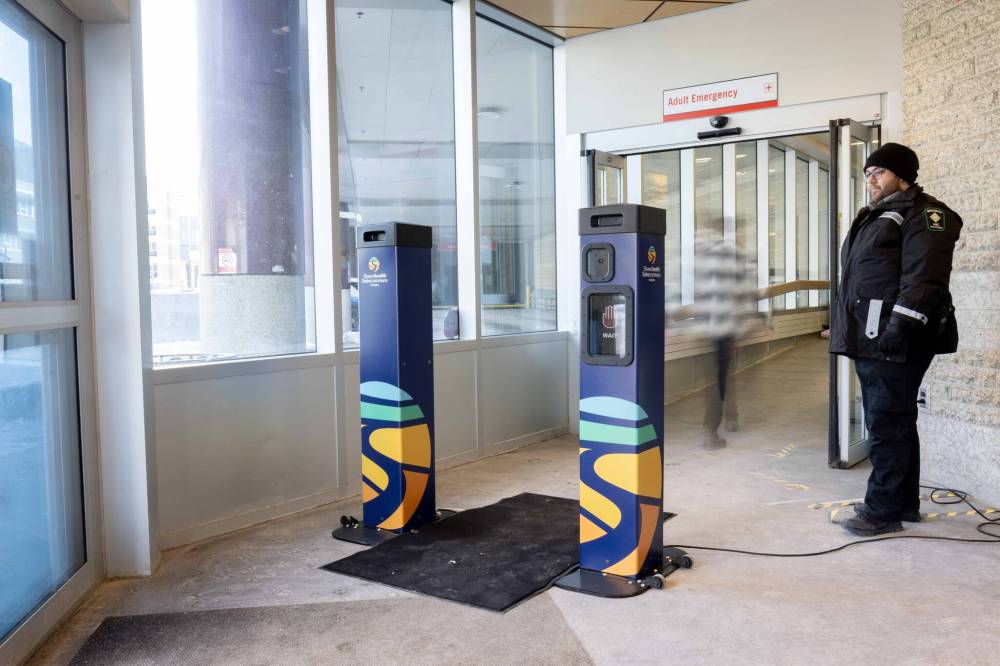
Knives, Swiss army knives and other multi-tools, drugs, alcohol, box cutters, syringes and other injection devices were detected, it said. The technology set up at entrances to the adult and children’s emergency rooms and the crisis response centre is designed to identify a wide range of objects that may require review under site safety protocols.
SUPPLIED
Shared Health says a total of 1,973 items had been flagged by the AI scanners and identified for further review.
But Manitoba Nurses Union president Darlene Jackson said the technology isn’t available everywhere at HSC, and a sawed-off rifle was discovered in the adult ER earlier this month.
The patient, who arrived by ambulance, wasn’t in a position to provide any identification or information to help staff provide care, so an ER nurse went through a bag the patient had, Jackson said.
“What he found was a sawed-off rifle that was not loaded, but there was apparently a bullet in the bag and there was bear spray in the bag, as well,” she said, adding he nurse immediately called security and institutional safety officers, who contacted the Winnipeg Police Service.
“One of the concerns that we heard from nurses was if nobody had gone through the bag and the patient had (been) admitted and had gone to the ward, that bag would have gone with them.”
Planners clearly hadn’t considered such a scenario when deciding on the number and locations of the scanners, Jackson said, adding it highlights the need for rigorous security and AI scanners at more locations. HSC is the lone Manitoba hospital with the equipment now.
“We are seeing more and more weapons coming in and more and more violence towards staff and I think that we definitely need that,” she said.
In April, an intoxicated man was found waiting at the Grace Hospital with a smoke grenade in his possession, something that would have been discovered at the entrance if the facility also had a weapons scanner, the MNU said at the time.
A hand-held wand scanner is used at Thompson General Hospital, where a patient was stabbed in the ER in 2025, and on Christmas Eve in 2024, a man pointed a rifle at staff and shot out a window in the hospital chapel.
“Someone has to stand there and manually scan everyone that comes through,” Jackson said. “A security person is doing that all day and all night.”
In February, Health Minister Uzoma Asagwara promised to step up safety measures at Manitoba’s hospitals, including the hiring of five institutional safety officers — trained and authorized to restrain and detain anyone posing a risk — for the hospital in Thompson.
The facility now has seven full-time ISOs, with one additional part-timer scheduled to start in the near future, Shared Health said this week. In November’s throne speech, the government promised eight ISOs for that hospital.
HSC now has more than 80 ISO positions. St. Boniface Hospital currently has 18 ISO-peace officer positions and Victoria Hospital has 19. Since early July, the Concordia, Seven Oaks and Grace hospitals have had an ISO in place 24-7. The Winnipeg Regional Health Authority is in the process of recruiting more ISOs for the three sites, a Shared Health spokesperson said.
In February, Asagwara also announced the installation of amnesty lockers at hospitals in Thompson and Swan River for patients or visitors carrying weapons or other prohibited items.
SUPPLIED
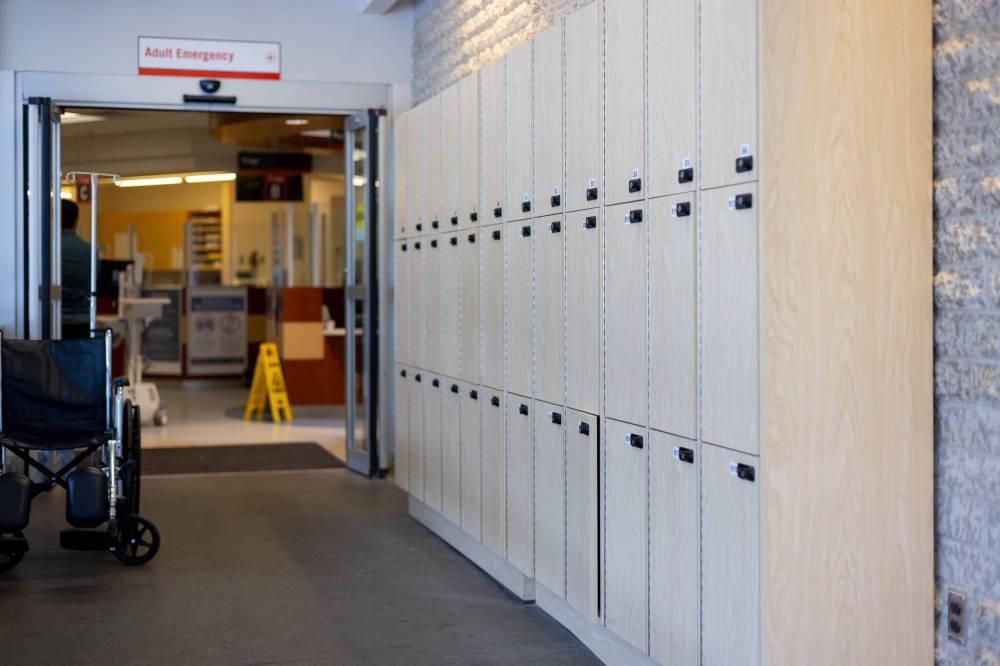
The amnesty lockers at HSC have been in place for nearly four years and are located at security checkpoints.
At HSC in Winnipeg, the lockers have been in place for nearly four years and are located at security checkpoints. The lockers provide a secure option for personal belongings that cannot be brought into a health facility, a Shared Health spokesperson said Friday. They are part of a broader prevention strategy designed to keep patients, staff and visitors safe, she said in an email.
One year ago, HSC nurses voted to grey-list the hospital — advising colleagues elsewhere against applying for jobs or taking shifts there — over safety concerns.
On Friday, Jackson applauded the security improvements that followed but said HSC remains on the grey list it until it provides a written promise that safety initiatives won’t be cut.
Last August, Doctors Manitoba also recommended hospital safety improvements, several of which have been implemented, a spokesperson for the physician advocacy organization said in an email.

“There’s been an increased presence of on-site institutional security officers, weapons detection scanners, enhanced communication with staff, and the development of the Shared Health Safety app.”
The app’s features include emergency notifications, a direct line to hospital security and safe ride or walk requests.
Doctors Manitoba also welcomed social workers who’ve been posted in many ER and urgent-care centres but said they’re not available at every point of care, “and there is still much room for improvement.”
“We do not want to see partial improvements turn into complacency, and we support continued efforts to ensure all of our hospitals and health facilities are violence-free and safe for everyone,” the spokesperson said.
carol.sanders@freepress.mb.ca
Carol Sanders
Legislature reporter
Carol Sanders is a reporter at the Free Press legislature bureau. The former general assignment reporter and copy editor joined the paper in 1997. Read more about Carol.
Every piece of reporting Carol produces is reviewed by an editing team before it is posted online or published in print — part of the Free Press‘s tradition, since 1872, of producing reliable independent journalism. Read more about Free Press’s history and mandate, and learn how our newsroom operates.
Our newsroom depends on a growing audience of readers to power our journalism. If you are not a paid reader, please consider becoming a subscriber.
Our newsroom depends on its audience of readers to power our journalism. Thank you for your support.
Carol Sanders
Legislature reporter
Carol Sanders is a reporter at the Free Press legislature bureau. The former general assignment reporter and copy editor joined the paper in 1997. Read more about Carol.
Every piece of reporting Carol produces is reviewed by an editing team before it is posted online or published in print — part of the Free Press‘s tradition, since 1872, of producing reliable independent journalism. Read more about Free Press’s history and mandate, and learn how our newsroom operates.
Our newsroom depends on a growing audience of readers to power our journalism. If you are not a paid reader, please consider becoming a subscriber.
Our newsroom depends on its audience of readers to power our journalism. Thank you for your support.
Advertisement Advertise With Us
Advertisement Advertise With Us