Legal aid underfunding violates Charter, lawsuit claims Canadian Civil Liberties Association takes province, feds to court
Read this article for free:
or
Already have an account? Log in here »
To continue reading, please subscribe:

Digital Subscription
One year of digital access for only $205*
- Enjoy unlimited reading on winnipegfreepress.com
- Read the E-Edition, our digital replica newspaper
- Access News Break, our award-winning app
- Play interactive puzzles
*First annual payment billed as $205.00 + GST for one year. This annual subscription will automatically renew at $233.00 + GST every 52 weeks (10% off the regular annual price of $259.35). Offer available to new and qualified returning subscribers only. Cancel any time.
To continue reading, please subscribe:
Add Free Press access to your Brandon Sun subscription for only an additional
$1 for the first 4 weeks*
- Enjoy unlimited reading on winnipegfreepress.com
- Read the E-Edition, our digital replica newspaper
- Access News Break, our award-winning app
- Play interactive puzzles
*Your next Brandon Sun subscription payment will increase by $1.00 and you will be charged $17.95 plus GST for four weeks. After four weeks, your payment will increase to $24.95 plus GST every four weeks.
Read unlimited articles for free today:
or
Already have an account? Log in here »
The Canadian Civil Liberties Association is taking the provincial and federal government to court, alleging decades of underfunding for criminal legal aid violates Canada’s Charter of Rights and Freedoms.
“It is one system of justice for those who can afford to pay and another for those who cannot,” Shakir Rahim, co-counsel in the case, said at a news conference outside the Manitoba legislature Thursday.
He said the “crisis” was particularly acute in Manitoba. Those who have been accused of a crime but cannot afford to pay for a lawyer are supposed to have access to counsel through criminal legal aid, which is funded jointly by the provincial and the federal governments.
MIKAELA MACKENZIE / FREE PRESS Shakir Rahim, director of the criminal justice program at the Canadian Civil Liberties Association, says legal aid services have been systemically underfunded.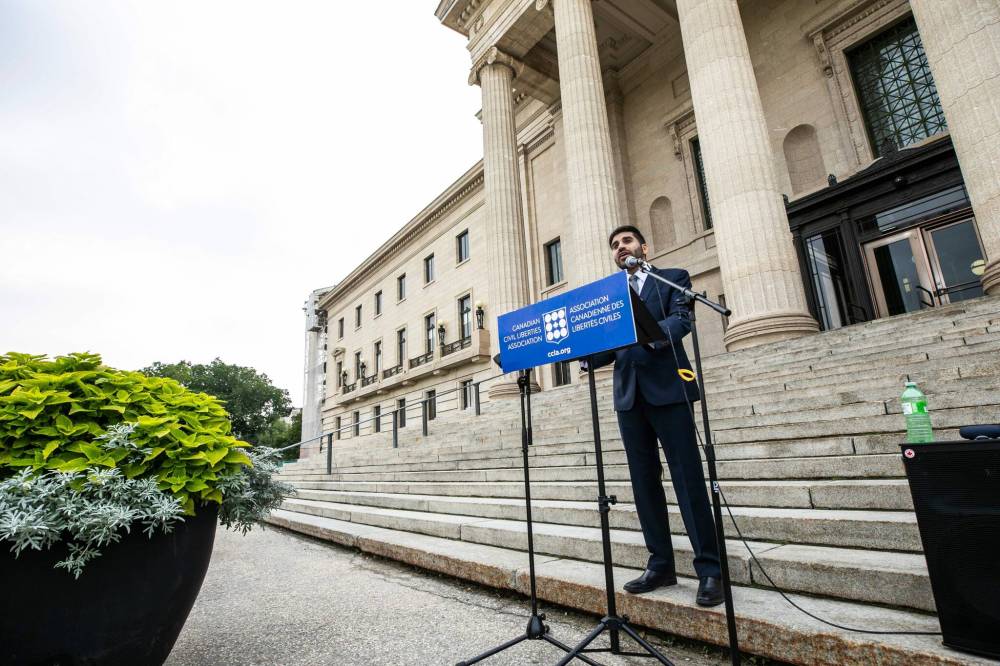
“While that may be our system’s promise, it is not its reality,” said Rahim, also the director of the Canadian Civil Liberties Association criminal justice program.
Funding for legal aid has been woefully insufficient for decades, the non-profit organization’s 31-page court application filed Thursday said.
“The gross inadequacy” of legal aid in Manitoba has led to the criminal defence bar taking job action three times since 2003, Rahim said.
The underfunding violates several Charter rights including the right to a fair trial, the right to life, liberty, and security of the person, and the right to equal protection and equal benefit of the law, the lawsuit says.
“Gross inadequacy.”
It asks the court to declare the situation a Charter rights violation — a ruling that would push the government to act, Rahim said. It also wants the regulation that governs legal aid in Manitoba to include consideration of Charter rights when deciding to fund a case.
Income cutoffs to receive legal aid have not kept up with the cost of living, Rahim said.
“A single person making more than $31,500 may be disqualified for legal aid funding on that basis, yet the cost of a private lawyer in a complex case can run well into the tens of thousands of dollars,” he said. A contested bail hearing would only be funded for about two hours of work, for example, he said.
“This is far removed from the reality of preparation, time and appearances required, particularly considering recent federal criminal code amendments that have increased the complexity of bail proceedings, amendments that the (province) asked for and supports,” Rahim said.
During the fiscal year 2009-10, Integrated Criminal Court Survey data show the median number of days to complete adult criminal cases in Manitoba was 192. In 2023-24, it was 233.
“In certain cases, if there is no likelihood of imprisonment or job loss, no legal aid will be provided, even if a person has no income. This is despite the fact that a criminal record alone can carry profound consequences for a person’s life,” the lawyer and advocate said.
Inadequate funding for legal aid has been a chronic issue in Manitoba, said Christopher Gamby with the Criminal Defence Lawyers Association of Manitoba.
“Wrongful convictions are not good for anyone and we, unfortunately, have a history of these issues here in Manitoba.”
“Wrongful convictions are not good for anyone and we, unfortunately, have a history of these issues here in Manitoba. We need to do more to ensure a fair and equitable trial process,” he said.
The lawsuit lists “adverse consequences” of underfunded legal aid, including uninformed and false guilty pleas, wrongful convictions, inadequate bail hearings and unwarranted detentions.
MIKAELA MACKENZIE / FREE PRESS “It is one system of justice for those who can afford to pay and another for those who cannot,” Rahim said Thursday. 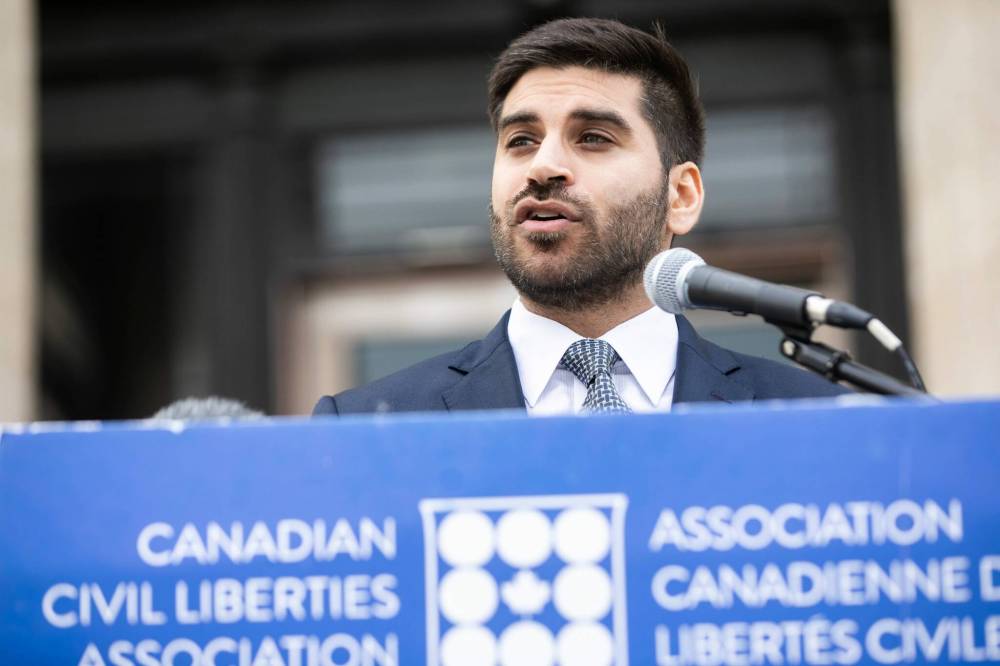
Of 19,348 criminal legal aid applications filed in Manitoba in 2023-24, 4,823 were refused, federal Justice Department data show. Forty per cent were rejected for financial ineligibility and 25 per cent of Indigenous accused persons were refused.
“How are people supposed to get a fair trial when they cannot get legal aid to take on their cases?” said Progressive Conservative justice critic Wayne Balcaen.
“By the NDP not funding them and actually rolling back the funding to legal aid, what they’re doing is disallowing marginalized populations from having a fair defence.”
Legal aid funding has been frozen at $36.6 million since the NDP took office in October 2023 and hasn’t kept pace with the rate of inflation, Balcaen said. It last increased under the PCs — from $33 million in 2020-21 to $37 million in 2022-23 before being cut to $36.6 million in 2023-2024.
Justice Minister Matt Wiebe was not made available for comment Thursday but issued a statement saying the NDP government is firmly committed to a strong justice system, “and legal aid is an important part of that.”
carol.sanders@freepress.mb.ca

Carol Sanders
Legislature reporter
Carol Sanders is a reporter at the Free Press legislature bureau. The former general assignment reporter and copy editor joined the paper in 1997. Read more about Carol.
Every piece of reporting Carol produces is reviewed by an editing team before it is posted online or published in print — part of the Free Press‘s tradition, since 1872, of producing reliable independent journalism. Read more about Free Press’s history and mandate, and learn how our newsroom operates.
Our newsroom depends on a growing audience of readers to power our journalism. If you are not a paid reader, please consider becoming a subscriber.
Our newsroom depends on its audience of readers to power our journalism. Thank you for your support.




History
Updated on Thursday, August 20, 2026 7:03 PM CDT: Adds details, photos.