

Manitoba gains doctors for third straight year, but loses at pandemic-level rate: report

Advertisement
Read this article for free:
or
Already have an account? Log in here »
To continue reading, please subscribe:

Digital Subscription
One year of digital access for only $205*
- Enjoy unlimited reading on winnipegfreepress.com
- Read the E-Edition, our digital replica newspaper
- Access News Break, our award-winning app
- Play interactive puzzles
*First annual payment billed as $205.00 + GST for one year. This annual subscription will automatically renew at $233.00 + GST every 52 weeks (10% off the regular annual price of $259.35). Offer available to new and qualified returning subscribers only. Cancel any time.
To continue reading, please subscribe:
Add Free Press access to your Brandon Sun subscription for only an additional
$1 for the first 4 weeks*
- Enjoy unlimited reading on winnipegfreepress.com
- Read the E-Edition, our digital replica newspaper
- Access News Break, our award-winning app
- Play interactive puzzles
*Your next Brandon Sun subscription payment will increase by $1.00 and you will be charged $17.95 plus GST for four weeks. After four weeks, your payment will increase to $24.95 plus GST every four weeks.
Read unlimited articles for free today:
or
Already have an account? Log in here »
Manitoba is adding doctors at a record clip — but it’s also losing them at a rate not seen since the depths of the COVID-19 pandemic, a physicians advocacy organization cautioned Wednesday.
The number of registered family physicians, specialists and medical residents with a full certificate of practice reached 3,694 as of April 30, for a net gain of 196 doctors during the previous 12 months, the highest net gain since 2008 (the earliest records available online) and the third consecutive year of net increases.
The figures are outlined in the 2025-2026 annual report of the College of Physicians and Surgeons of Manitoba, which was released Wednesday. The figures show a snapshot of registration on April 30, the final day of the fiscal year.
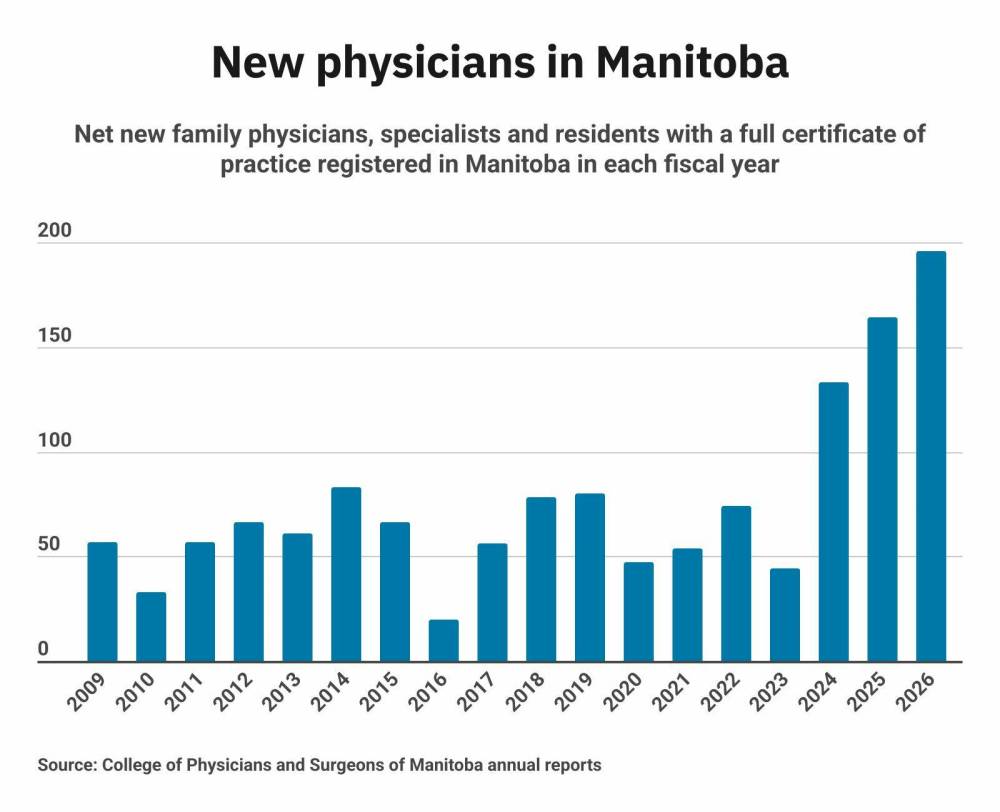
There were 1,792 family physicians, 1,823 specialists and 79 residents with a full scope of practice. Manitoba added 164 net new doctors in the previous fiscal year and 133 doctors in fiscal 2023-24.
“Another record-breaking increase in physicians is good news for patients,” said Dr. Alon Altman, president of Doctors Manitoba.
“Manitoba is still climbing out of one of the most serious doctor shortages in the country, but sustained growth like this is helping us close the gap.”
Doctors Manitoba later confirmed the net gain is the highest ever, based on its records that go back decades.
Altman said while record growth in the net number of new hires is encouraging, Doctors Manitoba’s own figures show the number of physicians leaving practice is returning to pandemic-era levels. A total of 158 doctors left the province during the latest fiscal year, an increase of 20 from the previous reporting period, he said.
The province lost 161 doctors in 2020-21, 159 in 2021-22 and a record high 165 in 2022-23. At the same time, Manitoba is increasingly relying on physicians trained internationally to fuel growth, while the number of new physicians who graduated in Manitoba remains below previous levels.
“Another record-breaking increase in physicians is good news for patients.”
“Recruitment gets a lot of attention, but retention is just as important,” Altman said. “If we can recruit more doctors while losing fewer of the ones already here, we can close Manitoba’s doctor shortage much faster.”
Altman also pointed to uneven growth in some areas of the province. Most regions gained doctors over the last year, but western Manitoba’s physician complement declined from 248 to 240 — a three per cent dip. There are also significant differences by specialty.
The number of family physicians has grown by 15 per cent over the last two years, while growth among other specialists is about half that rate (seven per cent).
The increase in family doctors helps Manitobans connect with a primary-care physician but also generates more referrals for care from a pool of specialists that isn’t growing as fast.
“We are moving in the right direction, but recruitment needs to be increasingly targeted to the specialties and communities where shortages remain most serious,” Altman said.
“A provincewide increase doesn’t necessarily mean patients are finding it easier to get care in some communities or from some specialties.”
“Recruitment gets a lot of attention, but retention is just as important.”
The college’s director of registration, Jeremy de Jong, said measures undertaken by the University of Manitoba to increase residency positions and seats in its licensure program for international medical graduates are largely responsible for the increase in doctors.
In addition, the university has revived a program, which was paused during the pandemic, to provide an accelerated route to licensure as a family physician in rural Manitoba. The program has assessed 12 new family doctors who will enter practice.
“(The college) has also been working with the Manitoba government to modernize registration pathways, particularly to better recognize international credentials,” said the statement by de Jong.
“Recent policy and regulatory work we accomplished includes: recognizing American board-certified physicians; we usually register fewer than three per year, and this year we saw six. We expect this number to continue growing,” the statement said.

In a statement, Manitoba Health Minister Uzoma Asagwara hailed the report as “great news” for the province.
“Having 196 more physicians practising in our province than a year ago means more doctors caring for Manitobans in hospitals, clinics and communities,” the minister said. “Since then, Manitoba has reached a record of more than 3,700 physicians practising in our province.
“Through our Health Care Retention and Recruitment Office, we’ve been focused on growing the physician workforce by training more doctors here at home, creating more pathways for internationally educated physicians and recruiting doctors from abroad.
“There is more work to do, but this is real progress and something worth celebrating.”
“There is more work to do, but this is real progress and something worth celebrating.”
In terms of regional breakdown, there were 2,770 doctors in Winnipeg, 350 in the North, 314 in the eastern region and 240 in the western part of the province.
Eight family physicians and 12 specialists had no primary practice, the college reported.
Doctors who obtained their degrees in the province made up 47 per cent of physicians with full certificates of practice. Another 16 per cent were educated in other parts of Canada and 37 per cent were trained internationally.
The latter group includes 75 doctors from Asia (compared to 60 in the previous fiscal year) and 75 who were trained in Africa (47 in the previous fiscal year).
The demographic breakdown shows two physicians older than 90, 36 in the 80-89 age bracket, 221 from 70 to 79 years of age and 549 between the ages of 60 and 69.
There were 841 from 50 to 59 years of age, 1,133 from 40 to 49 and 896 between the ages of 30 and 39, with just 16 still in their 20s.
scott.billeck@freepress.mb.ca
Scott Billeck is a general assignment reporter for the Free Press. A Creative Communications graduate from Red River College, Scott has more than a decade’s worth of experience covering hockey, football and global pandemics. He joined the Free Press in 2024. Read more about Scott.
Every piece of reporting Scott produces is reviewed by an editing team before it is posted online or published in print — part of the Free Press‘s tradition, since 1872, of producing reliable independent journalism. Read more about Free Press’s history and mandate, and learn how our newsroom operates.
Our newsroom depends on a growing audience of readers to power our journalism. If you are not a paid reader, please consider becoming a subscriber.
Our newsroom depends on its audience of readers to power our journalism. Thank you for your support.
Scott Billeck is a general assignment reporter for the Free Press. A Creative Communications graduate from Red River College, Scott has more than a decade’s worth of experience covering hockey, football and global pandemics. He joined the Free Press in 2024. Read more about Scott.
Every piece of reporting Scott produces is reviewed by an editing team before it is posted online or published in print — part of the Free Press‘s tradition, since 1872, of producing reliable independent journalism. Read more about Free Press’s history and mandate, and learn how our newsroom operates.
Our newsroom depends on a growing audience of readers to power our journalism. If you are not a paid reader, please consider becoming a subscriber.
Our newsroom depends on its audience of readers to power our journalism. Thank you for your support.
Related Articles
Close to 5,000 net new health-care workers added since 2023 election, province says


Advertisement Advertise With Us
Advertisement Advertise With Us
History
Updated on Wednesday, September 9, 2026 7:44 PM CDT: Adds comment from Jeremy de Jong