Taken by storm Manitoba has recorded 15 tornadoes this year, roughly twice the annual average
Read this article for free:
or
Already have an account? Log in here »
To continue reading, please subscribe:
Digital Subscription
One year of digital access for only $1.44 a week*
- Enjoy unlimited reading on winnipegfreepress.com
- Read the E-Edition, our digital replica newspaper
- Access News Break, our award-winning app
- Play interactive puzzles
*Billed as $5.77 plus GST every four weeks. After 52 weeks, price increases to the regular rate of $19.95 plus GST every four weeks. Offer available to new and qualified returning subscribers only. Cancel any time.
To continue reading, please subscribe:
Add Free Press access to your Brandon Sun subscription for only an additional
$1 for the first 4 weeks*
- Enjoy unlimited reading on winnipegfreepress.com
- Read the E-Edition, our digital replica newspaper
- Access News Break, our award-winning app
- Play interactive puzzles
*Your next Brandon Sun subscription payment will increase by $1.00 and you will be charged $17.95 plus GST for four weeks. After four weeks, your payment will increase to $24.95 plus GST every four weeks.
Read unlimited articles for free today:
or
Already have an account? Log in here »
It’s been a whirlwind year for tornado researchers in Manitoba.
“It’s the busiest we’ve ever been, by far,” John Hanesiak, a professor in the department of environment and geography at the University of Manitoba, says.
Hanesiak is a collaborator with the Northern Tornadoes Project, a national research program based at Western University in London, Ont., that aims to better understand tornadoes in Canada.
Since late May, Hanesiak and his team have spent 43 days in the field surveying damage caused by tornadoes and severe weather events across Manitoba and Saskatchewan. Previous seasons have required a maximum of 19 days on the road.
JOHN WOODS / FREE PRESS FILES
Fifteen tornadoes have touched down in Manitoba so far in 2026, including two within the city of Winnipeg — and that number could still rise as other storms are evaluated. It’s a substantial jump from the six to eight that typically occur in the province each summer, but doesn’t surpass the record of 18 tornadoes set in 1991.
It’s been a similarly busy season nationally, with 121 tornadoes recorded from northern Alberta to Nova Scotia. According to the federal government, Canada records an average of 97 tornadoes annually.
“This may end up being a year where we have the biggest tornado count overall,” David Sills, director of the Northern Tornadoes Project, says.
And the season isn’t over yet.
Why have there been so many tornadoes in Manitoba this year?
High levels of humidity and a series of particularly strong weather systems have resulted in the above-average tornado season, Hanesiak explains.
“This may end up being a year where we have the biggest tornado count overall.”
A tornado is a rapidly rotating vortex of air that stretches from the base of a thunderstorm cloud to the ground. Four ingredients are needed to generate thunderstorms capable of producing tornadoes
The first is high humidity, which acts as atmospheric fuel and can lead to more intense storms. Second is a high degree of instability in the upper atmosphere due to temperature changes. Third is a trigger that moves air upwards, such as a low-pressure trough or weather front that causes warm surface-level air to rise vertically like a hot air balloon. And fourth is wind shear, or sudden changes in wind speed and direction at higher altitudes.
After several years of drought conditions in Manitoba, these ingredients have been converging more frequently this summer thanks to a deluge of rain in June that led to widespread flash flooding.
“That just helps humidity, so you have a lot of potential storm energy available,” Hanesiak says. “And we’ve had some pretty intense weather systems.”
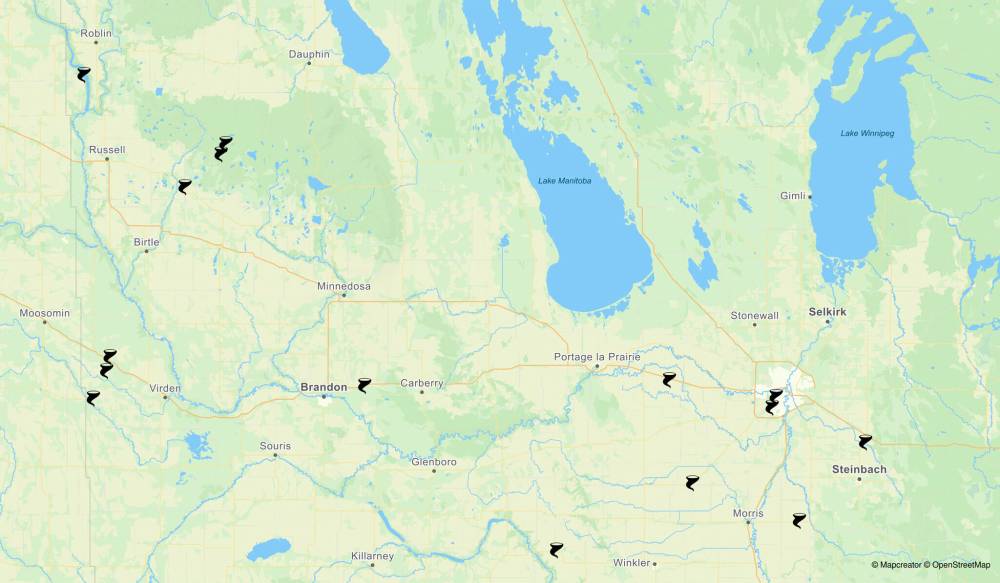
The tornado-producing storms in Manitoba and Saskatchewan in early June caused more than $840 million in insured damage, according to the Insurance Bureau of Canada.
Why does it take so long to confirm if a tornado has touched down?
Tornadoes are small, fast-moving events that can’t be tracked in real time with existing weather radar technology. Suspected tornadoes can only be verified through damage surveys; as well as reports, photos and videos from witnesses — the analysis of which takes time.
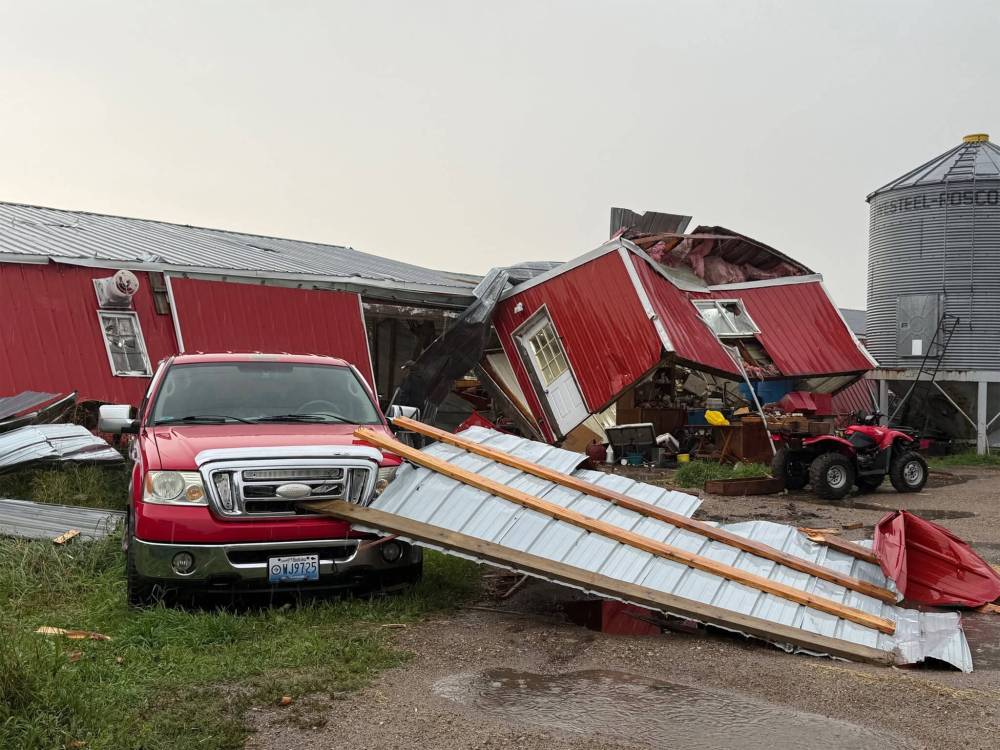
Researchers use the Enhanced Fujita scale to determine a tornado’s intensity based on the extent and degree of damage to foliage, vehicles and infrastructure. The weakest tornadoes are rated EF-0 and have a minimum estimated wind speed of 90 km/h, while the strongest are rated EF-5 and can reach wind speeds of 315 km/h or higher — about as fast as the top speed of a Formula 1 race car.
Most tornadoes fall on the weaker end of the spectrum. The strongest to hit Manitoba this year was an EF-3 near Rossburn, which reached a maximum estimated wind speed of 230 km/h, destroyed two homes and leveled trees. Canada’s only recorded EF-5 tornado landed in Elie in 2007.
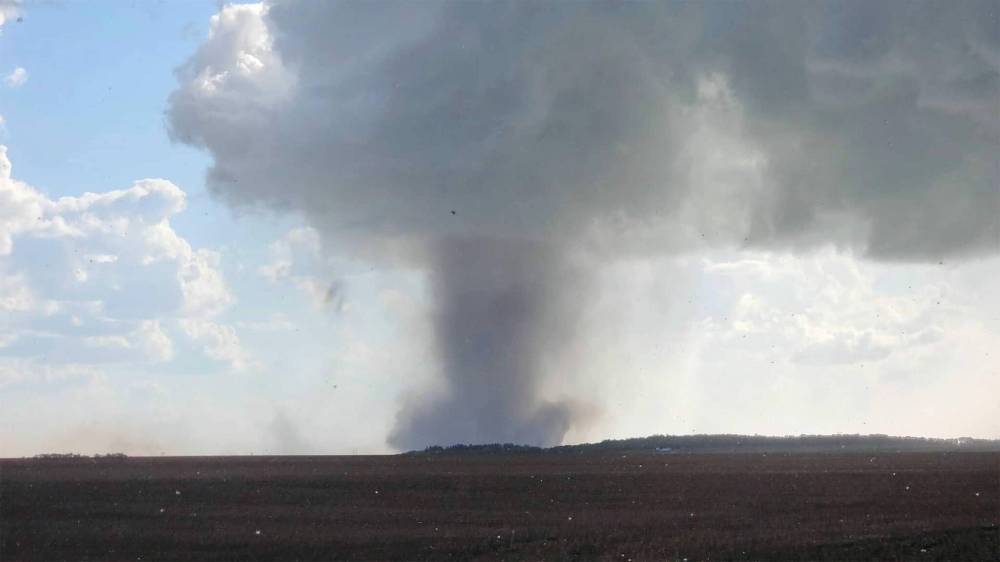
Tornadoes that occur in remote, unpopulated areas are often confirmed well after they make landfall. At the end of the season, Northern Tornadoes Project staff spend hundreds of hours combing through satellite imagery of Canadian forests to find evidence of unreported tornadoes, which look like long narrow scars from above.
“We usually find somewhere between 15 and 30 new tornadoes that we didn’t know about,” Sills says.
The project also tracks downbursts, which can produce damaging winds when air drops rapidly towards the ground during a thunderstorm. There have been five confirmed downbursts in Manitoba, including in Selkirk and Caddy Lake, and 47 across the country this year.
When and where do tornadoes occur in Manitoba?
The severe storm season typically begins in May and ends in September. While most occur in southern Manitoba, tornadoes have been reported as far north as Churchill, according to historic data from Environment and Climate Change Canada.
The majority of tornadoes take place in rural areas because most of the province is rural — but they can happen anywhere. Case in point: two EF-1 tornadoes landed within the city of Winnipeg this year.
JOHN WOODS / FREE PRESS FILES
The first destroyed a home in the Whyte Ridge neighbourhood and travelled more than six kilometres through southwest Winnipeg in June. The second tore through the River Heights neighbourhood on Sunday with estimated wind speeds of 155 km/h. No one was injured, but the storm left thousands of residents without power.
It’s a common misconception cities are less likely to experience tornadoes due to their taller buildings or higher temperatures (a.k.a. the urban heat island effect). This is false, according to Hanesiak. Urban tornadoes are rarer simply because cities make up a smaller proportion of the map.
“As cities get larger there’s a higher probability of actually getting hit.”
“It certainly happens,” Hanesiak says, adding urban sprawl may affect this dynamic in the future. “As cities get larger there’s a higher probability of actually getting hit.”
Changing storm trends may also increase the likelihood of tornado activity more broadly, Sills adds.
How is climate change affecting tornadoes?
More research is needed to understand the complex relationship between tornadoes and climate change, but Canada’s warm-weather storm season appears to be starting earlier and ending later, Sills says.
“We believe that the severe storm season is actually extending,” he says. “If you have a longer season, there’s more chances for tornadoes, more chances for the really big stuff.”
A warming planet is likely to alter weather patterns in ways that both encourage and hinder the development of tornadoes.
“It’s really not just a case of climate change equals more tornadoes. It’s changing by region, changing by season.”
Wildfires, for example, are becoming more frequent and can produce their own extreme weather events, such as lightning and tornadoes. At the same time, drifting smoke can cut down on the amount of sunlight that reaches the ground, Sills explains, creating cooler temperatures and reducing the amount of solar energy available for thunderstorms.
“It’s really not just a case of climate change equals more tornadoes. It’s changing by region, changing by season,” he says.
North America’s “tornado alley” is also moving eastward. Over the past 40 years in Canada, the number of tornadoes in the Prairies has gone down, while the number of tornadoes in Ontario and Quebec has gone up. This trend carries into the United States, representing a subtle but significant continental shift, Sills says.
Is tornado forecasting improving in Canada?
Yes, gradually.
Environment and Climate Change Canada is responsible for issuing tornado warnings and severe weather alerts across the country. In August, the department rolled out a new system called Convective Alert Modernization (CAM), which was designed to reduce “alert fatigue” by enabling forecasters to deliver more precise warnings to targeted areas.
The timeliness and accuracy of the department’s tornado warnings have improved from an F to a C since 2019, according to independent annual report cards issued by the Northern Tornadoes Project.
The project’s scope has grown since its founding in 2017. The project is now under the umbrella of the new Canadian Severe Storms Laboratory, which also collects data on hail storms. Flash flooding — a worsening phenomenon owing to climate change — is the lab’s next priority.
“It all helps us adapt to this new reality.”
“Anything we can do as a community to help improve community resilience, improve the way the prediction is done, it all helps us adapt to this new reality,” Sills says.
Days after Sills spoke with The Free Press/Narwhal staff at the Northern Tornadoes Project were busy analyzing the aftermath of another Manitoba storm using ground and drone surveys.
The project confirmed two more tornadoes touched down in the province on Sunday — the one in River Heights, the second west of Elie — leaving swaths of splintered trees, toppled Hydro poles and damaged cars and homes in their wake.
eva.wasney@winnipegfreepress.com

Eva Wasney covers environmental issues in Manitoba for The Narwhal in partnership with the Winnipeg Free Press. Read more about Eva.
Every piece of reporting Eva produces is reviewed by an editing team before it is posted online or published in print — part of the Free Press‘s tradition, since 1872, of producing reliable independent journalism. Read more about Free Press’s history and mandate, and learn how our newsroom operates.
Our newsroom depends on a growing audience of readers to power our journalism. If you are not a paid reader, please consider becoming a subscriber.
Our newsroom depends on its audience of readers to power our journalism. Thank you for your support.