

Health system would suffer during extended Dynacare strike, board told
Hearing probes necessity of essential services agreement involving lab workers

Advertisement
Read this article for free:
or
Already have an account? Log in here »
To continue reading, please subscribe:

Digital Subscription
One year of digital access for only $205*
- Enjoy unlimited reading on winnipegfreepress.com
- Read the E-Edition, our digital replica newspaper
- Access News Break, our award-winning app
- Play interactive puzzles
*First annual payment billed as $205.00 + GST for one year. This annual subscription will automatically renew at $233.00 + GST every 52 weeks (10% off the regular annual price of $259.35). Offer available to new and qualified returning subscribers only. Cancel any time.
To continue reading, please subscribe:
Add Free Press access to your Brandon Sun subscription for only an additional
$1 for the first 4 weeks*
- Enjoy unlimited reading on winnipegfreepress.com
- Read the E-Edition, our digital replica newspaper
- Access News Break, our award-winning app
- Play interactive puzzles
*Your next Brandon Sun subscription payment will increase by $1.00 and you will be charged $17.95 plus GST for four weeks. After four weeks, your payment will increase to $24.95 plus GST every four weeks.
Read unlimited articles for free today:
or
Already have an account? Log in here »
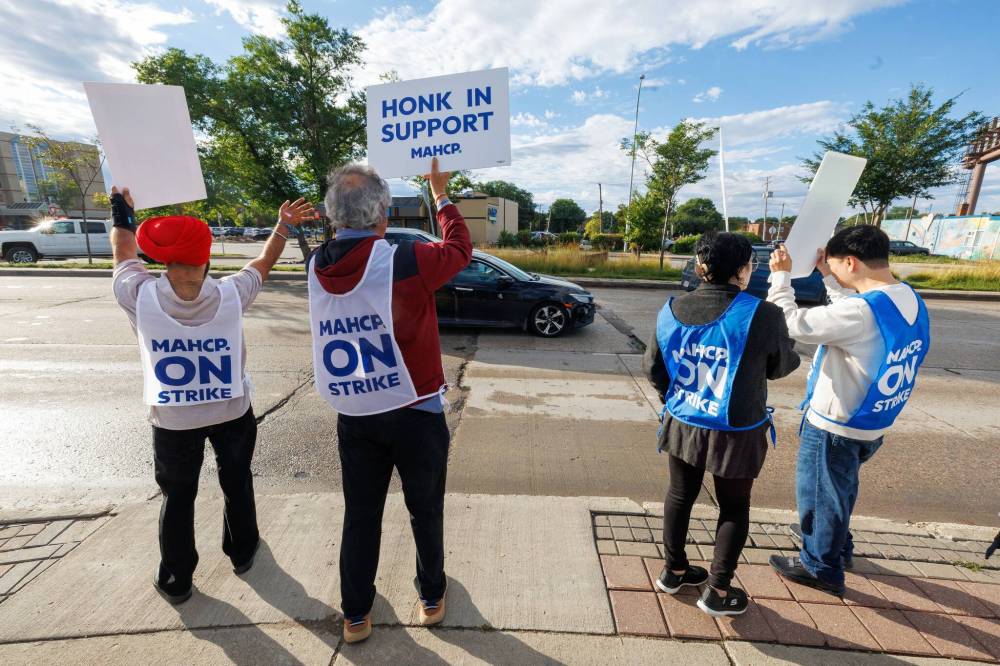
A prolonged strike at Dynacare labs would lead to unsustainable pressure on the public health-care system alongside testing and treatment delays for some patients, the Manitoba Labour Board was told Tuesday.
Dr. AbdulRazaq Sokoro, chief operating officer of diagnostic services at Shared Health, outlined the potential effect on blood, urine and other tests if the provincial authority has to implement a strike contingency plan that would give priority to patients deemed more vulnerable.
“We know from evidence and we know from medical fact that any patient that has complaints will get a worsening of their disease if they’re unattended to,” Sokoro said during a labour board hearing to determine whether unionized employees of Dynacare — a private, American-owned company — provide an essential service.
“We also know that in order for physicians to attend to complaints, they need to be able to diagnose the patient’s disease.
“If the lab testing is delayed, in essence, the intervention to treat the patient is also delayed. That would contribute, in many cases, to a worsening of the symptoms and missed opportunities for treatment.”
Some patients could end up in hospital emergency departments, he said.
As part of the contingency plan, physicians and community care providers would be asked to determine which patients could wait a week or two for tests.
Sokoro said testing capacity at public labs, which are located in hospitals, could be temporarily increased during a strike, using measures such as increased opening hours at 11 facilities.
“Not on a sustainable basis, and temporary meaning a day or two at the most, but it’s not a guaranteed and actionable plan from a system administrator,” he said.
Staff at the labs would be asked to work overtime on a voluntary basis. Gaps in shifts would be opened up to other qualified health-care workers — primarily nurses, but physicians would be considered if a strike were to drag on, Sokoro said.
He said the capacity of public laboratories would not equal Dynacare’s capacity, while staff would face increased fatigue and workloads.
A virtual hearing began Thursday after an interim order by the board forced about 350 lab technicians and technologists, who are represented by the Manitoba Association of Health Care Professionals, to return to work at Dynacare on Sept. 8, shortly after a strike began following a breakdown in contract negotiations.
The workers have been without a contract since March 31. The union is seeking wage parity, arguing its members’ counterparts in the public system are paid 20 to 50 per cent more.
A week before the work stoppage, an application from Labour Minister Malaya Marcelino — concerned that the consequences could have “catastrophic” impacts on Manitobans’ health — asked the board to suspend the strike and determine whether an essential services agreement is needed. Dynacare and the union deemed an agreement unnecessary in March.
“If the lab testing is delayed, in essence, the intervention to treat the patient is also delayed. That would contribute, in many cases, to a worsening of the symptoms and missed opportunities for treatment.”
The union has contended work can be done in the public system during a strike by its members. It has criticized the province’s intervention and wants Marcelino’s application to be dismissed.
It has argued Shared Health’s contingency plans show the strike didn’t put the public system in a “catastrophic” position.
The board heard details about an August 2025 letter that Dr. Chris Christodoulou, the interim president and CEO of Shared Health, sent to Dr. Jenisa Naidoo, Dynacare’s chief medical officer, in which he made the case that Dynacare should pursue an essential services agreement with the union.
Sokoro said he advocated for the letter to be written.
Earlier Tuesday, the board heard from Dr. Brent Roussin, Manitoba’s chief public health officer. Jake Giesbrecht, legal council for the union, asked about Dynacare’s daily specimen collection data for testing of some diseases, including HIV and measles.

Roussin included the figures in an Aug. 31 affidavit that said even a brief disruption in community-based testing can have a significant negative impact on Manitoba’s public health testing and response system.
He said he reviewed the estimated daily volume, based on data from recent months, with the provincial Cadham laboratory to go over its authenticity.
The former Tory government signed a deal in 2017 for Dynacare to provide community-based medical laboratory testing in most of Manitoba. The public system handles emergency testing and performs diagnostic blood and urine tests at hospitals and health centres.
The NDP government signed a new five-year agreement in 2025. Premier Wab Kinew said Thursday Manitoba may bring services currently provided by Dynacare back into the public system despite the extraordinary cost.
chris.kitching@freepress.mb.ca
Chris Kitching is a general assignment reporter at the Free Press. He began his newspaper career in 2001, with stops in Winnipeg, Toronto and London, England, along the way. After returning to Winnipeg, he joined the Free Press in 2021, and now covers a little bit of everything for the newspaper. Read more about Chris.
Every piece of reporting Chris produces is reviewed by an editing team before it is posted online or published in print — part of the Free Press‘s tradition, since 1872, of producing reliable independent journalism. Read more about Free Press’s history and mandate, and learn how our newsroom operates.
Our newsroom depends on a growing audience of readers to power our journalism. If you are not a paid reader, please consider becoming a subscriber.
Our newsroom depends on its audience of readers to power our journalism. Thank you for your support.
Chris Kitching is a general assignment reporter at the Free Press. He began his newspaper career in 2001, with stops in Winnipeg, Toronto and London, England, along the way. After returning to Winnipeg, he joined the Free Press in 2021, and now covers a little bit of everything for the newspaper. Read more about Chris.
Every piece of reporting Chris produces is reviewed by an editing team before it is posted online or published in print — part of the Free Press‘s tradition, since 1872, of producing reliable independent journalism. Read more about Free Press’s history and mandate, and learn how our newsroom operates.
Our newsroom depends on a growing audience of readers to power our journalism. If you are not a paid reader, please consider becoming a subscriber.
Our newsroom depends on its audience of readers to power our journalism. Thank you for your support.
Related Articles
‘Dynacare sucks’: premier muses about bringing lab services back into public system






Advertisement Advertise With Us
Advertisement Advertise With Us