

‘Moving in the right direction’
Audited public accounts show province's deficit last year half of predicted $1.67 billion

Advertisement
Read this article for free:
or
Already have an account? Log in here »
To continue reading, please subscribe:

Digital Subscription
One year of digital access for only $205*
- Enjoy unlimited reading on winnipegfreepress.com
- Read the E-Edition, our digital replica newspaper
- Access News Break, our award-winning app
- Play interactive puzzles
*First annual payment billed as $205.00 + GST for one year. This annual subscription will automatically renew at $233.00 + GST every 52 weeks (10% off the regular annual price of $259.35). Offer available to new and qualified returning subscribers only. Cancel any time.
To continue reading, please subscribe:
Add Free Press access to your Brandon Sun subscription for only an additional
$1 for the first 4 weeks*
- Enjoy unlimited reading on winnipegfreepress.com
- Read the E-Edition, our digital replica newspaper
- Access News Break, our award-winning app
- Play interactive puzzles
*Your next Brandon Sun subscription payment will increase by $1.00 and you will be charged $17.95 plus GST for four weeks. After four weeks, your payment will increase to $24.95 plus GST every four weeks.
Read unlimited articles for free today:
or
Already have an account? Log in here »
Manitoba’s audited public accounts for the last fiscal year show the province is “moving in the right direction,” NDP Finance Minister Adrien Sala said Monday.
The provincial deficit for fiscal 2025-26 was $832 million, nearly half the $1.67-billion deficit forecast in December, and in line with the $794-million estimate in Budget 2026.
“I’m particularly proud of this final result, (given the potential) implications of tariffs on our economy, the worst wildfire season in 30 years — which resulted in significant emergency expenditures — and, of course, a significant drought,” Sala said at a news conference.
MIKE DEAL / FREE PRESS Premier Wab Kinew and Finance Minister Adrien Sala release the 2025-26 audited public accounts during a press conference at the Manitoba Legislative Building on Monday.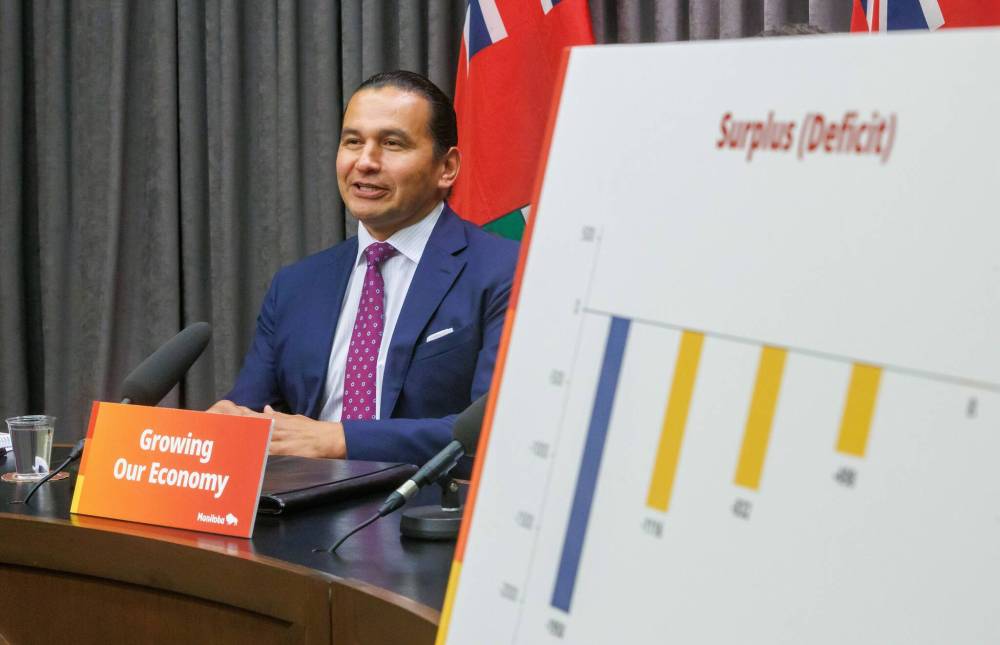
The province reported revenues of $25.1 billion and expenses of $25.9 billion, resulting in the $832-million deficit. Manitoba’s net debt is $36.5 billion and costs the province $2.3 billion a year in debt-servicing charges.
“While other provinces are struggling to rein in their deficits, here in Manitoba we’re moving in the right direction,” Sala said, flanked by Premier Wab Kinew.
“Today’s results show that.”
While Manitoba’s gross domestic product grew by just 1.3 per cent compared to the Canadian average of 1.7 per cent, it could’ve been a lot worse. Budget 2025 forecast that GDP could decline by 3.8 per cent, considering global trade tensions.
Manitoba’s diverse economic base showed resilience in 2026-26 at a time when international trade, U.S. tariffs and the conflict in the Middle East weighed on business confidence and the economic outlook, the public accounts said.
To prepare for potentially tougher times ahead, the province announced Monday that it made a $600-million contribution to the fiscal “rainy-day” stabilization fund, “that helps to ensure that government can continue providing services, no matter what happens,” Kinew said.
“This puts us on track to balance the budget next year, just like we promised.”
It is the first deposit in five years and the largest in more than 20 years, the province said. The contribution more than doubles the balance of the fund and re-establishes compliance with legislated reserve targets.
The premier said his government will meet its commitments to balance the province’s books before the next provincial election, which must be held by Oct. 5, 2027.
“This puts us on track to balance the budget next year, just like we promised,” Kinew said.
Progressive Conservative Leader Obby Khan said most Manitobans don’t feel like the province is heading in the right direction.
“Every Manitoban I’ve spoken to has said they are struggling with affordability, they’re struggling with paying bills, they’re struggling with putting food on the table,” Khan told reporters.
“This NDP government clearly has no plan for affordability. They have no plan to make life better for Manitobans. They are simply going to pick and choose the numbers they want to show Manitobans.”
Khan pointed to a line in a TD economic report Monday that said “2026 is shaping up to be yet another subpar year for Manitoba’s economy.”
MIKE DEAL / FREE PRESS Manitoba Finance Minister Adrien Sala at the announcement the province is on track to balance the budget next year after cutting the deficit in half.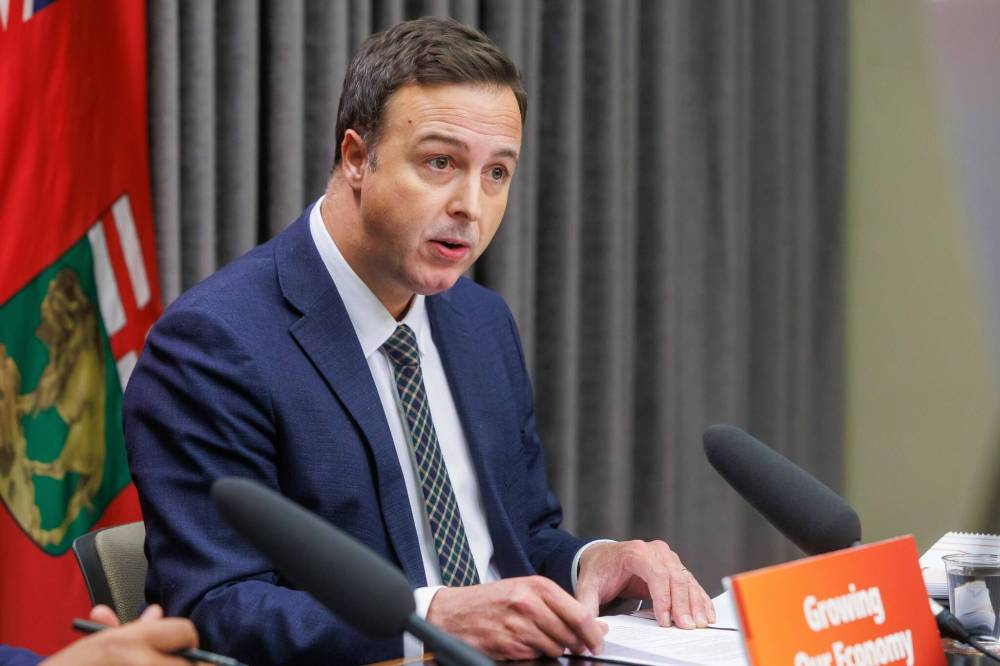
He said the NDP is collecting more in education property taxes and stopped indexing tax brackets to the rate of inflation, which has pushed Manitobans into higher brackets without a corresponding increase in their real income.
Sala explained the deficit reduction was owing, in part, to overall revenues being up, relative to the third quarter.
“By far the biggest contribution was personal income tax revenues, which were up $378 million,” he said.
“Broadly speaking, this was a function of a stronger labour market and higher incomes, which resulted in higher revenues at year end.”
Sala said the increase in education property tax revenue is almost a “non-factor.”
Education property tax increases have increased since the NDP government in its first year replaced the Tories’ 50 per cent homeowner rebate in favour of a flat $1,500 rebate that increased to $1,600 in the 2025 budget and $1,700 this year.
“We’re proud of reducing costs for Manitobans,” he said.
“We’re proud of reducing costs for Manitobans.”
While many owners of lower-value homes saved money, many people in middle- and higher-value homes have been paying more. Revenue generated by the education property tax jumped to more than $1.1 billion in 2025-26 from $764 million the previous year.
Sala said that revenue increases reported Monday have more to do with economic growth, more homes and their higher values.
The province took in $629 million in net income from government business enterprises, which was less than forecast, mainly because of Manitoba Hydro’s $446-million loss owing to drought conditions.
MPI reported net income of $56 million — an increase of $47 million from the budget, and Manitoba Liquor and Lotteries reported a net income of $724 million — a decrease of $13 million from the budget due to softening video lottery terminal revenues and decreases in per capita liquor consumption. That was offset by higher revenues from cannabis, casinos and online gaming, the 247-page public accounts report said.
Federal transfers to the province were $250 million (2.8 per cent) lower than budgeted because of a decrease in revenue related to federal-provincial child care and investing in Canada infrastructure bilateral funding agreements.
“Those child-care dollars are still coming forward. They’re just going to be spent at a later date. So some of that will be spent this year and in following years,” Sala said.
“We’re really looking forward to diving in and rolling up our sleeves with the federal government…”
The premier said the province relies on federal government funding transfers and bilateral agreements to deliver health care, and faces a “major fiscal cliff” next spring.
“We’re really looking forward to diving in and rolling up our sleeves with the federal government to try and extend those arrangements, because they are making a difference here in Manitoba,” Kinew said.
“Adding 4,000 net new health-care workers and reopening the emergency department at the Victoria Hospital and more primary-care clinics is, in part, made possible by having a good health-care working relationship and funding relationship with the federal government,” Kinew said.
He said he has raised the issued with Prime Minister Mark Carney and directed Sala and Health Minister Uzoma Asagwara to do likewise with their federal counterparts.
“We really need to see that clarity and that stability,” he said.
carol.sanders@freepress.mb.ca
Carol Sanders
Legislature reporter
Carol Sanders is a reporter at the Free Press legislature bureau. The former general assignment reporter and copy editor joined the paper in 1997. Read more about Carol.
Every piece of reporting Carol produces is reviewed by an editing team before it is posted online or published in print — part of the Free Press‘s tradition, since 1872, of producing reliable independent journalism. Read more about Free Press’s history and mandate, and learn how our newsroom operates.
Our newsroom depends on a growing audience of readers to power our journalism. If you are not a paid reader, please consider becoming a subscriber.
Our newsroom depends on its audience of readers to power our journalism. Thank you for your support.
Carol Sanders
Legislature reporter
Carol Sanders is a reporter at the Free Press legislature bureau. The former general assignment reporter and copy editor joined the paper in 1997. Read more about Carol.
Every piece of reporting Carol produces is reviewed by an editing team before it is posted online or published in print — part of the Free Press‘s tradition, since 1872, of producing reliable independent journalism. Read more about Free Press’s history and mandate, and learn how our newsroom operates.
Our newsroom depends on a growing audience of readers to power our journalism. If you are not a paid reader, please consider becoming a subscriber.
Our newsroom depends on its audience of readers to power our journalism. Thank you for your support.
Advertisement Advertise With Us
Advertisement Advertise With Us
History
Updated on Monday, September 21, 2026 7:27 PM CDT: Updated for quotes and additional details.