The centre of attention Positive anticipation is growing about major housing developments underway in Winnipeg’s downtown
Read this article for free:
or
Already have an account? Log in here »
To continue reading, please subscribe:

Digital Subscription
One year of digital access for only $205*
- Enjoy unlimited reading on winnipegfreepress.com
- Read the E-Edition, our digital replica newspaper
- Access News Break, our award-winning app
- Play interactive puzzles
*First annual payment billed as $205.00 + GST for one year. This annual subscription will automatically renew at $233.00 + GST every 52 weeks (10% off the regular annual price of $259.35). Offer available to new and qualified returning subscribers only. Cancel any time.
To continue reading, please subscribe:
Add Free Press access to your Brandon Sun subscription for only an additional
$1 for the first 4 weeks*
- Enjoy unlimited reading on winnipegfreepress.com
- Read the E-Edition, our digital replica newspaper
- Access News Break, our award-winning app
- Play interactive puzzles
*Your next Brandon Sun subscription payment will increase by $1.00 and you will be charged $17.95 plus GST for four weeks. After four weeks, your payment will increase to $24.95 plus GST every four weeks.
Read unlimited articles for free today:
or
Already have an account? Log in here »
If traffic is light and the wind is down, Somia Sadiq is able to hear the roar of Winnipeg Jets fans twice: first through her window, then on TV.
From her apartment view high above downtown, she can look out at Graham Avenue’s painted pedestrian landscape, see construction cranes and hear the heavy equipment at work as massive housing projects take shape at The Forks, at what used to be Portage Place shopping centre and at the former Hudson’s Bay building.
Sadiq has lived at 300 Main for 2 1/2 years, a few steps from the city’s famous, windy and reopened-to-pedestrians Portage Avenue intersection. At 42 storeys, it’s the tallest building in Winnipeg.
Ruth Bonneville / Free Press Files Somia Sadiq has lived at 300 Main for 2 1/2 years.
She is among 18,000 downtown residents who will soon be joined by thousands of others attracted to the city’s core by the new wave of major construction projects.
CentreVenture Development Corp. anticipates 4,000 units opening downtown over the next three to four years, bringing an expected influx of 6,000 residents.
Despite the optimism, long-standing challenges remain in the core. The Free Press spoke to residents, planners and community advocates about housing and downtown revitalization ahead of the Oct. 28 election.
“Love the place, spectacular views of our beautiful city,” Sadiq said of her apartment. “You realize how many trees our city has when you’re living that high up.”
The tower was completed in 2022, as the city reckoned with the damage of the COVID-19 pandemic.
Businesses had shuttered and downtown office staff who had been working from home were slow to return, yet Sadiq and her husband chose to move from East Kildonan. She’d lived in the city’s core years earlier and missed being “in the middle of all the action.”
“If you ever want to feel the experience of just how much happens in the city… living downtown is a great way to have that experience,” the 43-year-old said.
A seven-minute walk takes her to work. Baseball games, festivals and the Legislative Building are a short jaunt away.
“Every new investment downtown has an impact.”
Sadiq, who founded planning and design firm Narratives Inc., described the nearby housing developments as “excellent.”
“Every new investment downtown has an impact,” she said.
Dave Hall, a retiree who treks downtown Winnipeg several times a week, echoes her sentiments.
“I love downtown,” Hall said, pausing on his way to a hearing aid appointment. “We live in a 15-minute city.”
He gave his old car to his grandson last year. He walks from his Langside Street home to regular downtown haunts such as the Prairie Theatre Exchange, West End Cultural Centre and Times Change(d) High and Lonesome Club.
He acknowledges his enthusiasm for downtown is not shared by everyone.
“It’s sad. People think it’s dangerous, but it’s by and large not dangerous if you use common sense,” the 76-year-old said, adding new developments such as Railside at The Forks and Market Lands should improve density.
Railside at The Forks encompasses nine apartment buildings and one condominium project. About 400 units should be finished in 2028; a total 1,200 could open by 2040.
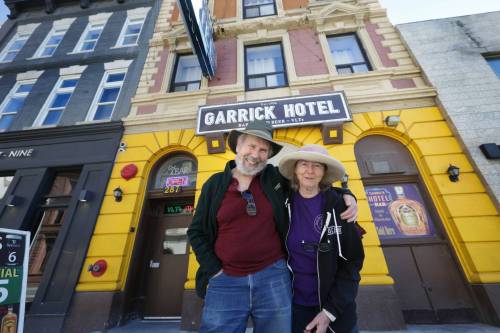
Ruth Bonneville / Free Press Retiree Dave Hall, with his partner Barb Remnant, says he loves downtown Winnipeg. After giving away his car, Hall regularly walks from his Langside Street home to his favourite downtown haunts.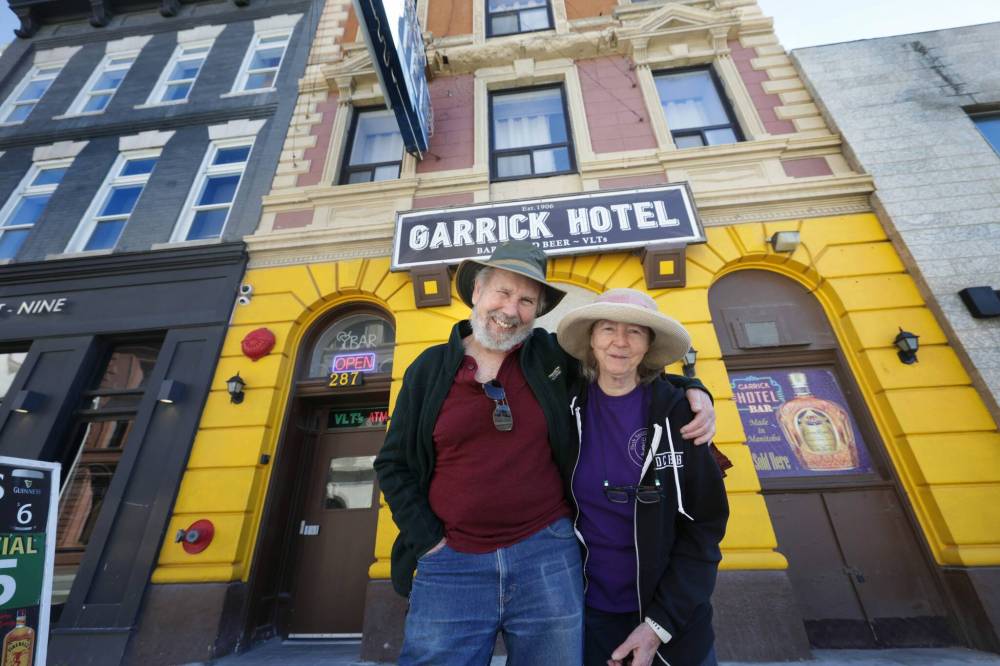
Market Lands, a mixed-use residential development on the former Public Safety Building site in the Exchange District, has three buildings in the works, with a total 369 apartment suites. The first structure, opening next month, has 95 units.
“But we desperately need that to be combined with public housing, low-cost housing,” Hall said, because private-sector housing isn’t “even within dreaming territory” of people living in tents in his West Broadway neighbourhood, which borders downtown.
As a frequent pedestrian, Hall said he’s become “a little bit desensitized” to witnessing poverty, mental-health and addiction issues play out on the street. He doesn’t feel unsafe, he said, but he understands it keeps others away.
“You see a lot of pain. You’ll see young people overdosing with a needle in their arm, people huffing in a corner with their crack… this is heartbreaking to see.”
Affordable grocery stores remain a top priority for downtown residents, said Corrine Clyne, 34.
Options are slim. Clyne visits Downtown Family Foods at Broadway and Donald Street, but it’s a smaller shop, she said. Another small core-area grocer, the Giant Tiger at Donald and Ellice Avenue, is closing in a few days.
A more promising option is coming, though not for another three years. Red River Co-op plans to open a full-scale grocery store and pharmacy in 2029, inside the $650-million transformation of Portage Place into a mixed-use residential, commercial, health-care and community hub.
“I think I order more online food than anything,” Clyne said, stopping during a walk near her Smith Street apartment. “But if I were somebody who didn’t have the luxury of doing that, then it would be a lot harder.”
Aside from buying groceries, living in the city’s core is convenient, she said, which is why she’s been there for 17 years. Before that she lived near the Perimeter Highway, but found “everything was so far away.”
Her commute to work was cut in half when she moved downtown. She often walks to coffee shops and Bonnycastle Dog Park.
SUPPLIED Artist's rendering of Railside at The Forks, a development with nine apartment buildings and one condominium project that will see about 400 units finished by 2028 and up to 1,200 planned by 2040.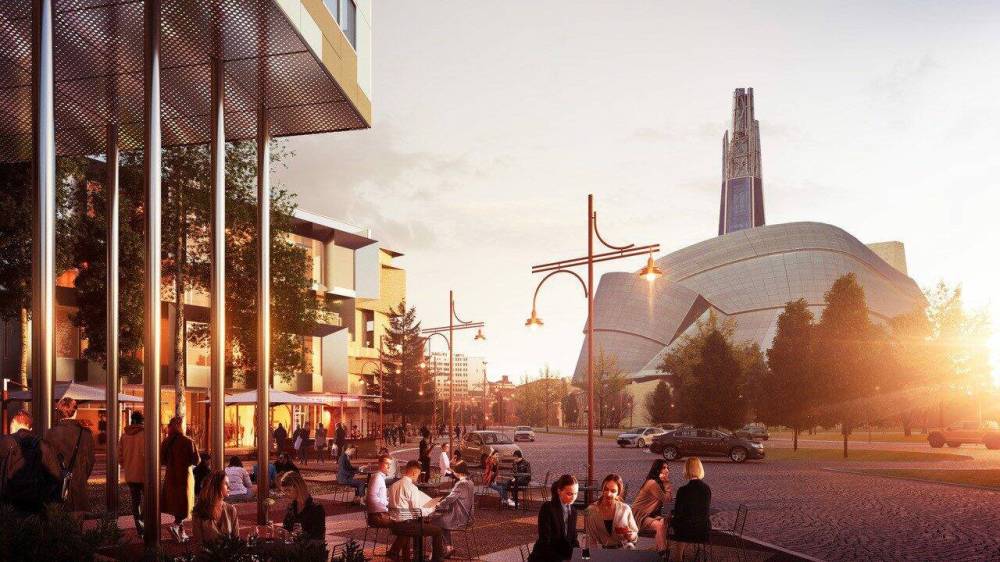
She watched as many retailers shuttered during the pandemic, but she’s sensing a change happening.
“Businesses are starting to open up,” said Clyne, who has become a frequent visitor to Mondays Cafe, which opened on Broadway last year.
The number of business openings has matched closures in the first two quarters of 2026. It marks a “sustained pause” in net losses over the past five years, the Downtown Winnipeg BIZ’s latest public report says.
“It’s been said that retail follows rooftop,” said Rochelle Squires, chief executive of CentreVenture Development Corp.
“A good amount of housing (is) coming online in the next three to four years, which will create vibrancy unlike anything… seen before.”
“It’s a complex community.”
CentreVenture and other planners expect to see 25,000 residents downtown in the coming years. Canada’s 2021 census recorded 17,190, a 17 per cent increase from five years earlier.
There was a significant spike in downtown building permits last year, with 1,040 issued. By comparison, 2,420 permits in total were issued between 2021 and the end of last month. So far this year, 295 permits had been issued.
None of those permits are for single-detached homes, city spokesman Adam Campbell confirmed. However, the city doesn’t track rental-unit versus owned permit numbers.
“We’re at the right moment in time to really be focusing on that density,” Squires said. “The support has been there from all levels of government, and it’s really good to see that, because that’s what it’s going to take.
“It’s a complex community.”
The city has committed more than $112.8 million in grants and tax increment financing — $71.1 million and $41.6 million, respectively — for downtown housing since 2022.
Of that, $56.3 million has come from Ottawa’s housing accelerator fund.
Manitoba Housing has tabbed at least $81 million for downtown housing projects over the past five years, including through loans and land contributions. Projects include the Portage Place and Hudson’s Bay redevelopments, a government spokesperson said in a statement.
Ruth Bonneville / Free Press Files Market Lands is a mixed-use residential development on the site of the former Public Safety Building with three buildings in the works, the first opening next month providing 95 units.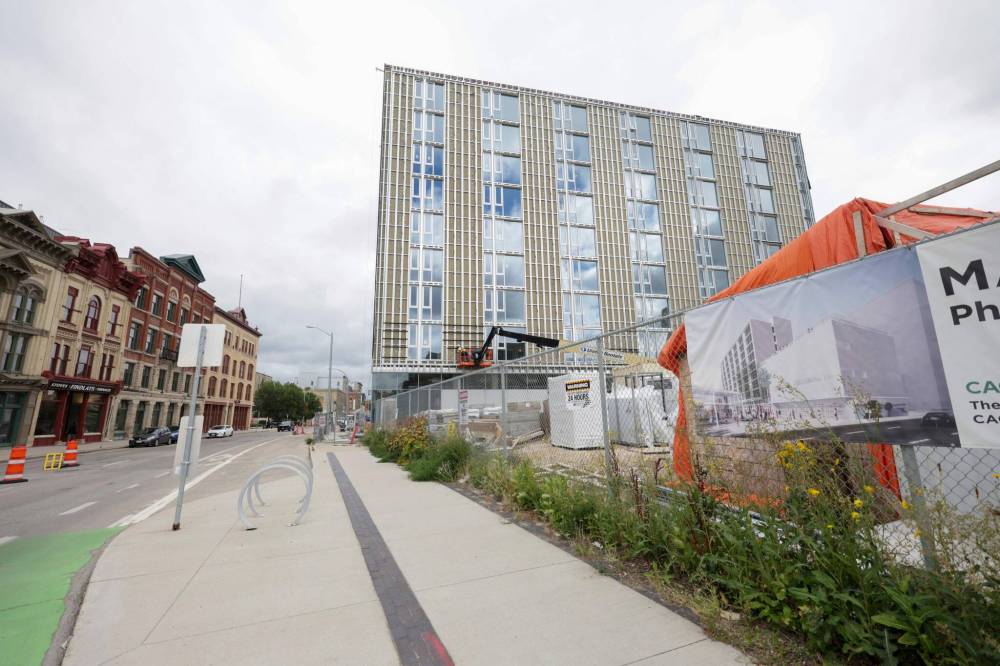
The housing will mesh with amenities such as health centres, green spaces and restaurants.
“This is a brand-new vision for downtown,” Squires said of the emphasis on mixed use development.
However, Coun. Sherri Rollins, whose Fort Rouge-East Fort Garry ward includes a portion of the core area, argues that downtown vision doesn’t have full municipal support.
Rollins has criticized the mayor’s executive policy committee for postponing CentrePlan 2050, a 25-year roadmap covering downtown investment and livability. It’s been pushed until at least 2027.
“My hope is that… we get back into a cycle where a lot of good things are happening.”
Downtown planning requires attention from all of council, instead of independent politicians’ offices providing money to specific initiatives, Rollins said.
“We lose something when downtown issues become the responsibility of an office like mine rather than a citywide priority,” she said.
“Successful cities usually have that important key — a mayor and council that understands that downtown belongs to the whole city.”
Garbage collection, daycare and school access and green space must be prioritized for residents, added Rollins, who isn’t running for re-election after serving eight years as a city councillor.
“You can’t build a downtown with the types of families we have and then manage it so it’s just a commercial district,” she said.
Safety concerns remain a hurdle to drawing residential developers downtown, said Nolan Ploegman, president of Winnipeg construction management and general contracting firm Concord Projects.
A 2026 Winnipeg Police Service survey found less than half of 600 respondents — 44 per cent — felt safe walking alone during the day. Just eight per cent felt safe at night.
Ploegman, however, has invested in downtown. He moved his company’s headquarters to 127 Bannatyne last year. Approximately 35 office staff members work out of the new 10-storey mixed-use Exchange District building that Concord co-developed with Alston Properties.
MIKE DEAL / FREE PRESS FILES Nolan Ploegman, president and CEO of Concord Projects, outside his company’s headquarters at 127 Bannatyne Avenue.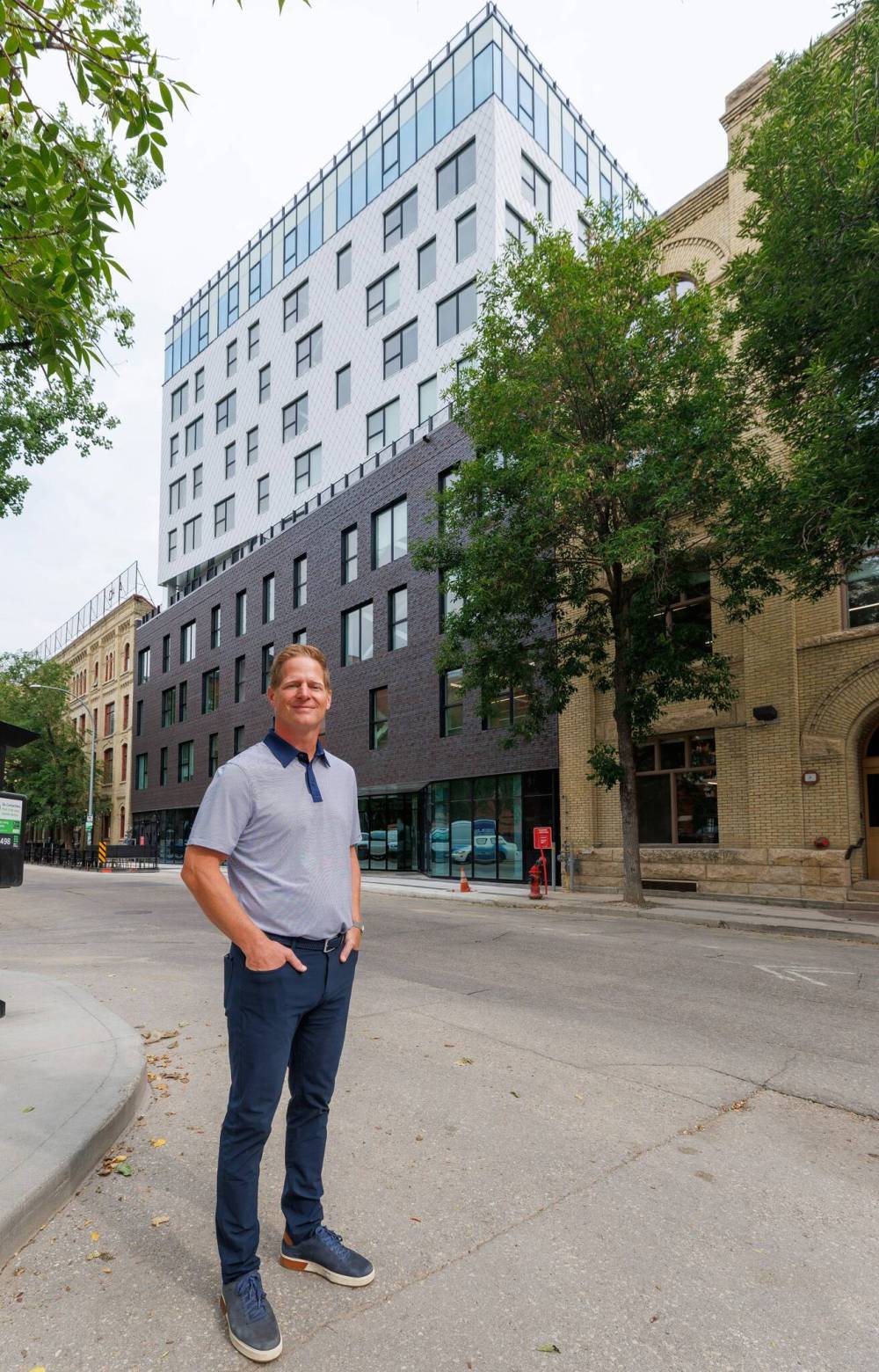
“We talk about wanting the downtown to be safer. We talk about… ‘More people should live downtown,’” Ploegman said. “This is my… small part of actually doing something about it.”
Concord Projects is the contractor for housing at Railside at The Forks and Market Lands. Ploegman said he’s working with developers who share the “same optimism” for revitalization.
Downtown projects are generally more expensive and come with greater challenges than new developments, such as dealing with older infrastructure, Ploegman said.
About 80 major projects have been undertaken in downtown Winnipeg since 2005, said Jino Distasio, interim president of the University of Winnipeg and an urban geography professor, calling it a “generational high” for housing starts.
“The big missing piece to all this is the struggle to regain a retail foothold in the downtown and to address the question of languishing negative perceptions,” Distasio said.
Squires pointed to “feet on the street” as a solution to the real and perceived safety concerns. CentreVenture counts roughly 80,000 people working downtown.
Winnipeg police tracked 19,369 crime calls between July 2025 and June 2026, up 3.2 per cent from the year prior. Violent crime had dropped 10 per cent year over year; non-violent crime rose eight per cent.
Downtown Winnipeg saw investment hit $2.4 billion between 2005 and 2015, with another $1 billion planned, but momentum halted during the pandemic, Distasio said.
“My hope is that… we get back into a cycle where a lot of good things are happening,” he said.
gabrielle.piche@winnipegfreepress.com

Gabrielle Piché reports on business for the Free Press. She interned at the Free Press and worked for its sister outlet, Canstar Community News, before entering the business beat in 2021. Read more about Gabrielle.
Every piece of reporting Gabrielle produces is reviewed by an editing team before it is posted online or published in print — part of the Free Press‘s tradition, since 1872, of producing reliable independent journalism. Read more about Free Press’s history and mandate, and learn how our newsroom operates.
Our newsroom depends on a growing audience of readers to power our journalism. If you are not a paid reader, please consider becoming a subscriber.
Our newsroom depends on its audience of readers to power our journalism. Thank you for your support.