

Nearly four in 10 Manitobans hope Canada restarts trade talks after U.S. midterm elections, poll reveals

Advertisement
Read this article for free:
or
Already have an account? Log in here »
To continue reading, please subscribe:

Digital Subscription
One year of digital access for only $205*
- Enjoy unlimited reading on winnipegfreepress.com
- Read the E-Edition, our digital replica newspaper
- Access News Break, our award-winning app
- Play interactive puzzles
*First annual payment billed as $205.00 + GST for one year. This annual subscription will automatically renew at $233.00 + GST every 52 weeks (10% off the regular annual price of $259.35). Offer available to new and qualified returning subscribers only. Cancel any time.
To continue reading, please subscribe:
Add Free Press access to your Brandon Sun subscription for only an additional
$1 for the first 4 weeks*
- Enjoy unlimited reading on winnipegfreepress.com
- Read the E-Edition, our digital replica newspaper
- Access News Break, our award-winning app
- Play interactive puzzles
*Your next Brandon Sun subscription payment will increase by $1.00 and you will be charged $17.95 plus GST for four weeks. After four weeks, your payment will increase to $24.95 plus GST every four weeks.
Read unlimited articles for free today:
or
Already have an account? Log in here »
Disorganized — that’s what Marcus Langlois calls recent United States tariffs.
He expects suppliers’ prices to increase — on mugs, pens, hoodies — for his employer, Dreamcatcher Promotions, if the United States–Canada trade war persists.
Still, he’s not pining for a quick trade deal.
“I think it should wait,” said Langlois, Dreamcatcher Promotions’ vice-president. “Let’s hope that it’s later on with proper negotiations happening.”
Wait until the United States midterm elections wrap up in November, Langlois said. A slight majority of Americans would prefer a Congress controlled by Democrats, NBC News polling showed Thursday afternoon.
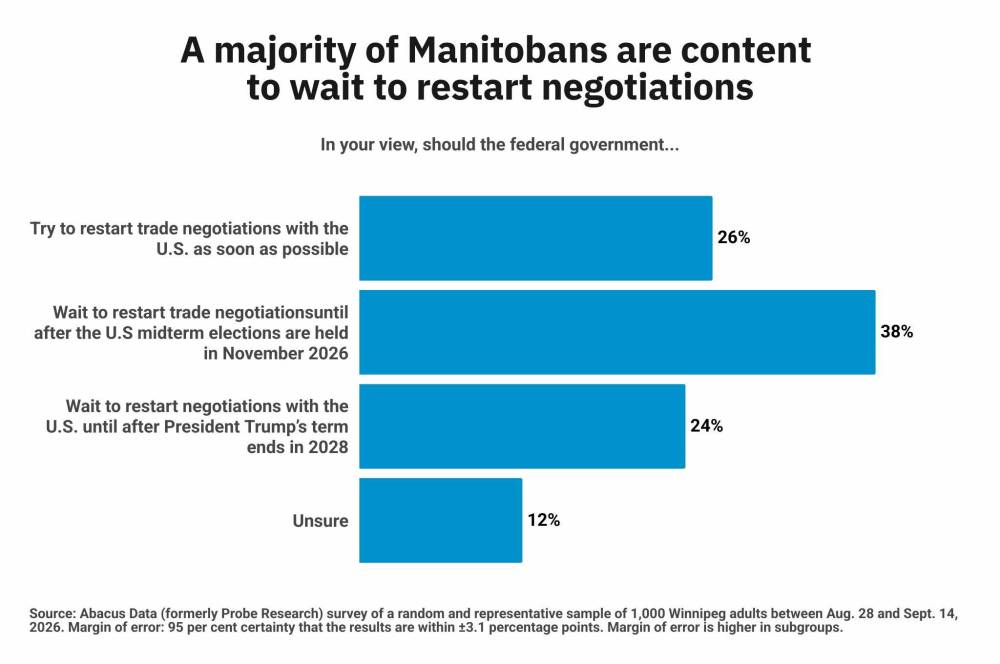
Nearly four in 10 Manitobans wish to restart trade negotiations following the midterms, a new survey commissioned by the Winnipeg Chamber of Commerce, Manitoba Chambers of Commerce and Business Council of Manitoba found.
Another 24 per cent are content waiting until U.S. President Donald Trump’s term ends in 2028.
Langlois is among the 66 per cent of survey respondents to support Canada walking away from free trade talks.
“There has to be fairness on both sides,” he said, noting steel industry layoffs. “(This is) affecting certain people in a way that has been a curveball to their means of life, financially.”
Abacus Data (formerly Probe Research) polled 1,000 Manitobans between Aug. 28 and Sept. 14. The results show people blame the U.S. administration for the tariff landscape instead of the country writ large, said Loren Remillard, president of the Winnipeg Chamber of Commerce.
But a change in Congress may not lead to a quick resolution, he cautioned.
“It’s not as though the Democratic party is out there indicating that they would do a 180 on the tariff policy,” Remillard said.
“It actually may complicate the matters if the U.S. government is in a stalemate with Congress.”
But if the Republicans hold tight to power, it could “embolden” the current regime, Remillard said.
The federal and Manitoba governments have announced aid for tariff-affected businesses. A majority of Abacus respondents — seven in 10 — said governments will need to help the impacted companies.
Retirees, white-collar workers and Liberal voters were most likely to agree. Blue-collar workers and federal Tory voters were less supportive (at 49 and 50 per cent, respectively).
Blue-collar workers were also most likely to want trade negotiations to restart immediately — 44 per cent did, compared to 24 per cent of respondents in other sectors.
“The blue-collar workers… are the ones who are going to be potentially more affected,” said Curtis Brown, Abacus Data’s managing director for Western Canada.
Young adults could see negative financial impacts “relatively soon” too, Brown added.
Fifty-two per cent of blue-collar workers expected tariffs to negatively affect their finances in a major way next year. Thirty-eight per cent said the same for the upcoming six months. (That changed to 47 and 29 per cent, respectively, for Manitobans ages 18 through 34.)
Overall, 77 per cent of respondents figure tariffs will negatively impact them in the next year; 66 per cent in the next six months.
Adia Branconnier is already reeling from higher gas and grocery prices.
“As a university student, (it’s) nerve-wracking because things are already tight,” said Branconnier, 18, who’s studying education.
“I would like for Trump to not be president anymore.”
Branconnier hopes companies use this moment, as they’re retooling their supply chains, to source from ethical sites.
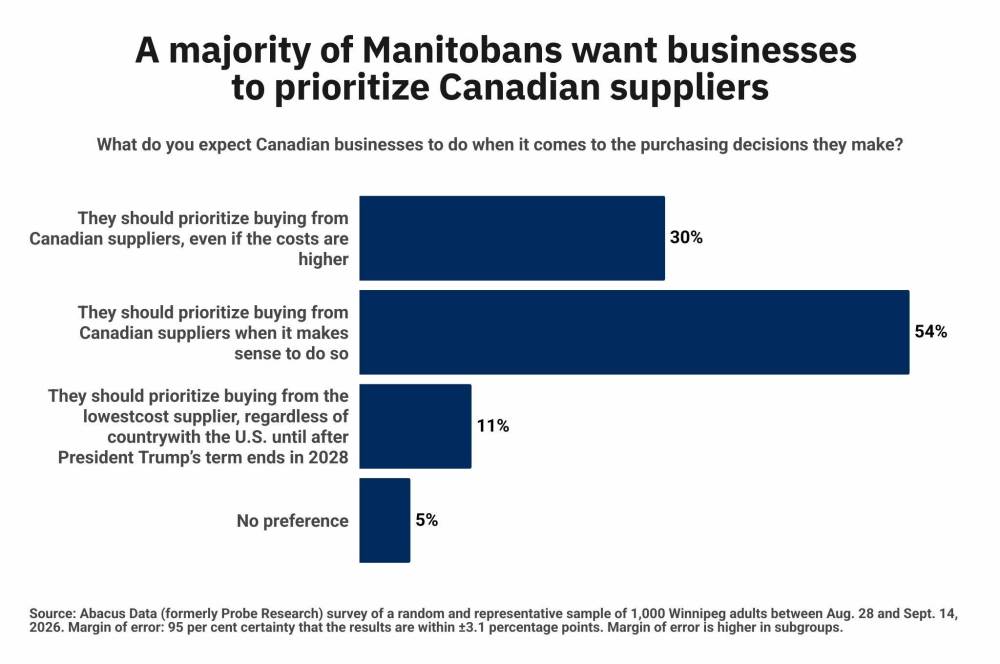
“And of course, I want to support Canadian, not U.S.-made products,” Branconnier said, joining 84 per cent of poll respondents who indicated a preference for Canadian suppliers.
Thirty per cent said Canadian suppliers should be prioritized, even at a higher cost. Another 54 per cent said Canadian companies should be chosen when it makes sense.
“You’re seeing a lot of Canadian companies shifting to Canadian suppliers because now, the business case has completely changed,” Remillard said.

It’s not always easy, he added — companies may flock to the same supplier who doesn’t have capacity to look after everyone. And often, business relationships are built over decades.
“We would ask a little bit of patience and understanding from the general public,” Remillard said. “Companies are trying to make this adjustment, but it isn’t as easy as flicking the switch.”
He called the Abacus results encouraging: “It’s probably the first survey I’ve seen in a long time where… it feels like business, government and the public are all on the same page.”
The survey has a 95 per cent certainty rate that results are plus or minus 3.1 per cent of what they would be if all Manitoba adults participated.
gabrielle.piche@winnipegfreepress.com
Gabrielle Piché reports on business for the Free Press. She interned at the Free Press and worked for its sister outlet, Canstar Community News, before entering the business beat in 2021. Read more about Gabrielle.
Every piece of reporting Gabrielle produces is reviewed by an editing team before it is posted online or published in print — part of the Free Press‘s tradition, since 1872, of producing reliable independent journalism. Read more about Free Press’s history and mandate, and learn how our newsroom operates.
Our newsroom depends on a growing audience of readers to power our journalism. If you are not a paid reader, please consider becoming a subscriber.
Our newsroom depends on its audience of readers to power our journalism. Thank you for your support.
Gabrielle Piché reports on business for the Free Press. She interned at the Free Press and worked for its sister outlet, Canstar Community News, before entering the business beat in 2021. Read more about Gabrielle.
Every piece of reporting Gabrielle produces is reviewed by an editing team before it is posted online or published in print — part of the Free Press‘s tradition, since 1872, of producing reliable independent journalism. Read more about Free Press’s history and mandate, and learn how our newsroom operates.
Our newsroom depends on a growing audience of readers to power our journalism. If you are not a paid reader, please consider becoming a subscriber.
Our newsroom depends on its audience of readers to power our journalism. Thank you for your support.
Related Articles
G20 trade talks yield little progress while tensions simmer


Advertisement Advertise With Us
Advertisement Advertise With Us