

International Peace Garden marks 90 years of greenery, tranquillity and reflection
Advertisement
Read this article for free:
or
Already have an account? Log in here »
To continue reading, please subscribe:

Digital Subscription
One year of digital access for only $205*
- Enjoy unlimited reading on winnipegfreepress.com
- Read the E-Edition, our digital replica newspaper
- Access News Break, our award-winning app
- Play interactive puzzles
*First annual payment billed as $205.00 + GST for one year. This annual subscription will automatically renew at $233.00 + GST every 52 weeks (10% off the regular annual price of $259.35). Offer available to new and qualified returning subscribers only. Cancel any time.
To continue reading, please subscribe:
Add Free Press access to your Brandon Sun subscription for only an additional
$1 for the first 4 weeks*
- Enjoy unlimited reading on winnipegfreepress.com
- Read the E-Edition, our digital replica newspaper
- Access News Break, our award-winning app
- Play interactive puzzles
*Your next Brandon Sun subscription payment will increase by $1.00 and you will be charged $17.95 plus GST for four weeks. After four weeks, your payment will increase to $24.95 plus GST every four weeks.
Read unlimited articles for free today:
or
Already have an account? Log in here »
Hey there, time traveller!
This article was published 22/07/2022 (1526 days ago), so information in it may no longer be current.
BOISSEVAIN, Man. – Tucked away in a sparsely populated stretch of prairie along the world’s longest undefended border, the International Peace Garden has, for 90 years, quietly celebrated the friendship between Canada and the United States.
The openness between the two countries is clear here.
A small creek marks the border, and people walk freely over it and back again as they stroll among gardens, ponds and monuments. It’s quiet enough to hear the gentle buzzing of bees among the flowers, some of which are laid out in the form of the Maple Leaf or the Stars and Stripes.
It’s a pastoral setting, aimed largely at thoughtful reflection.
“Peace is something we should always aim for, and what better way to contemplate it and share it with people than in a garden,” says Tim Chapman, the garden’s chief executive officer.
Established in 1932, the garden was conceived by Dr. Henry Moore of Islington, Ont., and was widely expected to be located in that province. But the National Association of Gardeners decided that it should be close to the geographical centre of North America — Rugby, N.D.
It lies in the Turtle Mountains, a lush area of gentle hills a 20-minute drive from the closest small communities on either side of the border. Surrounded by forests and lakes, there are 80,000 flowering annual and perennial plants, many of which are visible in a sweeping vista from a platform above a fountain.
A cairn at the entrance, put in place between the world wars, pledges the two countries to not take up arms against each other. It is flanked by Canadian and U.S. flags.
There is a “friendship rock,” originally from England, which sits directly on the 49th parallel. There is a clock tower that chimes every 15 minutes, momentarily breaking the quiet. And there is a small conference centre with inspirational quotes etched on limestone walls.
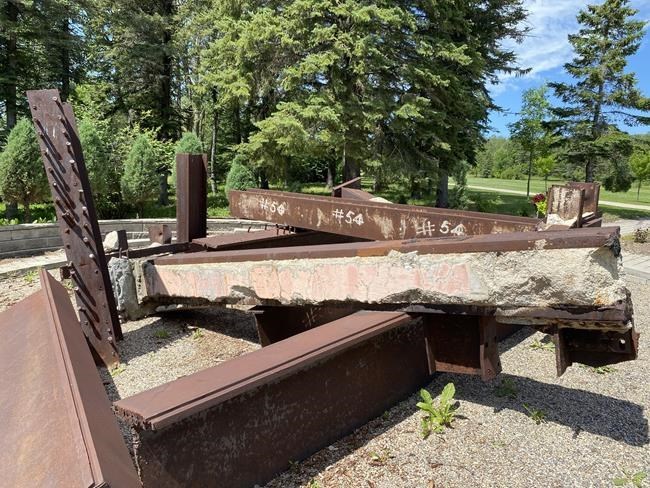
Of a more recent time, one display shows damaged girders from the World Trade Center that was targeted in the terrorist attack of Sept. 11, 2001. The girders are, in part, a tribute to the co-operation between Canada and the U.S. in the wake of the attack.
“Being here at the garden, it helps people contemplate, you know, if there isn’t greater dialogue and thoughts of co-operation and peace, unfortunately some really bad things can happen in the world,” Chapman said.
Plans for the 90th anniversary celebrations include a weekend of historical exhibits and cultural performances on July 30 and 31, along with a 1930s-themed dinner.
Exiting the gardens is a reminder of contemporary reality. Canadians and Americans don’t need to formally enter the other country to visit the gardens but, on the way back, must return through their respective border checkpoints located nearby on either side of the exit.
This report by The Canadian Press was first published July 22, 2022.