

Robot milker boon for bovines
It works till the cows come home -- er, leave
Advertisement
Read this article for free:
or
Already have an account? Log in here »
To continue reading, please subscribe:
Monthly Digital Subscription
$1 per week for 24 weeks*
- Enjoy unlimited reading on winnipegfreepress.com
- Read the E-Edition, our digital replica newspaper
- Access News Break, our award-winning app
- Play interactive puzzles
*Billed as $4.00 plus GST every four weeks. After 24 weeks, price increases to the regular rate of $19.95 plus GST every four weeks. Offer available to new and qualified returning subscribers only. Cancel any time.
Monthly Digital Subscription
$4.99/week*
- Enjoy unlimited reading on winnipegfreepress.com
- Read the E-Edition, our digital replica newspaper
- Access News Break, our award-winning app
- Play interactive puzzles
*Billed as $19.95 plus GST every four weeks. Cancel any time.
To continue reading, please subscribe:
Add Free Press access to your Brandon Sun subscription for only an additional
$1 for the first 4 weeks*
*Your next subscription payment will increase by $1.00 and you will be charged $16.99 plus GST for four weeks. After four weeks, your payment will increase to $23.99 plus GST every four weeks.
Read unlimited articles for free today:
or
Already have an account? Log in here »
Hey there, time traveller!
This article was published 21/02/2009 (6248 days ago), so information in it may no longer be current.
GRUNTHAL — On David and Charles Wiens’ farm, the cows get to decide when they’re milked and a computer is their gatekeeper.
And the cows seem to be quite content with that.
The southeast Manitoba dairy farm is one of about a half dozen or so in the province that have installed a robotic milking system, and it’s greatly changed the daily routine of the animals as well as their masters.
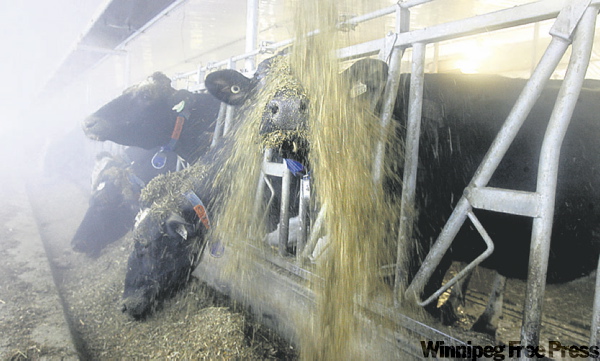
"The cows are on their own schedules and that creates a lot of cow comfort," David Wiens said this week while giving the Free Press a tour of his new 32,000-square-foot, $2-million dairy barn, a bright, roomy facility complete with cushioned-floor stalls, lots of fresh air and four large, automated rotating brushes that allow the cows to groom themselves.
Comfortable cows are more productive cows, Wiens said.
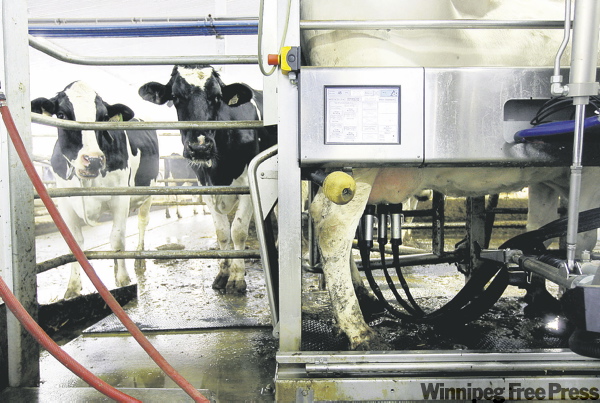
The main attraction, though, are the four robotic units in the centre of the barn that milk the 216 black and white Holsteins two to three times a day, around the clock.
Previously, the entire herd was milked twice a day using 14 milking machines — an effort that took three people six hours in total to accomplish.
Under the farm’s old milking system, when humans entered the barn in the morning or evening, all the cows would rise in anticipation of being milked. These days, though, the Wiens brothers and their staff — two full-time and two part-time — can enter the facility at any time, and the animals just carry on like they’re not there.
On Thursday morning, a couple of dozen cows were cued up to enter the milking area, while the rest were eating, lying in their stalls or being milked.
The cows wear transponders around their necks so that a computer can track their movements as they proceed through gates leading to stalls, feeding stations and the milking area that contains four robotic stations, each capable of milking 60 cows a day.
No more than 10 cows are allowed in the milking area at one time.
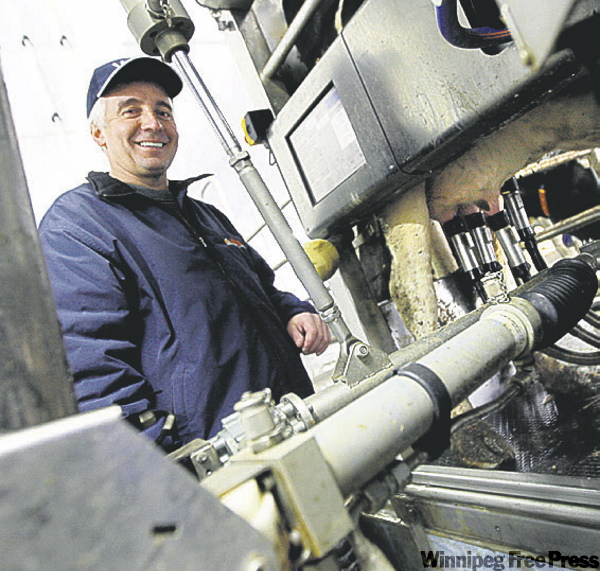
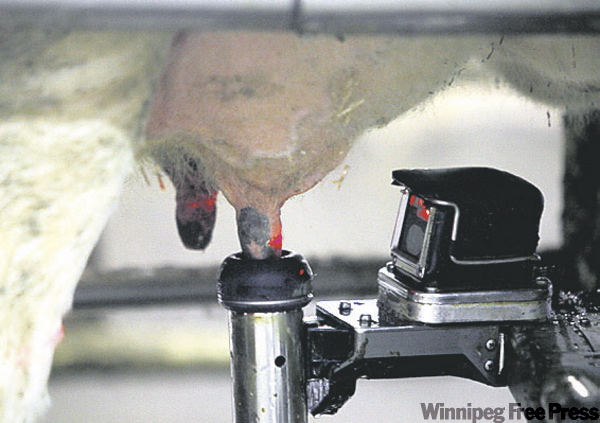
When a cow enters a milking station, it is fed a snack as a robotic arm washes and dries each of her four teats before hooking up the milking cups and hoses one after the other. This is done relatively quickly as the computer recalls each cow’s udder shape from previous milkings. When the milking is complete, the robot removes the hoses and sprays a disinfectant on the udder to ward off bacteria. A gate at the front of the milking station opens and the cow leaves.
Unlike human hands, the robotic arm is never hurried and always patient. The process never varies; there are no new handlers for the cow to become accustomed to. "Cows like to be treated the same every day…. They don’t like change. They like it less than we do," Wiens joked.
The computer keeps comprehensive stats on each cow, including how often she is milked — the Wiens herd average is 2.8 times a day — and how much is produced from each quarter of the udder. It flags any cow that hasn’t been milked in more than 12 hours and the production readouts and other data it collects help managers identify sick animals. It also prevents a cow from being milked more than once in a six-hour period, opening an alternate gate if an animal tries to sneak back into the milking station for another snack.
Clif Bakx, who operates a Grunthal business that designs, builds and equips dairy barns, said he’s sold 17 of the $200,000 Swedish-made robotic milkers to six Manitoba farms so far, and he has an order for four more units for two other farms.
"It’s taking off," Bakx said of the voluntary milking system, noting that another Manitoba supplier has also sold six or seven units of a competing brand.
"These units offer a tremendous labour-saving device," giving farmers more time to tend their herds and manage their business, rather than spending long tedious hours each day attaching milking machines, he said.
More importantly, said Bakx, a former dairy farmer, the robotic system allows animals to "go back to a more natural cycle" rather than having their day governed by twice-daily milkings and feedings.
Wiens, who is also chairman of the Dairy Farmers of Manitoba, said the new system has reduced the farm’s need for hired help — something that is sometimes hard to come by.
"We kept our herd management people. That’s key," he said. "This whole system milks cows, but you still have to manage cows."
larry.kusch@freepress.mb.ca
The facts
407 — the number of dairy farmers in Manitoba, compared with about 700 a decade ago.

83 — the average number of cows that are milked per farm, compared with about 55 in the late ’90s.
315 million litres — amount of milk produced last year in Manitoba.
$232 million — farm value of that milk.
4 — percentage of Canadian milk quota held by Manitoba dairy producers.
20-60 — number of litres of milk a dairy cow will produce in a day, depending on her lactation stage. The Manitoba average is about 30 litres per cow a day.