

Boeing 787 jetliner finally takes to the air
Advertisement
Read this article for free:
or
Already have an account? Log in here »
To continue reading, please subscribe:

Digital Subscription
One year of digital access for only $205*
- Enjoy unlimited reading on winnipegfreepress.com
- Read the E-Edition, our digital replica newspaper
- Access News Break, our award-winning app
- Play interactive puzzles
*First annual payment billed as $205.00 + GST for one year. This annual subscription will automatically renew at $233.00 + GST every 52 weeks (10% off the regular annual price of $259.35). Offer available to new and qualified returning subscribers only. Cancel any time.
To continue reading, please subscribe:
Add Free Press access to your Brandon Sun subscription for only an additional
$1 for the first 4 weeks*
- Enjoy unlimited reading on winnipegfreepress.com
- Read the E-Edition, our digital replica newspaper
- Access News Break, our award-winning app
- Play interactive puzzles
*Your next Brandon Sun subscription payment will increase by $1.00 and you will be charged $17.95 plus GST for four weeks. After four weeks, your payment will increase to $24.95 plus GST every four weeks.
Read unlimited articles for free today:
or
Already have an account? Log in here »
Hey there, time traveller!
This article was published 16/12/2009 (6093 days ago), so information in it may no longer be current.
EVERETT, Wash. — Boeing’s new 787 jetliner finally got airborne Tuesday, the long-delayed inaugural flight of the world’s first commercial plane constructed with half its components made from lightweight composite materials.
The sleek jet lifted off from Everett’s Paine Field on a flight over Washington state, beginning an extensive testing program needed to obtain Federal Aviation Administration certification.
"It’s very historical. I can’t think of a thing about it that I’m not impressed with," said Joe Bierce, a flight instructor for Delta Connection in Jacksonville, Fla., who was among the 25,000 people who gathered to watch the takeoff.
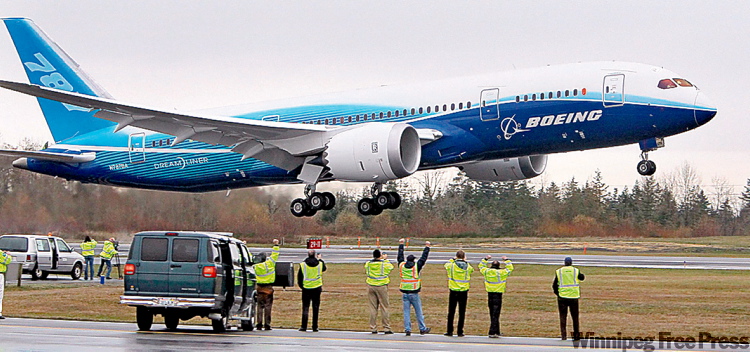
The two-member crew performed a variety of basic system checks, including testing the landing gear and the flaps, before landing at Seattle’s Boeing Field about three hours later. Deteriorating weather brought the plane back to earth about an hour earlier than planned.
"The airplane responded just as we expected," said Randy Neville, one of the two pilots. "It was a joy to fly."
Before takeoff, the aircraft paused for several minutes at the end of the runway while warming up its engines, adding to the tension for Boeing employees, customers and airline executives standing on the tarmac.
Although the runway was lined with fire trucks and other emergency vehicles, the first flight looked like a normal takeoff as the huge aircraft kicked up clouds of mist.
The plane is the first of six 787s Boeing will use in the nine-month flight-test program that will subject the planes to conditions well beyond those found in normal airline service.

Chicago-based Boeing, which has orders for 840 of the jets, plans to make the first delivery to Japan’s All Nippon Airways late next year.
The 787 is a radical departure in aircraft design. Where other passenger jets are made mostly from aluminum and titanium, about half of the 787 is made of lightweight composite materials such as carbon fibre.
Those materials have long been used on individual parts such as rudders, and on military planes, but the 787 is the most ambitious use of the technology aboard a passenger plane.
Boeing says the aircraft will be quieter, produce lower emissions and use 20 per cent less fuel than comparable planes.
— The Associated Press