

Downtown bastion moves to strip mall
Advertisement
Read this article for free:
or
Already have an account? Log in here »
To continue reading, please subscribe:

Digital Subscription
One year of digital access for only $205*
- Enjoy unlimited reading on winnipegfreepress.com
- Read the E-Edition, our digital replica newspaper
- Access News Break, our award-winning app
- Play interactive puzzles
*First annual payment billed as $205.00 + GST for one year. This annual subscription will automatically renew at $233.00 + GST every 52 weeks (10% off the regular annual price of $259.35). Offer available to new and qualified returning subscribers only. Cancel any time.
To continue reading, please subscribe:
Add Free Press access to your Brandon Sun subscription for only an additional
$1 for the first 4 weeks*
- Enjoy unlimited reading on winnipegfreepress.com
- Read the E-Edition, our digital replica newspaper
- Access News Break, our award-winning app
- Play interactive puzzles
*Your next Brandon Sun subscription payment will increase by $1.00 and you will be charged $17.95 plus GST for four weeks. After four weeks, your payment will increase to $24.95 plus GST every four weeks.
Read unlimited articles for free today:
or
Already have an account? Log in here »
Hey there, time traveller!
This article was published 08/05/2010 (5921 days ago), so information in it may no longer be current.
Some were aghast at the news. Others, perhaps, smiled a little smugly.
A few might have even rolled over in their graves at the irony of an organization that put Winnipeg at the centre of the global grain trade a century ago retreating to a strip mall.
The former Winnipeg Grain and Produce Exchange, which later became the Winnipeg Grain Exchange, the Winnipeg Commodity Exchange and now ICE Futures Canada, a subsidiary of Intercontinental Commodity Exchange, will vacate its downtown office tower next month and move to Pembina Highway across from Price Choppers.
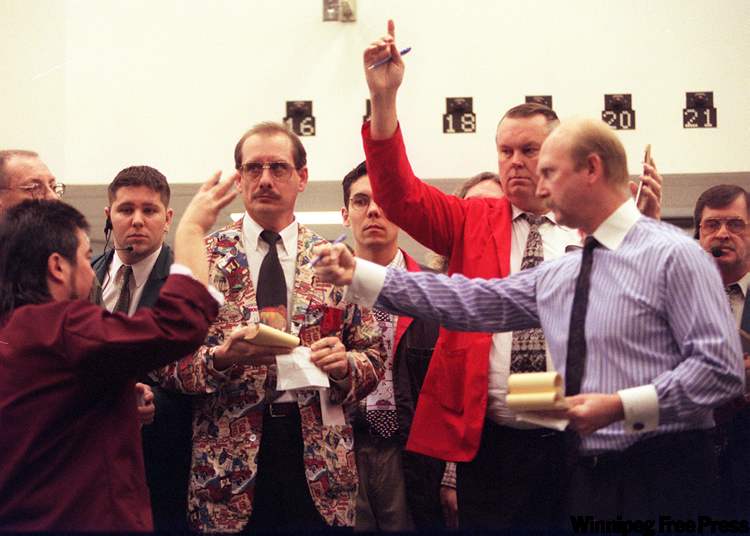
The move’s significance is more symbolic than anything else. The WCE ceased to exist as a stand-alone exchange when its members sold out to ICE in 2007. Some will say the exchange lost its mojo when it became the first in the world to switch to an electronic trading platform in 2004.
Business has boomed since, but it meant the end of the trading floor, where traders — usually men dressed in odd-coloured jackets — could trade tens of thousands of dollars worth of grain with a flick of their fingers.
Back in its heyday, these flamboyant characters with a reputation for being high rollers filled the downtown core. They represented the line companies that sourced grain from the farmers, the export players and the domestic processors all seeking to protect themselves from fluctuations in prices between the time they bought grain and sold it again. And of course there were the speculators, evil in the eyes of many farmers, but necessary for taking on that risk.
Sometimes the two agendas got a little mixed up. In the 1980s, there was a series of scandals involving traders who defrauded their companies or farmer clients. Fallout from some being on the wrong side of the market after the 1986 Chornobyl nuclear disaster led to prosecutions and jail time for several traders.
Still others trace the roots of the grain exchange’s demise back to the 1930s when the federal government caved to protests and established the Canadian Wheat Board with its single desk and orderly marketing.
That set in motion a debate that carried over from generation to generation, as farmers — egged on by the private grain trade — argued whether orderly marketing or the open market captured value better.
It was often said that the Winnipeg Exchange was forever crippled by the removal of wheat, barley and oats from the open market with the establishment of the CWB.
Yet although domestic feed oats were traded on the WCE for all the years the board had control over exports, oats disappeared from the Winnipeg trading board soon after the crop was returned to the open market in 1989. Oat processors are in the U.S. and preferred to do their trading on the Chicago Board of Trade.
If truth be told, the two marketing systems were remarkably compatible. Many farmers like the security of pooled pricing for some commodities, along with an open market for others.
For all of the board bashing, many of these same companies did well acting as export agents for the board. Some would argue these companies, small players by global standards, owe their very existence to it.

Over time, the grain industry has consolidated and it’s now often the same multinational companies doing the buying, exporting, and processing. Moving to an electronic trading platform made it easier for outside interests to be in the market, providing the liquidity from non-traditional players such as commodity funds.
But computerized trading means people are no longer needed to execute the trades, which means there is no longer a need for the commodity exchange to have as many staff keeping an eye on things. As well, when the nameless, faceless trades are originating in Geneva, Bangkok or New York, and when they are trading grain today and currencies tomorrow, it doesn’t much matter where the exchange is located.
Given our Prairie history, some will delight that the wheat board still stands on Main Street, bruised but not yet broken, while its archrival, the grain exchange, has been banished to the suburbs.
It’s all very practical, but it marks the end of a long and colourful chapter in Winnipeg’s history.
Laura Rance is editor of the Manitoba Co-operator. She can be reached at 792-4382 or by email laura@fbcpublishing.com