

Hutterites not afraid of change
Colonies turn to non-ag industries as province's hog market slumps
Advertisement
Read this article for free:
or
Already have an account? Log in here »
To continue reading, please subscribe:

Digital Subscription
One year of digital access for only $205*
- Enjoy unlimited reading on winnipegfreepress.com
- Read the E-Edition, our digital replica newspaper
- Access News Break, our award-winning app
- Play interactive puzzles
*First annual payment billed as $205.00 + GST for one year. This annual subscription will automatically renew at $233.00 + GST every 52 weeks (10% off the regular annual price of $259.35). Offer available to new and qualified returning subscribers only. Cancel any time.
To continue reading, please subscribe:
Add Free Press access to your Brandon Sun subscription for only an additional
$1 for the first 4 weeks*
- Enjoy unlimited reading on winnipegfreepress.com
- Read the E-Edition, our digital replica newspaper
- Access News Break, our award-winning app
- Play interactive puzzles
*Your next Brandon Sun subscription payment will increase by $1.00 and you will be charged $17.95 plus GST for four weeks. After four weeks, your payment will increase to $24.95 plus GST every four weeks.
Read unlimited articles for free today:
or
Already have an account? Log in here »
Hey there, time traveller!
This article was published 29/05/2010 (5891 days ago), so information in it may no longer be current.
A few years ago, before the bottom fell out of the hog market, the Airport Hutterite colony near Portage la Prairie invested more than a million dollars in a manufacturing venture.
Unfortunately, the idea was to build precast components for hog barns and that business suffered when hog prices collapsed more than two years ago.
"Whatever money we invested, which was millions, has done nothing for us," said Jake Hofer, farm boss at the Airport colony. "We have managed to hold our own, but what we have had to do was learn how to put more water in the soup to survive and at the same time, we have dropped into debt a little more."
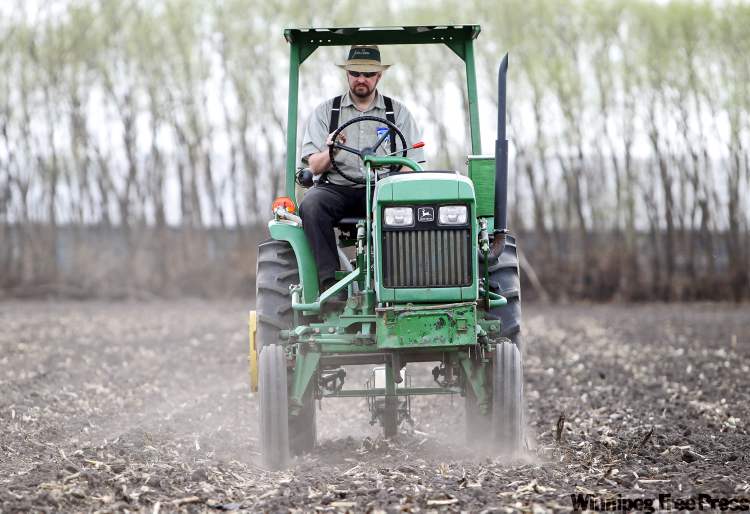
But the Airport colony’s foray into business outside the agri-food sector is not uncommon for Hutterite colonies, according to a new study by the Calgary consulting firm, Blacksheep Strategy, called Understanding Business on the Colony.
According to Sharon Barker, director of research at Blacksheep, more than 33 per cent of the more than 300 Hutterite colonies in Manitoba, Saskatchewan and Alberta are now engaged in some sort of non-agricultural business. Although manufacturing was not very successful for the 90-person Airport colony, its agri-food businesses have held their own. After the poor results of its manufacturing venture, the colony invested more in poultry and dairy operations and now that hog prices are coming back — they are up about 15 per cent over last year — the colony can continue to rely on its vaunted Hutterite productivity when it comes to agricultural production.
"We maintained our hog operation (through the market slump)," Hofer said. "We did not slow it down, we waited for the turnaround. We’re clapping with both hands now."
Barker said Blacksheep’s interest in Hutterite colony operations was partly to compare issues and interests on the colonies to other large acreage farmers. She said among other things, large mainstream farms have ongoing labour concerns because it is often difficult to find experienced, skilled workers for temporary employment.
"The opposite is true on the colonies where they have plenty of labour," Barker said. "It’s all about keeping people employed on the colonies. That is their goal, to keep everyone working and productive. They are looking for ways to do that and it may not be directly related to the farm."
While Hutterites are as cost-conscious as any other savvy business operator, Barker said colonies may place more emphasis on establishing a personal relationship with outsiders they do business with than might be the case with other large-scale farming operations.
As if to emphasize that point, Tim Waldner, manager of the fire engine production shop at the Green Acres Hutterite colony south of Brandon, urged a reporter to "sit down" with colony elders as opposed to doing an interview over the phone.
But a story last year in the Free Press on Green Acres’ growing fire truck business indicated business was directly related to the colony’s need to diversify out of ag-related enterprises.
Ron Kroeker, a senior associate at Blacksheep, said sometimes the Hutterites’ fundamental religious beliefs will override economic opportunities.
He said a colony in Alberta, where strict practices exist when it comes to electronic communication influences, hired an outsider to establish an Internet presence for its plastics business, even though the colony does not allow Internet usage.
Barker made it clear there were different trends in Hutterite businesses across the Prairies, with Manitoba colonies typically being the most progressive in just about every respect.
While there is a move to diversify, there is still a high degree of reliance on the ag sector. For instance, more than 70 per cent of Manitoba colonies have stuck it out in the hog industry.
The Starlite colony near Starbuck is considered a particularly prosperous colony. But when asked how business was, a member of the colony said in no uncertain terms its hog business was struggling.
Andrew Dickson, general manager of the Manitoba Pork Council, said Hutterite colonies account for 25 to 30 per cent of provincial hog production. While the total provincial production numbers are down about 10 per cent, the Hutterite contribution to the total has not changed.
He said some closed their hog barns through the downturn, but many of those have reopened as prices are rising.
Dickson said the shift to non-ag businesses on Hutterite colonies is not just about poor commodity prices. It also has something to do with the fact Hutterite colonies are avid users of production technology.
"The technology replaces labour and so they have had to seek out other businesses to use the labour on the colony," he said.
For instance, the Crystal Spring colony near Ste. Agathe is developing equipment for the hog industry and the Rock Lake colony near Grosse Isle has invested in laser cutters and is now in the metal-cutting business.
Others are doing carpentry, cabinet-making and the folks at Green Acres are making fire trucks.
Even though Airport colony’s precast barn component business may not have worked, the trend at Hutterite colonies, where agricultural businesses have been characterized by high productivity, is for even more non-ag related business.
martin.cash@freepress.mb.ca
Prairie Hutterites
30,000-plus — number of Hutterites living on colonies in the three Prairie provinces

105 — number of Hutterite colonies in Manitoba
170 — number of Hutterite colonies in Alberta
60 — number of Hutterite colonies in Saskatchewan
3,000 to 4,000 acres — average crop acreage per colony in Manitoba
About 120 — average population size per Manitoba colony