

Game for mission in space
City firm leads team developing multi-player online program
Advertisement
Read this article for free:
or
Already have an account? Log in here »
To continue reading, please subscribe:
Monthly Digital Subscription
$1 per week for 24 weeks*
- Enjoy unlimited reading on winnipegfreepress.com
- Read the E-Edition, our digital replica newspaper
- Access News Break, our award-winning app
- Play interactive puzzles
*Billed as $4.00 plus GST every four weeks. After 24 weeks, price increases to the regular rate of $19.95 plus GST every four weeks. Offer available to new and qualified returning subscribers only. Cancel any time.
Monthly Digital Subscription
$4.99/week*
- Enjoy unlimited reading on winnipegfreepress.com
- Read the E-Edition, our digital replica newspaper
- Access News Break, our award-winning app
- Play interactive puzzles
*Billed as $19.95 plus GST every four weeks. Cancel any time.
To continue reading, please subscribe:
Add Free Press access to your Brandon Sun subscription for only an additional
$1 for the first 4 weeks*
*Your next subscription payment will increase by $1.00 and you will be charged $16.99 plus GST for four weeks. After four weeks, your payment will increase to $23.99 plus GST every four weeks.
Read unlimited articles for free today:
or
Already have an account? Log in here »
Hey there, time traveller!
This article was published 24/07/2010 (5763 days ago), so information in it may no longer be current.
The year is 2035.
Humankind has started settling the solar system and it will take some math and science skills to manoeuvre your way into your new digs on Mars or the moon.
But Winnipeggers will have a crucial leg up in the process.
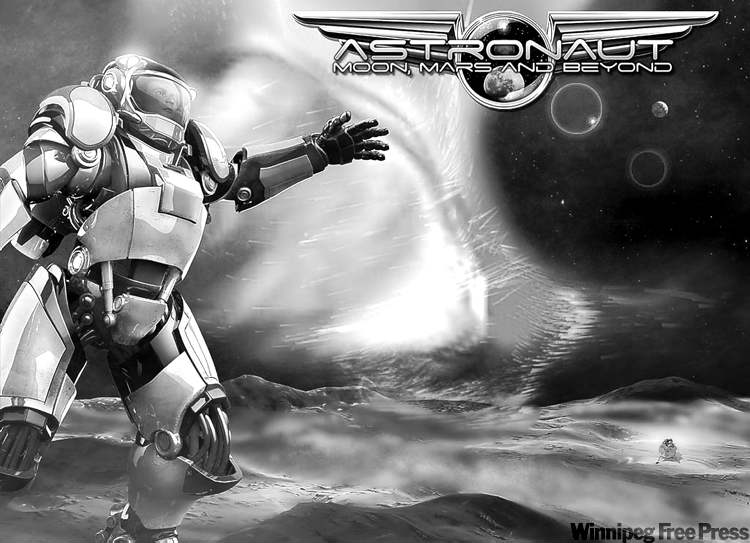
That’s because Khal Shariff and his team at Project Whitecard Inc. are one of the three partners creating a realistic virtual world for an online space discovery educational game that has full endorsement, sponsorship and support of NASA.
In a couple of weeks, Project Whitecard and its two U.S. partners will sign a major contract with NASA, laying out the final details of an association with the massive U.S. space agency to develop an MMO (massively multi-player online) game called Astronaut: Moon, Mars and Beyond.
The project — which could require as much as $12 million in development costs over the next two and a half years — is the brainchild of Shariff, a serious game developer (as opposed to purely entertaining games) who started Project Whitecard in Winnipeg in 2008.
The Winnipeg company and its two partners from Indiana and North Carolina beat out 170 other submissions in a competition for NASA and are now about to embark on a project that could become the benchmark for educational serious games in the future.
Shariff has developed a reputation as a brilliant and creative developer with an expanding global network including the likes of Richard Garriott, a pioneer in space tourism and a legendary game developer and producer.
Gary Brownstone, director of the Smartpark business incubator Eureka Project, where Project Whitecard is a tenant, has advised the company for a couple of years.
“Khal is such a bright guy, I think he lives in a different space than the rest of us,” Brownstone said.
Shariff has said he can imagine up to 10 million people playing the game.
But in an effort to inject a more conservative tone to the expectations, Brownstone said, “Everyone dreams of creating the next World of Warcraft (the largest MMO game on the market). But even with one million users, they could be talking about annual revenue of about $85 million.”
The actual commercial plan has not yet been devised, but Shariff said they are thinking of subscription fees of $5 to $7 a month.
As a comparison, World of Warcraft fees are about $20 a month and it has close to 12 million subscribers worldwide.
Shariff and his seven-person staff have already established a reputation in the serious game field after playing a major role in the design and production of Canada Space Agency’s Robomath game that is now being used by one million students in Canada.
Daniel Laughlin, project manager at NASA Learning Technologies, part of NASA’s Goddard Space Flight Center in Greenbelt, Md., is the senior NASA official attached to the project.
“Khal is a very bright and passionate guy,” he said.
NASA will be committing significant resources to help develop the project and it will have the right to vet it before it’s released. But it is not helping to pay the costs of development. That will be up to Project Whitecard and its partners — Virtual Heroes of Raleigh, N.C. and Wisdom Tools of Bloomington, Ind., both small companies themselves.
Although Shariff doesn’t know where that money is coming from right now, he doesn’t expect it will be a problem.
For instance, Discovery Channel Canada has already been involved and Shariff is meeting a major publisher in New York next week who has expressed interest in novelizing the game. The group will also source research and development grants in Canada and the United States.
“There are a lot of people who have already expressed interest in supporting the project,” he said.
Brownstone said, “They won’t need a lot of users to be profitable. There could be a fairly quick return on investment.”
Sonny Kirkley, president of Wisdom Tools, whose company specializes in educational software, said NASA is one of the most respected brands in the world and should help generate a buzz.

“The assumption is that this will be big,” Kirkley said. “NASA doesn’t want something that only a few thousand people are using.”
As for NASA, Laughlin has said in the past “We want to create a fun, compelling gaming experience that will give players the chance to learn about science and engineering careers while they play the game. NASA is committed to attracting more students to science, technology, engineering and mathematics fields of study and careers. We hope this game will inspire players to consider those careers.”
martin.cash@freepress.mb.ca
Serious gaming
in Winnipeg
— Among other things, Project Whitecard’s Khal Shariff wants to turn Winnipeg into a hotbed of serious gaming activity. “We’re already there to some extent,” he said.
— Project Whitecard has grown from three employees 18 months ago to seven right now.
— Eventually, Shariff hopes to have about 12 people in Winnipeg working on Astronaut: Moon, Mars and Beyond.
— The province’s 40 per cent tax credit on game development costs could attract even greater numbers.
Astronaut: Moon, Mars and Beyond
— Development costs for the game
are estimated by Shariff at $5 million to $12 million.

— Users pick a profession like space geologist, astrobiologist or mechanical engineer and then work together to complete a mission such as figuring out the quickest way to get to Mars.
— The game will operate as a meritocracy where understanding the science will allow the players to use the technology to get ahead.
— Shariff describes the environment at the space station part of the game as “Hogwarts in space,” in reference to the wizard academy in the Harry Potter books.
— NASA will share details on technology like jet propulsion and on space geography like the topography of the moon and Mars, to make the game as realistic as possible.
— The data centre that will be needed to manage the online activity for AMM&B will have the same power as an airline ticket reservation system.