

New hospital innovative, warm
Cutting-edge techniques will make Women's and Newborn Hospital neighbourhood-friendly
Advertisement
Read this article for free:
or
Already have an account? Log in here »
To continue reading, please subscribe:
Monthly Digital Subscription
$1 per week for 24 weeks*
- Enjoy unlimited reading on winnipegfreepress.com
- Read the E-Edition, our digital replica newspaper
- Access News Break, our award-winning app
- Play interactive puzzles
*Billed as $4.00 plus GST every four weeks. After 24 weeks, price increases to the regular rate of $19.95 plus GST every four weeks. Offer available to new and qualified returning subscribers only. Cancel any time.
Monthly Digital Subscription
$4.99/week*
- Enjoy unlimited reading on winnipegfreepress.com
- Read the E-Edition, our digital replica newspaper
- Access News Break, our award-winning app
- Play interactive puzzles
*Billed as $19.95 plus GST every four weeks. Cancel any time.
To continue reading, please subscribe:
Add Free Press access to your Brandon Sun subscription for only an additional
$1 for the first 4 weeks*
*Your next subscription payment will increase by $1.00 and you will be charged $16.99 plus GST for four weeks. After four weeks, your payment will increase to $23.99 plus GST every four weeks.
Read unlimited articles for free today:
or
Already have an account? Log in here »
Hey there, time traveller!
This article was published 13/06/2011 (5433 days ago), so information in it may no longer be current.
The biggest health-care building ever built in the province boasts an award-winning design that’s not only more neighbourhood-friendly, but could help lead to the eventual commercialization of a made-in-Manitoba building technology.
Construction hasn’t even begun yet on the $150-million-plus, 300,000-square-foot Women’s and Newborn Hospital and it’s already won a 2010 Award of Excellence from Canadian Architecture Magazine.
The five-storey building’s eye-popping exterior features include a curtain wall with a picture of an elm-tree canopy digitally printed on the glass, shingle-styled zinc cladding, “playfully angled” support columns and a fabric-formed concrete canopy and landscape planters at the front entranceway.
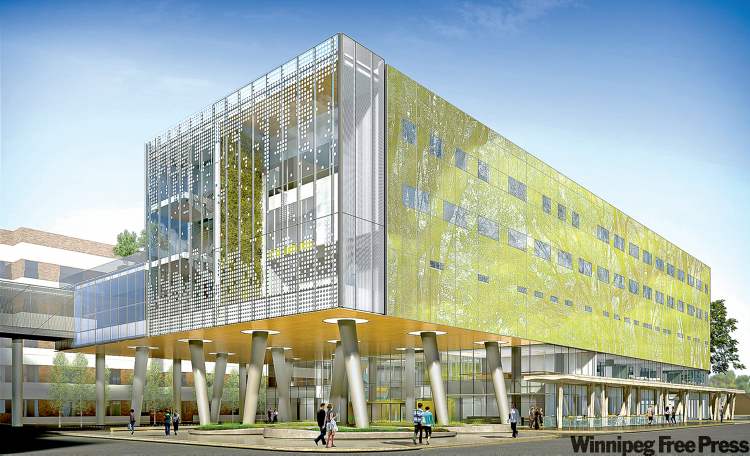
“The design intent was to make the hospital more sympathetic to the residential area it neighbours with,” said Doug Corbett, design principal with the lead architecture firm on the project — Smith Carter Architects and Engineers Inc. “I call it socially responsible architecture.”
Construction is expected to get underway this summer, with completion in the fall of 2014.
Because of its size, Corbett said residents on Elgin Avenue were worried their homes would be dwarfed by the massive L-shaped facility, which will be built on Sherbrook Street between William Avenue and Elgin.
To address those concerns, the architects came up with a building design that incorporates materials or designs that relate to the existing scale, texture and character of the neighbourhood. The glass wall curtain wall mimics the stately elm trees in the neighbourhood, and the design on the zinc cladding is a nod to the shingle accent walls found on some of the nearby homes.
The Elgin side of the building will also be set 4.5 metres back from the sidewalk, with a tapered facade to preserve sunlight and reduce the scale of the building.
To further enhance the “human scale” of the building, the architects have added a sculptured concrete canopy and sculptured landscape planters at the front entranceway. They’ll be made using a construction technique called fabric-forming, which was developed by researchers at the University of Manitoba’s Centre for Architectural Structures and Technology (CAST).
The technique, with which the centre has been experimenting for more than a decade, has already been used in a handful of projects outside of Manitoba. It was also used to make the distinctive support columns at the front of the Manitoba Theatre for Young People building at The Forks.
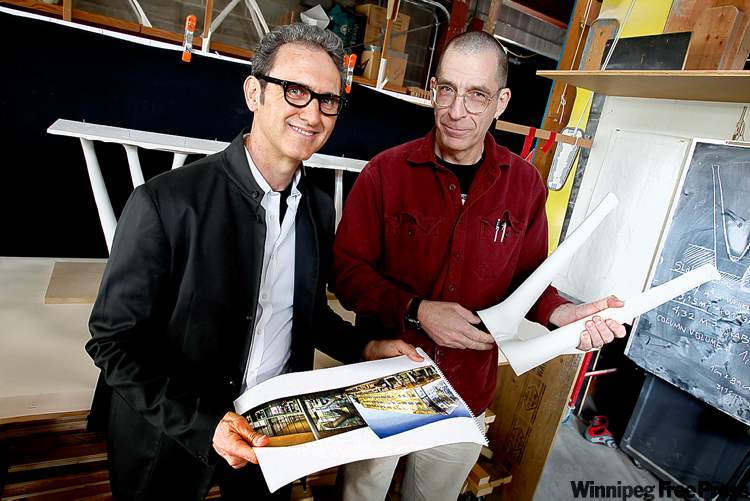
Corbett and CAST director Mark West get downright poetic when describing the curved, rippling, and bulging geometric shapes that can be achieved when fabric-forming is used for things like concrete support columns, planters and curtain walls.
“They’re drop-dead beautiful,” West said during a recent visit to the CAST research facility on the U of M campus. “They’re deep, natural symmetries.”
And Corbett tosses in terms like “elegant” and “sensual” to describe the shapes, saying they give people a new appreciation for the potential beauty of concrete as a building material.
West, who teaches architecture at the U of M, said the technique has already captured the attention of some of the world’s leading architects and engineers. This week, he’s flying to England to meet architect Norm Foster of Foster & Partners.
“It’s like being called to see the prince,” he said, adding he’s also got meetings lined up with some prominent U.S. architects.
European engineers are also interested in the technique because it takes a lot less concrete and steel rebar to make a fabric-formed concrete beam than a conventional, rectangular-shaped one.
“They think they can save 30 per cent on the concrete and 40 per cent on the steel,” he said.
Lafarge Canada’s precast division will manufacture the canopy and support beams for the new hospital, using CAST’s fabric forms. General manager Peter Schuster said if the technique works, Lafarge will look at using it to produce other building components.
“It’s an architectural feature and a structure at the same time,” he said.
The planters will be built by Barkman Concrete. Although Lafarge has been working with CAST for years, this is Barkman’s first project with the centre.
Product development specialist Cal Schellenberg said if the technique works well for planters, Barkman will look at using it to make other custom-designed landscaping products, such as outdoor benches and retaining walls. They could be sold to landscaping firms and possibly even homeowners.
“It allows you to do shapes that are really not that feasible with any other mediums,” Schellenberg said. “But it’s one step at a time. First we have to learn how to well, and then take it from there.”
Know of any newsworthy or interesting trends or developments in the local office, retail, or industrial real estate sectors? Let real estate reporter Murray McNeill know at the e-mail address below, or at 697-7254.
murray.mcneill@freepress.mb.ca
Unique process

Here’s how the fabric-forming technique works:
Instead of using a rigid form made of wood, steel or fibreglass, the wet concrete is poured into a form made from polypropylene fabric, which is similar to landscaping fabric.
Because is the fabric is flexible, the concrete will naturally form into a variety of esthetically pleasing geometric shapes that can curve, ripple or bulge. The fabric acts as a membrane and holds the concrete in place until it dries, after which it can be removed.
Instead of winding up with a solid, rectangular-shaped beam or pillar, you can end up with one that’s curved or bulging. Or it can be thick in the middle (where most of the weight will be) and tapered at the ends.
The University of Manitoba’s Centre for Architectural Structures and Technology (CAST) has also been experimenting with ideas such as Y-shaped support columns and concrete curtain walls that look like drapes.