

Roll up the barbed-wire fence, farmers
Managing herds is now a science

Advertisement
Read this article for free:
or
Already have an account? Log in here »
To continue reading, please subscribe:
Monthly Digital Subscription
$1 per week for 24 weeks*
- Enjoy unlimited reading on winnipegfreepress.com
- Read the E-Edition, our digital replica newspaper
- Access News Break, our award-winning app
- Play interactive puzzles
*Billed as $4.00 plus GST every four weeks. After 24 weeks, price increases to the regular rate of $19.95 plus GST every four weeks. Offer available to new and qualified returning subscribers only. Cancel any time.
Monthly Digital Subscription
$4.99/week*
- Enjoy unlimited reading on winnipegfreepress.com
- Read the E-Edition, our digital replica newspaper
- Access News Break, our award-winning app
- Play interactive puzzles
*Billed as $19.95 plus GST every four weeks. Cancel any time.
To continue reading, please subscribe:
Add Free Press access to your Brandon Sun subscription for only an additional
$1 for the first 4 weeks*
- Enjoy unlimited reading on winnipegfreepress.com
- Read the E-Edition, our digital replica newspaper
- Access News Break, our award-winning app
- Play interactive puzzles
*Your next Brandon Sun subscription payment will increase by $1.00 and you will be charged $17.95 plus GST for four weeks. After four weeks, your payment will increase to $24.95 plus GST every four weeks.
Read unlimited articles for free today:
or
Already have an account? Log in here »
Hey there, time traveller!
This article was published 27/08/2011 (5372 days ago), so information in it may no longer be current.
Anyone who has ever wrestled an old barbed-wire fence out of the bushes can appreciate why the native Americans dubbed it the “devil’s rope” when 19th-century ranchers first started using it to keep their cattle in — and the nomads out.
When attached to fence posts as intended, the line of twisted wires interspersed with sharp barbs does a stellar job of keeping critters on one side or the other.
It’s when it becomes forgotten and loose, partially buried in undergrowth and embedded into tree trunks that this kind of fence becomes evil — a nearly invisible trap that pierces and tears into the flesh any passersby, be they human or beast.
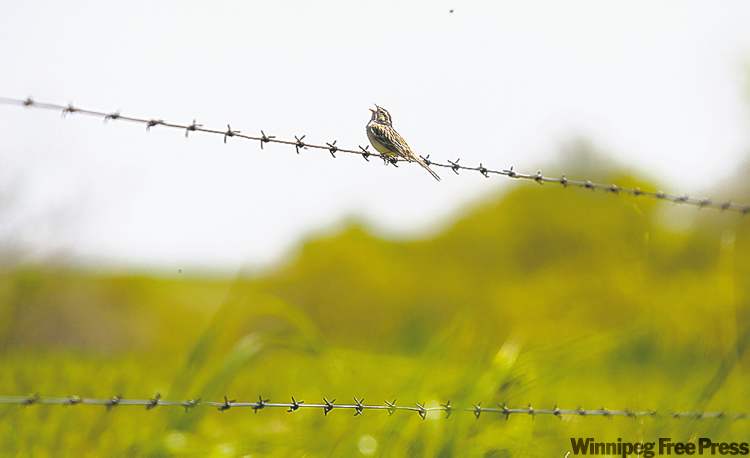
Aside from making its Dekalb, Ill., inventor Joseph Glidden one of the richest men in North America by the early 1900s, barbed wire played a pivotal role in settling the continent’s vast frontiers, which didn’t have electricity and were largely treeless.
If railways have opened up the West, then it was the barbed wire that fenced it in again, this time in the hands of homesteaders looking to stake their claim on lands where people and animals once roamed freely.
Some even argue it became a political symbol, an instrument of war in the hands of Nazis, who used it extensively in their effort to subjugate Europe and massacre Jews.
Of course, Glidden had no inkling of how his invention might be used when he modified a coffee-bean grinder in 1874 to bend wire into barbs, which were then held in place by two smooth wires twisted together. Legend has it he was trying to protect his wife’s garden. It worked so well, he patented it.
As inventions go, his has stood the test of time remarkably unchanged from its original design. But even though you can still buy barbed wire in the fencing department of farm-supply stores, fencing technology and culture has changed so much it is gradually becoming obsolete.
Permanent fencing nowadays is more apt to be high-tensile wire, which may or may not be electrified. Temporary, portable fencing is also gaining favour as producers explore methods of pasturing animals well into winter.
Herd management has changed dramatically from the days when stock was turned out to freely wander the available space. An increasing number of producers now practise intensive rotational systems to increase the lifespan and carrying capacity of their pastures.
Cattle, like kids, are picky eaters. If given the chance, they’ll eat what they like and leave what they don’t, even if it’s good for them. Over time, the tasty plants are nibbled out of existence and the less palatable plants, as well as invasive weeds, are free to flourish and take over.
Confining the cattle into smaller areas for short bursts of feeding forces them to clean up their plates, so to speak, before moving on to fresh pasture. Solar-powered electric fencers and watering systems provide tremendous flexibility for graziers, some of whom are even temporarily fencing in annual cereal crops planted specifically to extend the forage season.
Extended grazing not only reduces production costs, it cuts down on the labour involved with hauling feed to animals and then hauling the manure away.
And it recycles nutrients back onto the land where they can do some good as opposed to stockpiling them in environmentally suspect feedlot manure piles.
One of the institutions that has helped guide this move toward extended grazing is almost as old as barbed wire itself.
Agriculture and Agri-Food Canada’s Brandon Research Centre has just celebrated the 125th anniversary of its establishment in 1886. One of the original five research farms created by the federal government, the Brandon station has been one of the leaders in developing grazing strategies that keep cattle well-fed on the range instead of eating harvested hay in a feedlot through the winter.
Ongoing research is demonstrating how cattle producers can effectively manage high-quality perennial forages such as alfalfa in their grazing systems, as well as annual crops such as barley, triticale or millet.

Research manager Byron Irvine said many of the species used in conventional grazing systems produce a flush of lush nutritious growth in the early spring, but not much afterwards. Researchers have been looking at species that can provide that kind of quality later in the season.
It’s all about helping producers farm more profitably while having less impact on the environment.
And if it happens to relegate barbed wire to a museum display, thank goodness for that.
Laura Rance is editor of the Manitoba Co-operator. She can be reached at 792-4382 or by email: laura@fbcpublishing.com.
Laura Rance is editorial director at Farm Business Communications.
Our newsroom depends on a growing audience of readers to power our journalism. If you are not a paid reader, please consider becoming a subscriber.
Our newsroom depends on its audience of readers to power our journalism. Thank you for your support.
Laura Rance is editorial director at Farm Business Communications.
Our newsroom depends on a growing audience of readers to power our journalism. If you are not a paid reader, please consider becoming a subscriber.
Our newsroom depends on its audience of readers to power our journalism. Thank you for your support.
Advertisement Advertise With Us
Advertisement Advertise With Us