

Not your average keyboard
Advertisement
Read this article for free:
or
Already have an account? Log in here »
To continue reading, please subscribe:
Monthly Digital Subscription
$1 per week for 24 weeks*
- Enjoy unlimited reading on winnipegfreepress.com
- Read the E-Edition, our digital replica newspaper
- Access News Break, our award-winning app
- Play interactive puzzles
*Billed as $4.00 plus GST every four weeks. After 24 weeks, price increases to the regular rate of $19.95 plus GST every four weeks. Offer available to new and qualified returning subscribers only. Cancel any time.
Monthly Digital Subscription
$4.99/week*
- Enjoy unlimited reading on winnipegfreepress.com
- Read the E-Edition, our digital replica newspaper
- Access News Break, our award-winning app
- Play interactive puzzles
*Billed as $19.95 plus GST every four weeks. Cancel any time.
To continue reading, please subscribe:
Add Free Press access to your Brandon Sun subscription for only an additional
$1 for the first 4 weeks*
*Your next subscription payment will increase by $1.00 and you will be charged $16.99 plus GST for four weeks. After four weeks, your payment will increase to $23.99 plus GST every four weeks.
Read unlimited articles for free today:
or
Already have an account? Log in here »
Hey there, time traveller!
This article was published 25/10/2011 (5197 days ago), so information in it may no longer be current.
Randy Marsden started making computer-assisted devices for people with disabilities while studying engineering at the University of Alberta in 1987, winning accolades for a technology he developed to help a paralyzed friend speak by touching his lips to a switch that communicated with a keyboard. Turning down job offers, he founded Medantec Inc. in 1989 in Edmonton. It licensed its onscreen keyboard software to Microsoft, and it now comes with every copy of Windows. After a name change in 2009 to Cleankeys Inc., it began focusing on making and selling a one-wipe-clean wireless keyboard, marketed as a means for dentists to control the spread of bacteria. The company has sold more than 10,000 of the keyboards since they hit the market in February 2010. Cleankeys chief executive Marsden spoke with the Financial Post’s Christine Dobby about how his team came up with this surprising solution to an infection threat. The following is an edited transcript of their conversation.
Q. Your company has a history of making assistive technologies for people with disabilities. How did your current product evolve from that?
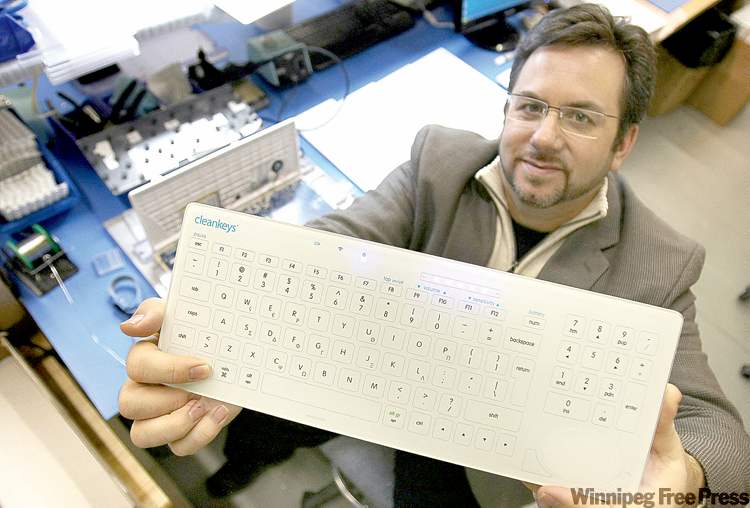
A. A dentist purchased a head-tracking camera we made for people with disabilities to use with their mouth. We asked why he was buying it, since he had use of his hands, and he explained that every time he uses a mouse in his treatment room, he has to take his gloves off, otherwise he’d be transferring blood and saliva to it, which could then get cross-contaminated with the next patient.
Most dentists now have digital X-ray systems, which means there’s a keyboard and a computer right next to the patient. All of that has to be wiped down and disinfected between every patient, so this dentist was trying to avoid the mouse problem by using our head-tracking camera.
Once we understood the problem we said, “What about the keyboard?” The problem with the keyboard is it has mechanical keys and there’s space between each one, which makes it almost impossible to clean, especially often and thoroughly.
We’d been working in this world of onscreen keyboards and we know about things like disambiguation and different ways of entering text, so we came up with the idea of using a touch surface to type on, much like what tablets and smartphones have. But if it’s just a touch-sensitive surface, then it registers a key event and types every time you rest your fingers. So we put vibration sensors in the keyboard as well, and now the user can rest their fingers.
We have the only touch-sensitive surface in the world that you can rest your fingers on, and we have a patent pending on that idea in Europe, Canada, the United States, Japan, China, Brazil, Australia, India — most of the developed world.
Q. What are your main markets for the keyboard?
A. We’ve been selling primarily to dentists, but I think very quickly that will become one of many markets. We’re looking at hospitals as our next market, and that has to do with the cost of lives: 100,000 people a year die from hospital-acquired infections in North America, which is staggering.
Infection control is what this is all about.
About 75 per cent of our sales are in Europe, because there are much stricter regulations and much more awareness in the dental and medical fields that infection control is important.
A lot of dentists in North America are doing nothing; they’re just taking the risk and leaving the keyboard uncovered. So it’s an education process (to help them understand) they’re putting themselves and their patients at risk.
Q. Your other products have had non-medical applications. What about the keyboard?
A. We’ve already sold to food-processing plants. There’s also heavy-industrial situations where keyboards are getting mucked up with dirt or metal filings, as well as public kiosks, laboratories, clean rooms and just about every home with a toddler.
We believe as we start developing the keyboard further, bringing its price point down and increasing volumes, there will be a mainstream use for this.
Q. Have there been any hurdles in getting the product out?
A. We’ve had manufacturing challenges, because the keyboard has to be completely sealed and waterproof and there’s no screws in it. We’ve found we can’t just go out to the world and say, “Here, print on this,” because no one’s really done it before, so we’ve had to invent the process as we’ve gone along.

The keyboard retails to dentists for $399, and I see that price changing as we grow our market. That price point won’t be supported in the consumer world, but over time we expect it to come down as we increase volume and find ways to manufacture it for less money.
Sales and marketing can also be a challenge. A lot of people view this as a keyboard, and they go down to Best Buy and see they can buy a keyboard for $20.
It’s really meant to be an infection-control solution, but it’s difficult for people not to look at it as a keyboard, so we have to get that message out.
— Postmedia News