

His eggs going in organic basket
Steinbach producer following demand
Advertisement
Read this article for free:
or
Already have an account? Log in here »
To continue reading, please subscribe:
Digital Subscription
One year of digital access for only $1.44 a week*
- Enjoy unlimited reading on winnipegfreepress.com
- Read the E-Edition, our digital replica newspaper
- Access News Break, our award-winning app
- Play interactive puzzles
*Billed as $5.77 plus GST every four weeks. After 52 weeks, price increases to the regular rate of $19.95 plus GST every four weeks. Offer available to new and qualified returning subscribers only. Cancel any time.
To continue reading, please subscribe:
Add Free Press access to your Brandon Sun subscription for only an additional
$1 for the first 4 weeks*
- Enjoy unlimited reading on winnipegfreepress.com
- Read the E-Edition, our digital replica newspaper
- Access News Break, our award-winning app
- Play interactive puzzles
*Your next Brandon Sun subscription payment will increase by $1.00 and you will be charged $17.95 plus GST for four weeks. After four weeks, your payment will increase to $24.95 plus GST every four weeks.
Read unlimited articles for free today:
or
Already have an account? Log in here »
Hey there, time traveller!
This article was published 21/01/2012 (5252 days ago), so information in it may no longer be current.
HERMAN Grauer’s mission is to see every single one of the best attributes of eggs produced in Manitoba today are in each Nature’s Farm egg.
The Steinbach-area agri-food business known for its Nature’s Farm pasta is returning to the retail egg business.
“I go to stores and there is such a proliferation of egg varieties,” he said. “Free-run, free-run brown, free-run Omega 3, DHA, lutein, organic. We decided to package it all into one egg, check off all the boxes — finished, topic over.”
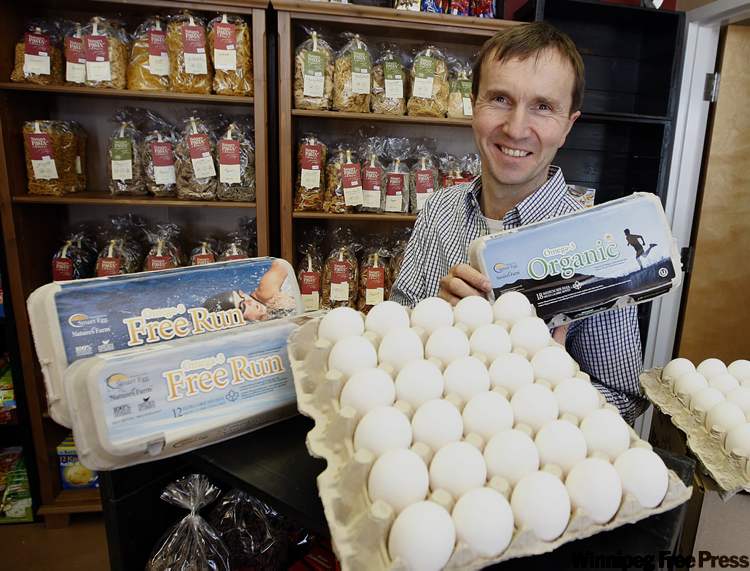
Grauer’s Nature’s Farm, has been producing eggs since the early ’90s.
After a brief early incursion into the retail egg market, his eggs have primarily been used in the production of Nature’s Farm premium pasta, available across Western Canada for more than a decade. Most of the rest of his eggs have gone to Manitoba hatcheries.
But for the past two years, Grauer has been selling his organic, free-range, Omega 3 eggs at farmers markets in the summer and he said he has experienced growing demand to get them into the retail stream.
“This isn’t something I’m doing with a blind feeling — launching and not knowing what will happen,” he said..
After coming to Manitoba from Germany in 1987, Grauer has invested millions of dollars and exhibited the kind of enterprise that will open markets for niche products that agribusiness development people say Manitoba agriculture can produce.
Cory Rybuck, general manager of Egg Farmers of Manitoba, the producers association that handles supply management, said of the 170 egg producers in the province, Nature’s Farm is the only one producing organic eggs.
Grauer said in addition to the nutritional features and whatever value is perceived from being certified organic (Nature’s Farm is also producing non-organic, free-run, Omega 3 eggs), his eggs will not include any artificial yolk colourants.
(Grauer maintains that is something the egg industry will engage in in a routine fashion, but Rybuck says that is not the case.)
After investing heavily and turning his pasta business into a profitable undertaking, Grauer is clearly not a misguided idealist about the demand for fresh, natural, nutritious food that comes at a premium price.
He said he understands there are many motivations for people to buy products such as organic eggs, but knowing where they come from and knowing something about the producer is increasingly important.
As it turns out, about 99 per cent of the eggs sold in Manitoba are produced here and plenty are exported to other provinces.
But Grauer’s point about transparency is a hot issue in the food business these days.
Dave Shambrock, executive director of the Manitoba Food Processors Association, said those types of issues might be the most important the industry will face in coming years.
“I think there is a backlash coming against products that people don’t know the origin of,” Shambrock said recently.
Grauer has about 17,000 hens split into two flocks. One is free-range and fed organic food, and the other is free-run but kept in a European-style aviary and fed non-organic food.

“People will be able to trace back that organic feed to only four field plots in southern Manitoba, North Dakota and Minnesota,” he said.
Not everyone will be happy to pay $6 for a dozen eggs — the suggested retail price for a dozen Nature’s Farm organic eggs.
But the way Grauer sees it, he’s on the same team with the independent and specialty retailer who can’t offer a lower price than the big-box outlets for the same product.
So he’s got something different for them to sell.
martin.cash@freepress.mb.ca