

Big name backs eco-friendly paper mill
Actor Harrelson supporting product made from ag waste
Advertisement
Read this article for free:
or
Already have an account? Log in here »
To continue reading, please subscribe:
Monthly Digital Subscription
$1 per week for 24 weeks*
- Enjoy unlimited reading on winnipegfreepress.com
- Read the E-Edition, our digital replica newspaper
- Access News Break, our award-winning app
- Play interactive puzzles
*Billed as $4.00 plus GST every four weeks. After 24 weeks, price increases to the regular rate of $19.95 plus GST every four weeks. Offer available to new and qualified returning subscribers only. Cancel any time.
Monthly Digital Subscription
$4.99/week*
- Enjoy unlimited reading on winnipegfreepress.com
- Read the E-Edition, our digital replica newspaper
- Access News Break, our award-winning app
- Play interactive puzzles
*Billed as $19.95 plus GST every four weeks. Cancel any time.
To continue reading, please subscribe:
Add Free Press access to your Brandon Sun subscription for only an additional
$1 for the first 4 weeks*
- Enjoy unlimited reading on winnipegfreepress.com
- Read the E-Edition, our digital replica newspaper
- Access News Break, our award-winning app
- Play interactive puzzles
*Your next Brandon Sun subscription payment will increase by $1.00 and you will be charged $17.95 plus GST for four weeks. After four weeks, your payment will increase to $24.95 plus GST every four weeks.
Read unlimited articles for free today:
or
Already have an account? Log in here »
Hey there, time traveller!
This article was published 26/10/2012 (4941 days ago), so information in it may no longer be current.
ACTOR Woody Harrelson has played every character from a gullible bartender to an irascible porn publisher to the drunken hero in The Hunger Games, but in real life he wants to be a paper-industry revolutionary who saves forests from chainsaws.
Harrelson, on the phone from Atlanta, Ga., where he’s filming the sequel to The Hunger Games and reprising his role as the heavy-drinking Haymitch Abernathy, says his support of Manitoba-based Prairie Pulp and Paper Inc. is not an act.
Prairie Pulp and Paper, produces paper made from waste wheat straw and Harrelson said he wants to get in on the movement that will see North America’s first non-wood pulp-and-paper mill set up in Manitoba.
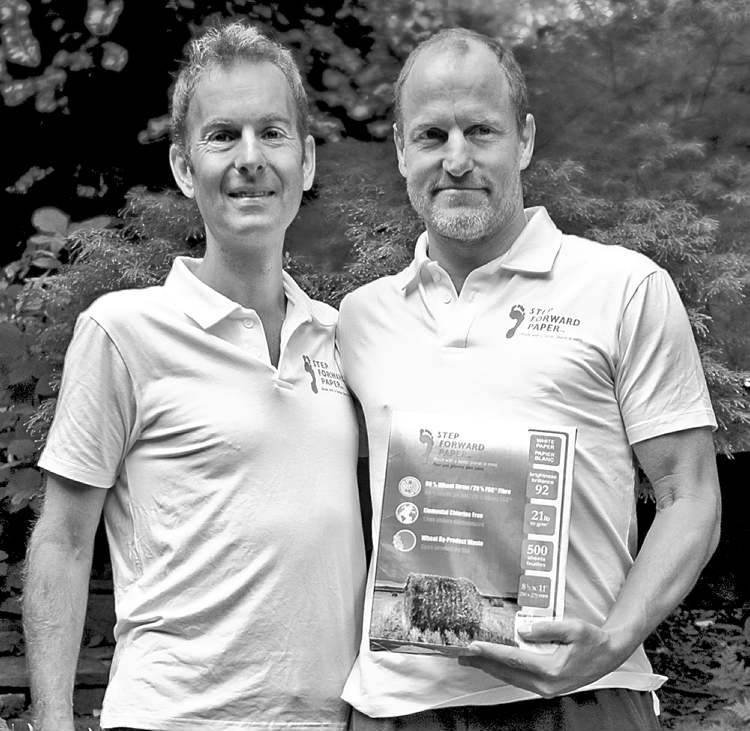
“When we build a plant there in Manitoba, it’s going to be 100 per cent wood-free… really from agricultural waste,” said Harrelson, a two-time Academy Award nominee. “I’d like to see a revolution in the paper industry and I think this is an important part of that process.”
Jeff Golfman and Clayton Manness, Harrelson’s Winnipeg partners, couldn’t agree more. This week an environmental study was released that concludes the company’s recently launched Step Forward wheat-based paper has the least amount of environmental impact among North American copy papers, including 100 per cent recycled paper.
It is another significant stage in the company’s 14-year odyssey to establish a foothold in the market.
Step Forward paper, currently made in India with 80 per cent waste wheat straw and 20 per cent wood fibres, has been available at more than 330 Staples stores across Canada since last summer.
Vancouver-based Offsetters was commissioned by Prairie Pulp and Paper to conduct the environmental study that was reviewed by an advisory panel including three environmental not-for-profit organizations and four industry representatives.
James Tansey, CEO and founder of Offsetters said the life-cycle study follows international protocols and even though the Winnipeg company commissioned the study, Tansey said he made it clear he would present his findings no matter what they were.
The results were just what the company needs.
In an email exchange, Golfman said, “This will be an invaluable component of the value proposition that all sophisticated investors will look for. Corporate social responsibility and eco-responsibility are prerequisites in today’s business climate. Having a life-cycle study on your product demonstrates transparency, leadership and vision. Most importantly, all major customers require proof to back up any ‘eco’ claim before they will purchase.”
The relative acceptance of the product in the retail world is another key in chipping away at the massive fundraising challenge.
As Harrelson said, the company’s goal is to build a production mill in Manitoba where Golfman and Manness live and where there’s a healthy supply of wheat straw every fall.

It will be a steep climb to get there, though. Such a plant will cost about $500 million to build.
“We have had several early-stage discussions with many later-phase investors,” Golfman said. “The acceptance of our Step Forward paper in the marketplace first in Canada and then in the U.S. is crucial for our ability to raise the capital required to build a tree-free, chorine-free, pulp and paper mill in Manitoba. Although there are many hurdles still in front of us, we remain optimistic that we will see our vision realized.”
— with files from The Canadian Press
martin.cash@freepress.mb.ca