

$1B in missing bills no mystery to experts
Gangsters believed to hold high-value notes
Advertisement
Read this article for free:
or
Already have an account? Log in here »
To continue reading, please subscribe:
Digital Subscription
One year of digital access for only $1.44 a week*
- Enjoy unlimited reading on winnipegfreepress.com
- Read the E-Edition, our digital replica newspaper
- Access News Break, our award-winning app
- Play interactive puzzles
*Billed as $5.77 plus GST every four weeks. After 52 weeks, price increases to the regular rate of $19.95 plus GST every four weeks. Offer available to new and qualified returning subscribers only. Cancel any time.
To continue reading, please subscribe:
Add Free Press access to your Brandon Sun subscription for only an additional
$1 for the first 4 weeks*
- Enjoy unlimited reading on winnipegfreepress.com
- Read the E-Edition, our digital replica newspaper
- Access News Break, our award-winning app
- Play interactive puzzles
*Your next Brandon Sun subscription payment will increase by $1.00 and you will be charged $17.95 plus GST for four weeks. After four weeks, your payment will increase to $24.95 plus GST every four weeks.
Read unlimited articles for free today:
or
Already have an account? Log in here »
Hey there, time traveller!
This article was published 17/11/2012 (4940 days ago), so information in it may no longer be current.
More than 10 years after the $1,000 bill disappeared from circulation, 946,043 of them are still out there, somewhere.
The whereabouts of almost $1-billion worth of the banknotes is a mystery rekindled this month at Quebec’s corruption probe when a witness spoke of a safe over-stuffed with cash, including $1,000 notes, inside a political office.
Retired on May 12, 2000, for mostly being used in criminal transactions, any $1,000 note deposited at a bank is destroyed, although the bills — nicknamed “pinkies” by gangsters because of their colour — remain legal tender.
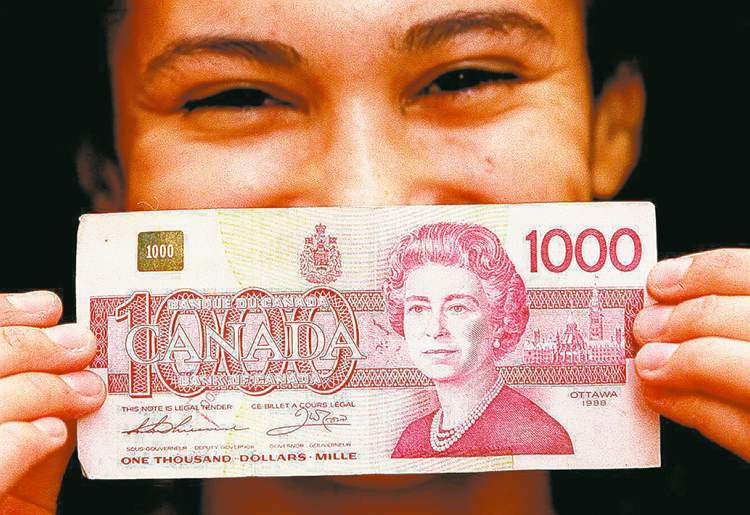
Money-laundering experts believe most of the missing bills continue to circulate among criminal elites who use them to pay large debts, with the recipients, in turn, using them to pay their own debts, with only a portion of the notes bleeding off into the legitimate banking system.
“They are used now to pay off IOUs, not as traditional cash. They are used for buying and selling but not for cashing, because they know if they cash them, it is traceable,” said Jeffrey Robinson, a New York-based author of several landmark books on money laundering.
The notes were retired as part of the fight against organized crime at the recommendation of the RCMP, said Jeremy Harrison, spokesman for the Bank of Canada.
He said the bank could not speculate about where the missing $1,000 bills are or how they might be used.
At Quebec’s Charbonneau commission inquiry into corruption, a former organizer for the Union Montréal said the political party was awash with cash, some of it in $1,000 bills. Martin Dumont said the party’s chief fundraiser had a safe in his office so stuffed that he once needed help closing it.
“They were red, brown and pink,” Mr. Dumont told the commission, listing the colours of the Canadian $50, $100 and $1,000 bills.
High-denomination bank notes are popular with high-end criminals because they make moving large amounts of cash easier.

Every Canadian bank note weighs the same — one gram — and for cash deals as big as those done by drug rings, payment can require a duffle bag.
A $1-million payment in $100 bills, currently the highest-denomination circulating Canadian note, requires 10,000 bills and weighs 10 kilograms.
But in $1,000 bills, it is a manageable 1,000 notes weighing one kilo.
— Postmedia News