

Rule change lets drivers keep on trucking
Double-long rigs safer, more fuel efficient
Advertisement
Read this article for free:
or
Already have an account? Log in here »
To continue reading, please subscribe:
Monthly Digital Subscription
$1 per week for 24 weeks*
- Enjoy unlimited reading on winnipegfreepress.com
- Read the E-Edition, our digital replica newspaper
- Access News Break, our award-winning app
- Play interactive puzzles
*Billed as $4.00 plus GST every four weeks. After 24 weeks, price increases to the regular rate of $19.95 plus GST every four weeks. Offer available to new and qualified returning subscribers only. Cancel any time.
Monthly Digital Subscription
$4.99/week*
- Enjoy unlimited reading on winnipegfreepress.com
- Read the E-Edition, our digital replica newspaper
- Access News Break, our award-winning app
- Play interactive puzzles
*Billed as $19.95 plus GST every four weeks. Cancel any time.
To continue reading, please subscribe:
Add Free Press access to your Brandon Sun subscription for only an additional
$1 for the first 4 weeks*
*Your next subscription payment will increase by $1.00 and you will be charged $16.99 plus GST for four weeks. After four weeks, your payment will increase to $23.99 plus GST every four weeks.
Read unlimited articles for free today:
or
Already have an account? Log in here »
Hey there, time traveller!
This article was published 09/02/2013 (4801 days ago), so information in it may no longer be current.
LONG-SOUGHT harmonization of rules governing technical and operational aspects of running double-trailer highway rigs have been agreed to by the four western provinces.
Rules have been changed so quirky technical regulations governing configurations of axles that were different in all four provinces will now let truckers drive straight through from the Ontario-Manitoba border to the B.C. border.
In the past, for instance, some drivers would be required to stop by the side of the road before entering Saskatchewan to slide axle groups into different positions to conform with Saskatchewan regulations, which were different than Manitoba and Alberta. That will no longer be necessary.
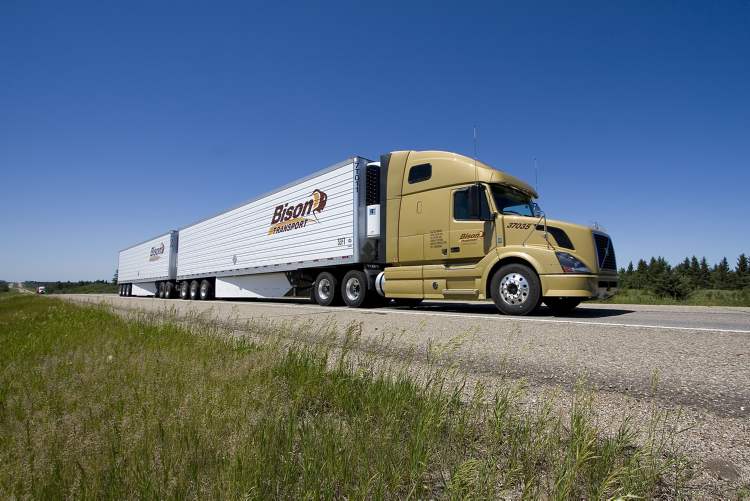
The memorandum of understanding between the four provinces will also eliminate certain regional restrictions that used to be in place against operating long combination vehicles (LCVs) — double-trailer rigs each 16 metres long.
For instance, in some provinces, there were restrictions against operating on the evening before a statutory holiday and in some cases on the day of the statutory holiday.
Among other things, it will also mean LCVs (also called turnpike doubles) will once again start populating the Trans-Canada Highway east of Winnipeg on Friday evenings.
In the past, there had been a restriction against operating the big rigs at that time when many Winnipeggers are heading to cottages in the Whiteshell or Lake of the Woods.
Across the country, LCVs have only ever been allowed on double divided highways (there are certain exceptions to get in and out of urban centres). They will now be allowed to run on those roads 24 hours a day, seven days a week.
The new harmonized rules still mean such rigs have to decoupled and trailers driven separately through the Rogers Pass in B.C.
Industry and government officials are heralding the harmonization as an important step toward greater efficiencies.
Jess Pries, vice-president of sales and marketing for Winnipeg-based Bison Transport — the largest users of LCVs in the country — said all elements of the industry will benefit.
“Philosophically… uniformity matters and is good,” Pries said. “It is about being efficient, eliminating wherever possible time restrictions and limitations on when we could operate the equipment and on what highways we could operate the equipment. Shippers using this mode (LCVs) have gained, and our country and provinces have become more efficient and cost-effective and competitive as a result.”
The agreement was arrived at after a number of meetings between provincial officials and provincial trucking associations.
“Now when the combination is set up, if it meets the dimensional requirements, they will be able to drive worryfree from the Ontario-Manitoba border to the Alberta border,” said Bob Dolyniuk, executive director of the Manitoba Trucking Association. “It will allow us to be more efficient and keep our cost of transportation down.”
Industry officials say running LCVs reduces greenhouse gas emissions, pointing out if they are not hauling two trailers behind one truck, there would be two trucks hauling one trailer each, using more fuel and resources.

They also say they are the safest trucks on the road.
Despite whatever concerns other drivers may have of sharing the highway with such large vehicles, Pries said LCVs are the safest portion of Bison’s fleet with the fewest safety incidents and the most experienced and welltrained drivers. Another feature of the memorandum of understanding between the four provinces is an agreement LCVs will run at a maximum of 100 kilometres per hour even in areas with posted maximum speed limits of 110 km/h.
Manitoba Infrastructure and Transportation Minister Steve Ashton said, “We will continue to work with these groups to further harmonize trucking regulations.”
martin.cash@freepress.mb.ca