

Engine-testing facility takes off
GE Aviation expands city operations year-round
Advertisement
Read this article for free:
or
Already have an account? Log in here »
To continue reading, please subscribe:
Monthly Digital Subscription
$1 per week for 24 weeks*
- Enjoy unlimited reading on winnipegfreepress.com
- Read the E-Edition, our digital replica newspaper
- Access News Break, our award-winning app
- Play interactive puzzles
*Billed as $4.00 plus GST every four weeks. After 24 weeks, price increases to the regular rate of $19.95 plus GST every four weeks. Offer available to new and qualified returning subscribers only. Cancel any time.
Monthly Digital Subscription
$4.99/week*
- Enjoy unlimited reading on winnipegfreepress.com
- Read the E-Edition, our digital replica newspaper
- Access News Break, our award-winning app
- Play interactive puzzles
*Billed as $19.95 plus GST every four weeks. Cancel any time.
To continue reading, please subscribe:
Add Free Press access to your Brandon Sun subscription for only an additional
$1 for the first 4 weeks*
- Enjoy unlimited reading on winnipegfreepress.com
- Read the E-Edition, our digital replica newspaper
- Access News Break, our award-winning app
- Play interactive puzzles
*Your next Brandon Sun subscription payment will increase by $1.00 and you will be charged $17.95 plus GST for four weeks. After four weeks, your payment will increase to $24.95 plus GST every four weeks.
Read unlimited articles for free today:
or
Already have an account? Log in here »
Hey there, time traveller!
This article was published 27/02/2013 (4816 days ago), so information in it may no longer be current.
A year after the rapid construction of the $50-million cold weather engine-testing facility opened on the grounds of the Richardson International Airport, additional investment has been made making it functional year-round.
The mammoth 122,000 square foot outdoor engine-test facility was built by GE Aviation out of its Ohio shop and is managed and staffed by StandardAero of Winnipeg.
Originally designed to more reliably handle cold weather and ice-condition testing required by aviation regulators, the Winnipeg shop has quickly become a key asset for GE’s all-weather development and test cycle on a number of new engines.
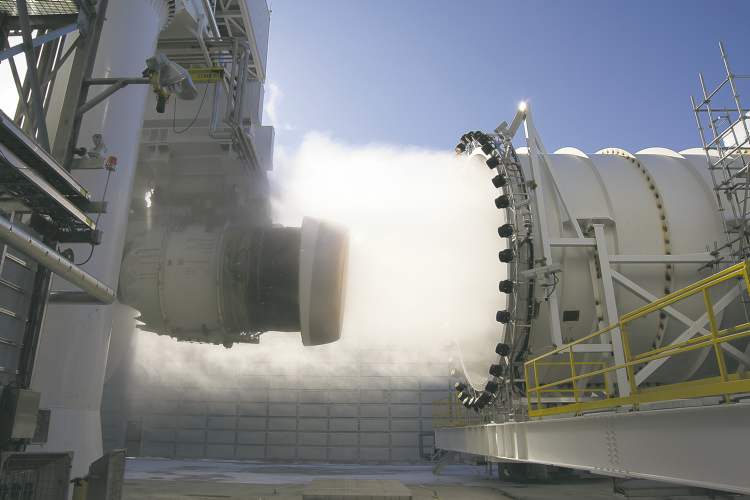
Kevin Kanter, general manager, design and systems integration engineering at GE’s Evendale, Ohio facility, said the Winnipeg plant is already booked solid for the next three years.
“The issue is we have the highest level of new engine development we have ever seen in the history of GE aviation and with that a lot of capacity issues have developed on testing,” Kanter said.
“So the Winnipeg facility has become one of our key assets for testing year-round.”
This winter’s cold weather was a welcome feature.
Brent Ostermann, StandardAero’s director of engineering responsible for the GE facility, said, “We’ve been blessed by nice, cold weather this year.”
The cold-weather-testing protocols require a certain number of hours on the test stand and Ostermann said after starting this season in mid-November they were able to complete the de-icing test on a new version of a GEnx engine before Christmas, something GE never could do at a facility it once operated at the Mirabel airport in Montreal.
After opening in February 2012, GE spent another $2.5 million extending the concrete base to allow the huge wind tunnel to be moved back farther to allow different types of testing in the summer.
Those tests include bird ingestion (accomplished with the help of a device known as a bird cannon) as well as a number of tests using sophisticated digital-temperature-capturing technology, digital pressure units and a newly purchased turbulent control structure used to straighten the air coming into the engine for performance testing.
Some of the equipment was acquired by West Canitest R&D Inc., (WestCaRD), a non-profit entity established with $5-million of federal government funding. Its mandate is to set up ancillary research projects to assist third-party technology development programs and academic research associated with the engine-testing facility.

Ostermann and his team are already running the place on their own with GE staff participating via a remote simulation control room in Ohio.
The local facility was never expected to be a large employer, but staffing has increased from less than 10 to 13 and Kanter said GE intends to continue investing in Winnipeg. The expectation from all parties is more jobs will be created.
Ostermann said WestCaRD is working with a non-profit research organization attached to the Global Aerospace Centre for Icing and Environmental Research centre in Thompson — a cold-weather engine-testing partnership between engine makers Pratt & Whitney and Rolls Royce.
GE has an intensive test schedule over the next few years in Winnipeg with no less than seven new engines in development, including three versions of the LEAP engine (part of a joint venture between GE and Snecma of France) that will power the Airbus A320neo, the Boeing 737 MAX and China’s C919 narrow body/single aisle aircraft and the Passport engine that will power Bombardier’s Global 7000 and Global 8000 business jet.
martin.cash@freepress.mb.ca