

Bakken oil may be more flammable, says U.S.
Advertisement
Read this article for free:
or
Already have an account? Log in here »
To continue reading, please subscribe:

Digital Subscription
One year of digital access for only $205*
- Enjoy unlimited reading on winnipegfreepress.com
- Read the E-Edition, our digital replica newspaper
- Access News Break, our award-winning app
- Play interactive puzzles
*First annual payment billed as $205.00 + GST for one year. This annual subscription will automatically renew at $233.00 + GST every 52 weeks (10% off the regular annual price of $259.35). Offer available to new and qualified returning subscribers only. Cancel any time.
To continue reading, please subscribe:
Add Free Press access to your Brandon Sun subscription for only an additional
$1 for the first 4 weeks*
- Enjoy unlimited reading on winnipegfreepress.com
- Read the E-Edition, our digital replica newspaper
- Access News Break, our award-winning app
- Play interactive puzzles
*Your next Brandon Sun subscription payment will increase by $1.00 and you will be charged $17.95 plus GST for four weeks. After four weeks, your payment will increase to $24.95 plus GST every four weeks.
Read unlimited articles for free today:
or
Already have an account? Log in here »
Hey there, time traveller!
This article was published 03/01/2014 (4586 days ago), so information in it may no longer be current.
BILLINGS, Mont. — Following a string of explosive accidents, federal officials said Thursday crude oil being shipped by rail from the Northern Plains across the U.S. and Canada may be more flammable than traditional forms of oil.
A safety alert issued by the U.S. Department of Transportation warns the public, emergency responders and shippers about the potential high volatility of crude from the Bakken oil shale patch. The massive oil reserve is fuelling the surging industry in eastern Montana and western North Dakota, now the nation’s second-largest oil producer.
The warning comes after a massive explosion caused by an oil train derailment on Monday near Casselton, N.D. No one was hurt, but worries about toxic fumes prompted the evacuation of hundreds of residents from the small eastern North Dakota town.
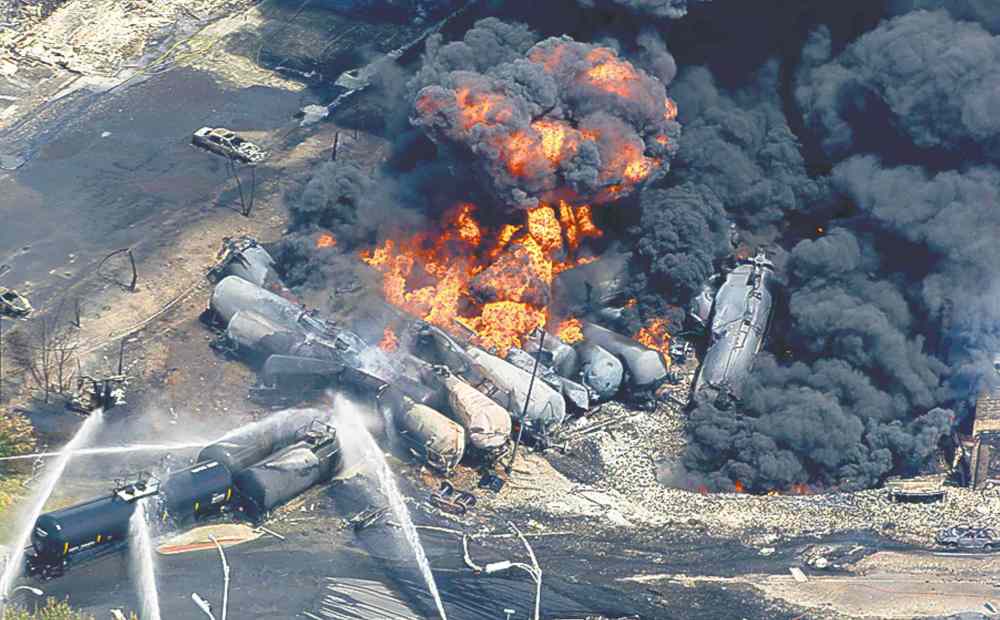
The oil boom in the Bakken has reduced the nation’s reliance on imported oil and brought thousands of jobs to the region. But as companies have increasingly relied on trains to get that oil to lucrative coastal markets, public safety in communities bisected by rail lines has become a major concern.
In July, 47 people were killed in Lac-Mégantic, Que., when a train carrying Bakken crude derailed. Another oil train derailed and exploded in Alabama in November, causing no deaths but releasing an estimated 2,835 cubic metres of oil from 26 tanker cars.
The amount of oil moving by rail in the U.S. has spiked since 2009, to a projected 400,000 cars in 2013 from just more than 10,000 tanker cars.
The safety alert resulted in part from results of preliminary tests on Bakken oil to find just how dangerous it is, said Jeannie Shiffer with the Department of Transportation’s Pipeline and Hazardous Material Safety Administration.
Shiffer said knowing the volatility of the oil is crucial so it can be properly handled during shipping.
“The material must be properly classified at the beginning of the process. That determines everything,” she said.
The issue of volatility is of particular importance for firefighters and other emergency responders who have to deal with accidents such as the one in Casselton, said Fred Millar, a rail-safety consultant in Virginia.
While it may appear obvious crude oil is dangerous, that message has not been adequately communicated to the hundreds of counties and cities across the U.S. that have seen a surge in crude oil trains, Millar said. He added railroads should also consider routing Bakken oil trains around highly populated areas.
After the Lac-Mégantic crash, federal officials issued an advisory for companies to properly classify their crude oil according to a scale that ranks hazardous materials as a great danger, medium danger or minor danger.
Thursday’s announcement goes a step further, declaring the Bakken’s light, sweet crude oil — extracted from shale formations through the drilling process known as hydraulic fracturing, or “fracking” — may be different from traditional heavy crudes because it is prone to ignite at a lower temperature.
The volatility of crude varies from one oilfield to the next and is driven largely by how heavy it is, said Kennth Medlock, senior director at the Center for Energy Studies at Rice University in Houston. Lighter crudes, which contain more natural gas, have a much lower “flash point” — the temperature at which vapours given off by the oil can ignite.
Larry Bierlein, an attorney for the Association of Hazmat Shippers, questioned the importance of Thursday’s announcement given oil is typically shipped in the same tank cars no matter its volatility. Flaws that render the most commonly used tank cars prone to rupture have been known for more than two decades.
Instead, Bierlein said, the public would be better served by the government adopting a long-delayed proposal to improve those cars, known as DOT-111s.

North Dakota regulators had said last month they were considering crafting a report to disprove hauling the state’s crude by rail is dangerously explosive. On Thursday, a state official said those plans had been dropped in the aftermath of the Casselton derailment. “We have no plans to go forward with anything,” said Justin Kringstad, director of the North Dakota Pipeline Authority.
The state’s oil production is now pegged at about one million barrels daily, and the state’s sweet crude is increasingly moving by rail to feed refineries on the East, West and Gulf coasts.
That pace of production likely won’t be stunted by the derailment in Casselton, Kringstad said, though he did not know what the impact would be if new rules concerning rail shipments are adopted.
— The Associated Press