

The good life, without money
Daniel Suelo has lived for almost 15 years without cash of any kind and couldn't be happier
Advertisement
Read this article for free:
or
Already have an account? Log in here »
To continue reading, please subscribe:

Digital Subscription
One year of digital access for only $205*
- Enjoy unlimited reading on winnipegfreepress.com
- Read the E-Edition, our digital replica newspaper
- Access News Break, our award-winning app
- Play interactive puzzles
*First annual payment billed as $205.00 + GST for one year. This annual subscription will automatically renew at $233.00 + GST every 52 weeks (10% off the regular annual price of $259.35). Offer available to new and qualified returning subscribers only. Cancel any time.
To continue reading, please subscribe:
Add Free Press access to your Brandon Sun subscription for only an additional
$1 for the first 4 weeks*
- Enjoy unlimited reading on winnipegfreepress.com
- Read the E-Edition, our digital replica newspaper
- Access News Break, our award-winning app
- Play interactive puzzles
*Your next Brandon Sun subscription payment will increase by $1.00 and you will be charged $17.95 plus GST for four weeks. After four weeks, your payment will increase to $24.95 plus GST every four weeks.
Read unlimited articles for free today:
or
Already have an account? Log in here »
Hey there, time traveller!
This article was published 10/01/2015 (4201 days ago), so information in it may no longer be current.
Most of us feel like we’re running on an economic treadmill that’s getting faster, slowly but surely. And we can’t get off.
We’re seemingly dependent on earning, saving and spending money to live. It’s the fuel of our lives. Yet we know this isn’t entirely true. Money isn’t an absolute requirement for living, even if it seems that way.
In fact, one individual has got off the treadmill entirely.
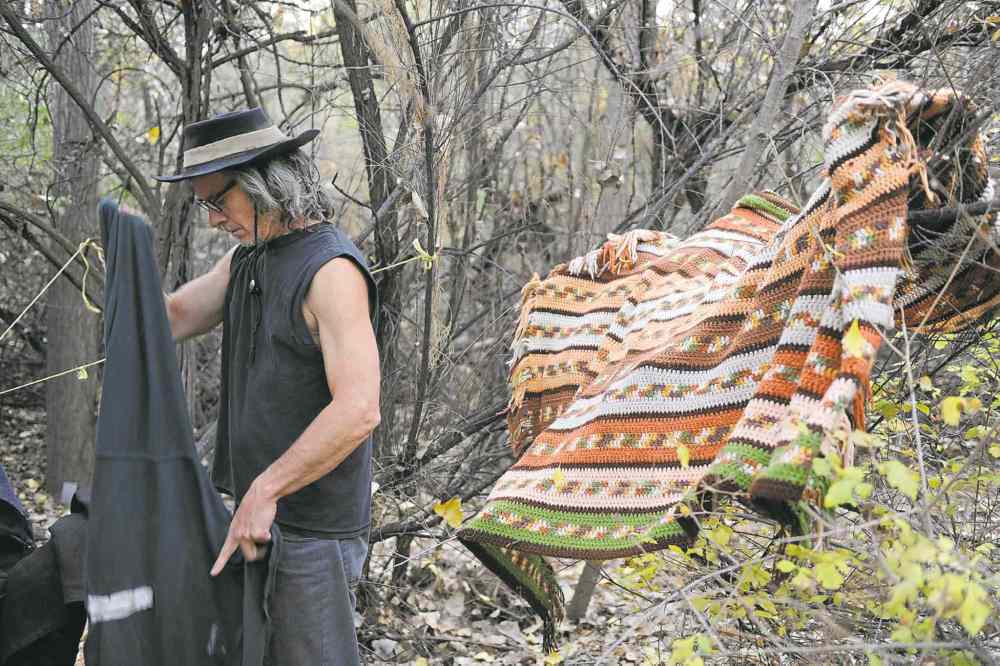
Really.
For several years, Daniel Suelo has been disproving the notion we need money to survive, having left his life savings — about US$30 — in a phone booth in the fall of 2000.
Since then, he hasn’t earned money, spent it or accepted it as a gift.
That doesn’t mean Suelo doesn’t work. He just hasn’t worked in exchange for money. Instead, he volunteers, puts in sweat equity at co-operatives and scours through garbage for food and other items. As for a place to live, he occasionally couch surfs or camps. But he mostly lives in a cave in Arches National Park near Moab, Utah.
Suelo certainly lives at society’s fringes, yet he is far from a loner. He is part of a wide community of friends and acquaintances, many who often share his belief the world will be better off without money.
He’s been the subject of several articles in newspapers and magazines, and has even been written about in the 2012 book The Man Who Quit Money by Mark Sundeen.
Suelo has become a moneyless prophet of sorts, drawing visitors from all over seeking to learn how to live without money — so many in fact, he recently posted on his blog he needs time to himself.
It’s no understatement Suelo — who changed his name from Daniel James Shellabarger — is a far-out dude, which is surprising considering his upbringing.
Born in 1961, he grew up in a conservative Christian family. It wasn’t until he attended university that he began exploring philosophy and other religions. As he learned, Suelo became aware of a paradox that although many cultures were rooted in philosophical and religious beliefs that frowned upon money and accumulating material goods, they often seemed just as preoccupied in the pursuit of these things.
During the next several years, working in the Peace Corps and social services, Suelo became increasingly disillusioned, and much of the blame lay with money. To him, it was the physical representation of greed, causing more harm than good. He also came to realize money is largely a creation of our imagination. So Suelo imagined something different: living without money. And he recently spoke with the Free Press about the subject.
In the following Q & A, Suelo shares a few thoughts that, while not aimed at getting us to eschew money, may help shift our perspective about our relationship with the almighty dollar just as we come to grips with our post-holiday bills.
What was your original reason for giving up money, and how have your motives changed over time?
My reason for giving up money has been to find truth, to find freedom. “The truth will set you free.” What doesn’t cost money is free. Truth is a gift. Notice how we talk of humans like chattel, having a net worth. People say Bill Gates’s net worth is $85 billion. How degrading to Mr. Gates! A slave is worth money. A free person is priceless. “Live free or die.” I would rather die than be a slave, even a slave in a gilded cage.
You’ve said once you gave up money, you felt a lot of anxiety melt away. Why is that? And why do you think money is often a great source of stress for people? Does it have to be?
Money is just a belief, shared by two or more people. It represents past and future, but never present. If money represented its present self, it would not be money. Worry is dwelling on past and future. It is impossible for the present mind to worry. But it is possible to have thoughts of past and future without worry. Thus, it is possible to have money without anxiety. But that takes a strong person. A strong person realizes money is nothing more than a thought in the head, here to serve us, not us serving it. Funny, if we were all so strong, then money would become useless, obsolete. Realize Santa Claus is fiction, and you outgrow Santa Claus.
Some people have referred to you as a mystic. How do you see yourself, and why do you think giving up money would prompt people to see what you’re doing in spiritual/religious terms?
This is about being a realist, seeing reality stripped of ambiguity. Mysticism is the enigmatic, mysterious, hidden in mist. Ironically, to a world lost in the mist of thoughts, judgments, opinions and symbols, unambiguous realism appears as mysticism. We live in a modern world that can’t even see the veins on a leaf or smell a blossom. Realism does not see judgments, does not see opinions, but sees everything as it is. Money — like words, like graven images — is a symbol, nothing more. But the world sees money as “real” and thus is blinded to what’s real. An image mistaken as real is called an idol. To serve an image as real is to worship it. You worship what you work for. You become what you worship. If we work for money, not working for work’s own sake, we become unable to see, hear, smell, taste or feel reality, just as our idols can’t see, hear, taste or feel. You cannot work for both reality and illusion.
Some have called you a freeloader. How would you respond to this?
I have yet to meet any person, creature, or particle in the entire universe that is not a freeloader. All the energy running our bodies, computers and entire civilization was freely given and freely taken — all of it. When did the sun ever ask you to pay it back, and how could you pay it back even if you wanted to? Everything we think we own, everything we are, was and is given to us freely without merit. Who chose to be born? Who earned the care of the mother? Who earned the air in their lungs they breathe in and breathe out from the totally shared communal supply of all life on Earth? But, by the laws of physics, if we take more than we need, we deplete resources of others. We take more than we give back. If we take more than we need, we destroy not only the environment, but we destroy ourselves. If we take more than we need, we are not even a parasite, but we are cancer. Cancer and our economic and political systems are the only things I can think of that cannot say, “Enough, let’s quit now!” Those who call me freeloader (should ask themselves): Do you take more than you need? Why are those who take way more than they need threatened by those who take only what they need or even less than they need?
What does the future hold for you? Do you plan long term or do you live day to day, and if so, why do you believe that is essential to your well-being?
I don’t know the future. Nobody does. Worry about what will happen is a worse illness than what will happen. Lack of worry is called faith. There is no better health insurance, no better investment for the future than lack of worry. I do plan, I do have eyes in front of my head, and I have feet that walk forward, and I have a brain that thinks ahead. Planning is good, but attachment to plans is harmful to me and others. Planning is fun and gives my brain something to do. But a game is not fun anymore when you forget it’s a game.
Your lifestyle is unique. Is it catching on? How difficult is it for others to follow in your footsteps? Is it something everyone can do, or is it a way of life that only certain individuals could endure?

Since the publicity started, more and more people contact me, and more and more people come to visit or live with me. Many others have told me they are now taking steps to simplify their lives. I can’t express my gratitude for this. Not everybody can totally give up money and live in a cave like I do. But I envision society overcoming selfishness, learning again how to share, and moneyless communities forming, making it possible for all to live free, from babies to grandparents, from singles to families, as it is possible for every wild creature to live free. The whole universe lives without money, as it has for billions of years. How have we come to believe our microscopic speck of commercial civilization is the whole universe?
What can people do to become less reliant on money? Do they have to give it up entirely, or are there baby steps they could take?
Some addicts can go cold turkey; some must take baby steps. But realize that everybody’s true self already lives moneyless. When you interact with your loved ones, do you demand payment? If you do, you have no loved ones. How many times do you give to a stranger, expecting nothing in return? How many times do you breathe in and out communal air with no thought of credit and debt? When you do things with thought of reward, your motivations are ulterior, and you are false. When you do for the sake of doing itself, you are being real. Your real self has no thought of credit and debt. Cultivate your real self and walk away from your unreal self as much as you can. It does no good to fight what you can’t fight. But it does all good to cultivate what is real. It’s futile to weed a wheat field. Let the wheat and weeds grow together, and in the end it will all work out.
joelschles@gmail.com