

Choking on food prices
Plunging loonie blamed for escalating costs
Advertisement
Read this article for free:
or
Already have an account? Log in here »
To continue reading, please subscribe:
Monthly Digital Subscription
$1 per week for 24 weeks*
- Enjoy unlimited reading on winnipegfreepress.com
- Read the E-Edition, our digital replica newspaper
- Access News Break, our award-winning app
- Play interactive puzzles
*Billed as $4.00 plus GST every four weeks. After 24 weeks, price increases to the regular rate of $19.95 plus GST every four weeks. Offer available to new and qualified returning subscribers only. Cancel any time.
Monthly Digital Subscription
$4.99/week*
- Enjoy unlimited reading on winnipegfreepress.com
- Read the E-Edition, our digital replica newspaper
- Access News Break, our award-winning app
- Play interactive puzzles
*Billed as $19.95 plus GST every four weeks. Cancel any time.
To continue reading, please subscribe:
Add Free Press access to your Brandon Sun subscription for only an additional
$1 for the first 4 weeks*
*Your next subscription payment will increase by $1.00 and you will be charged $16.99 plus GST for four weeks. After four weeks, your payment will increase to $23.99 plus GST every four weeks.
Read unlimited articles for free today:
or
Already have an account? Log in here »
Hey there, time traveller!
This article was published 06/02/2015 (4076 days ago), so information in it may no longer be current.
It’s in one pocket and out the other for Manitoba consumers as the extra money they’re saving at the gas pump is being eaten up by the extra cash they’re spending at the grocery store.
“(The past year) is the weirdest year I’ve seen in a very long time,” Munther Zeid, whose family owns five Food Fare grocery stores in the city, said in an interview Thursday.
“Normally it (the price of imported food) go up for a bit, and then it comes back down. But now it’s going up and it’s staying up. It’s just a constant increase. It’s very unusual.”
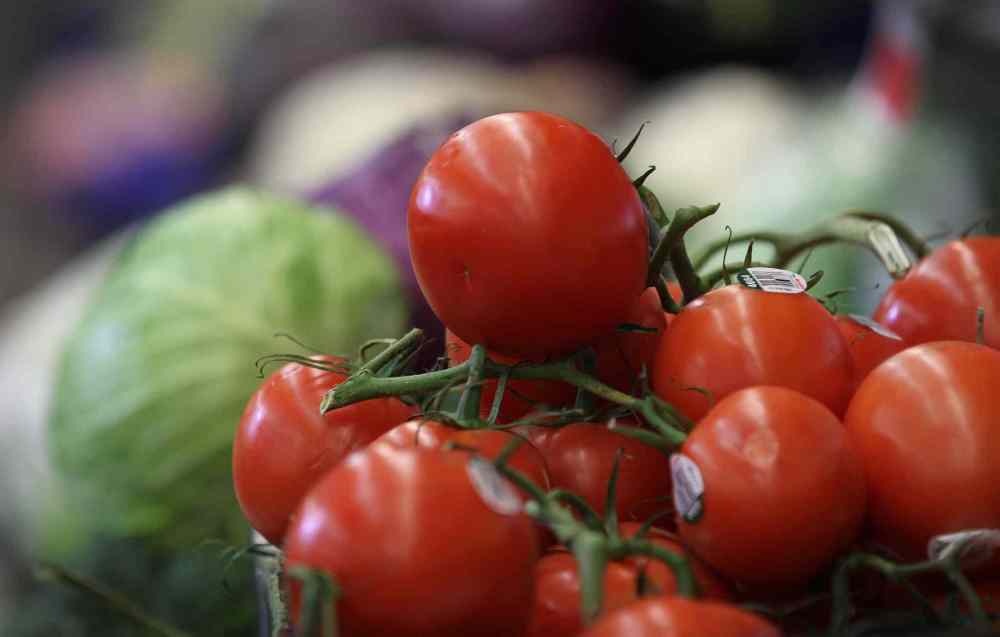
The cost of premium tomatoes, for example, is about $4.99 per pound, compared to $1.50 to $2 per pound this time last year. Broccoli is $3.50 a pound versus $1.49 to $2.49, and grapes are $4.50 to $5 per container, compared to $3.50. The list goes on and on.
Zeid also said the price hikes haven’t been limited to just imported fruits and vegetables.
“All beef prices are up. Pork is coming down slowly, but it’s still not at the level it was a year ago, and deli meats are all up.”
He said most food processors are blaming the higher prices on the sharp drop in the value of the Canadian dollar. It has fallen from 94 cents US last summer to less than 80 cents earlier this week, although it rebounded a bit on Thursday to close at 80.49 cents.
“A good chunk of it is the dollar,” Zeid conceded. “They’re also saying it’s bad growing conditions, but this is not the first time we’ve seen bad growing conditions in the United States.”
While soaring food costs are hard to swallow, what’s even more galling is they’re overshadowing the cost savings Winnipeg motorists have been enjoying every time they fill up at gas pumps in recent weeks. Last week, a litre of regular gasoline was selling at some Winnipeg stations for less than 80 cents. That’s roughly 45 cents a litre less than what they were paying six months ago, when the average price was 124.9 cents.
“My personal view is that the gain I save at the gas pump is going to be offset — significantly more than offset — by the eventual rise in prices from a 79-cent dollar,” John McCallum, an economist at the University of Manitoba’s Asper School of Business, said in an interview.
He noted a lowered-valued loonie drives up the cost of any imported goods and services that are priced in U.S. dollars — everything from entertainment products like CDs and DVDs to clothing.
“So there are an awful lot of things Manitobans buy, beyond fruits and vegetables, that are affected by the decline in the Canadian dollar,” he added, including trips and vacations south of the border.
McCallum also said that while currency fluctuations are one of the most difficult things to predict, his gut feeling is a lower-priced loonie is here for the longer term.
Some economists are predicting it will eventually settle into a price range of between 75 and 85 cents US., but McCallum said he wouldn’t be surprised to see it fall below 75 cents US before that happens.
“Commodity (prices) are not in good shape, the (Canadian) economy is slowing, the central bank has given no indication they want to support the dollar. So what’s going to take it up?”
Canadian consumers also shouldn’t expect much relief on the food front this year, according to the University of Guelph’s Food Institute. It released a report earlier this week that predicts vegetable prices in Canada will rise by a further 5.5 to 7.5 per cent in 2015. It also expects the price of meat, fruits and nuts, and fish and seafood to climb by another three to five per cent.
That’s on top of last year’s double-digit price hikes for things like tomatoes and lettuce, it adds.
It also blames soaring food prices in Canada on the swooning loonie. It’s even helping to nudge up the price of things such as grains and restaurant meals, although at a slower pace than some of those other food items.
“One silver lining is that we do expect only modest hikes, at best, for dairy products,” said Sylvain Charlebois, the report’s lead author. He noted the price of ice cream is already two per cent cheaper than it was this time last year.
“So there are pockets of bargains on the grocery list that you can actually find in the grocery stores. You just have to be careful and look for them …”
Another piece of good news, according to one oil industry analyst, is that the 12-cent-per-litre jump over the last two days in the price of a litre of regular gas was likely a temporary thing.

Gas prices in Winnipeg on Thursday ranged from 84.9 cents per litre to 96.9 cents.
Dan McTeague, senior petroleum analyst for GasBuddy.com., said speculation on the part of oil traders is what’s been driving up world oil prices in recent days, not a drop in world oil or gasoline inventories or a spike in demand for gas.
“So I would think in all likelihood you’re probably going to see a decrease… between now and Sunday of three to four cents a litre,” he added.
He said while the retail price could eventually rise to between 96 cents and $1.05 per litre, “I don’t see it going much higher than that. And if it does, you’ll know who to blame,” he added.
murray.mcneill@freepress.mb.ca
History
Updated on Friday, February 6, 2015 5:37 AM CST: Replaces photo