

New tech device for guru
Keyboard for wearable devices
Advertisement
Read this article for free:
or
Already have an account? Log in here »
To continue reading, please subscribe:
Digital Subscription
One year of digital access for only $1.44 a week*
- Enjoy unlimited reading on winnipegfreepress.com
- Read the E-Edition, our digital replica newspaper
- Access News Break, our award-winning app
- Play interactive puzzles
*Billed as $5.77 plus GST every four weeks. After 52 weeks, price increases to the regular rate of $19.95 plus GST every four weeks. Offer available to new and qualified returning subscribers only. Cancel any time.
To continue reading, please subscribe:
Add Free Press access to your Brandon Sun subscription for only an additional
$1 for the first 4 weeks*
- Enjoy unlimited reading on winnipegfreepress.com
- Read the E-Edition, our digital replica newspaper
- Access News Break, our award-winning app
- Play interactive puzzles
*Your next Brandon Sun subscription payment will increase by $1.00 and you will be charged $17.95 plus GST for four weeks. After four weeks, your payment will increase to $24.95 plus GST every four weeks.
Read unlimited articles for free today:
or
Already have an account? Log in here »
Hey there, time traveller!
This article was published 06/05/2015 (4039 days ago), so information in it may no longer be current.
Tony Havelka has been working on the fringe of high-technology wearable computer consumer gear for more than 20 years in Winnipeg, and he’s still at it.
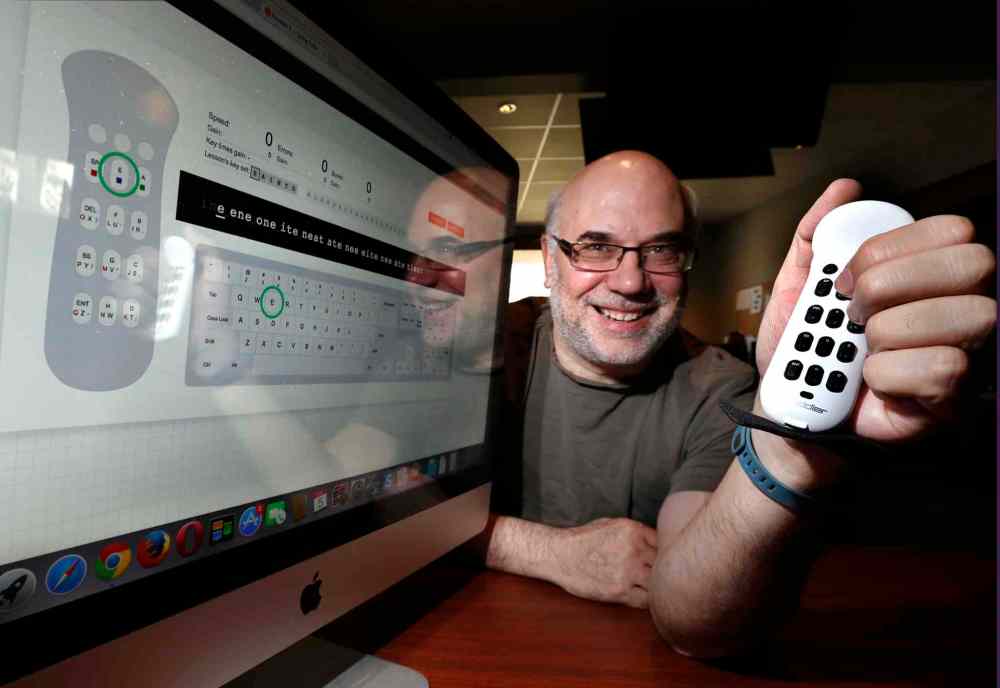
His latest product is a wireless, hand-held keyboard with an ingenious 19-key pad.
Back in the early 1990s, Havelka was building head-mounted displays (HMD) in Winnipeg for the virtual-reality market and was at the vanguard of that business.
He’d gotten out of the HMD market that had become far too crowded and littered with all sorts of failed companies and formed a device-development and online retailer called Tek Gear.
Rather than make consumer products for a fickle market, “We help people who want to build stuff,” said Havelka.
About 31/2 years ago when Google was about to release Google Glass, Havelka got a message from Thad Starner, the “grandfather of wearable computers” no less, about building an interface device for the Google Glass.
“They were using voice and touch, but there was no keyboard interface,” Havelka said. “They were still in the lab and they really didn’t tell us what it was for — they (Google) are really secretive. They just told us what it has to do.”
Prior to that, Havelka had bought a small Colorado company called HandyKey that made hand-held keyboards.
He built something for Starner with all sorts of bells and whistles, but it would have had to sell for $2,000.
He subsequently went back to the drawing board, and after close to $500,000 in development costs, Tek Gear has just launched the Twiddler 3. (About 20,000 copies of earlier iterations of the Twiddler have been sold into the market over the past 20 years.)
Tek Gear’s latest release is a smaller, more mobile version of the Twiddler keyboard that could be twinned with the growing number of tablets and other mobile devices that now include watches.
Unlike traditional keyboards, the Twiddler has only 19 keys and uses a function called chording one uses when typing uppercase letters, for example, requiring a user to hold the shift key together with a letter key. The Twiddler builds on that concept. Using a combination of single keystrokes and chords, it can be used to type all the letters, characters, symbols and commands found on a standard keyboard.
With practice, average users can type between 30 and 60 words per minute.
The tiny wireless keyboard can go anywhere and connect to just about any device via Bluetooth, making it popular with a range of people from the tech-savvy to those who have lost the use of one hand.
Havelka said with about 1,000 beta copies already in circulation among developers and others, he believes there is a growing market.
“What we are focusing in on is people who need portable wearable-computer interfaces,” he said. “We’re also taking a lot of interest right now in the rehabilitation market — people with the use of only one arm or hand or people who have had a stroke.”
The Twiddler 3 sells for $199, and like all sorts of new technology, the developer can’t predict the scope of usage.
His old HMD company, called Liquid Image, made equipment for all sorts of uses, and Havelka became a reliable supplier to all sorts of developers including some who sold to military end users.
He figures the new Twiddler might have some use there in drone manipulation, for instance.
Tek Gear sells all sort of niche technology, much of it related to wearable computing including printed circuit boards for specialized micro-displays as well as a number of HMDs, much of it made and developed by Havelka and his small, five-person staff.
A serial entrepreneur, Havelka has also developed and operates a streaming video service for kids called Ameba that has more than 100,000 installations and more than 2,000 hours of content.
He was one of the first North American distributors of thumb drives and remembers selling 16-megabyte USB drives for $50 until the mass-market retailers started driving the prices down.
“Now when markets go from niche to mass, we pull out,” he said.

“That’s not our specialty.”
His longevity ends up being his specialty.
“We’ve seen competitors come and go, and if you’re there for the long haul, people will come to you,” he said.
“They know you will be there.”
martin.cash@freepress.mb.ca