

New rules will require car ads to show the full price of vehicle, including additional fees
Advertisement
Read this article for free:
or
Already have an account? Log in here »
To continue reading, please subscribe:

Digital Subscription
One year of digital access for only $205*
- Enjoy unlimited reading on winnipegfreepress.com
- Read the E-Edition, our digital replica newspaper
- Access News Break, our award-winning app
- Play interactive puzzles
*First annual payment billed as $205.00 + GST for one year. This annual subscription will automatically renew at $233.00 + GST every 52 weeks (10% off the regular annual price of $259.35). Offer available to new and qualified returning subscribers only. Cancel any time.
To continue reading, please subscribe:
Add Free Press access to your Brandon Sun subscription for only an additional
$1 for the first 4 weeks*
- Enjoy unlimited reading on winnipegfreepress.com
- Read the E-Edition, our digital replica newspaper
- Access News Break, our award-winning app
- Play interactive puzzles
*Your next Brandon Sun subscription payment will increase by $1.00 and you will be charged $17.95 plus GST for four weeks. After four weeks, your payment will increase to $24.95 plus GST every four weeks.
Read unlimited articles for free today:
or
Already have an account? Log in here »
Hey there, time traveller!
This article was published 21/05/2015 (4138 days ago), so information in it may no longer be current.
New rules will soon be in place to better protect car buyers when they purchase a new vehicle.
The rules will add more transparent pricing and control dealership advertising practices, Consumer Protection Minister Ron Lemieux said today at a media event at Birchwood Toyota.
Lemieux said buying a car is the biggest purchase Manitobans can make next to a house, and can be a stressful for many if they are not provided sufficient amount of information.
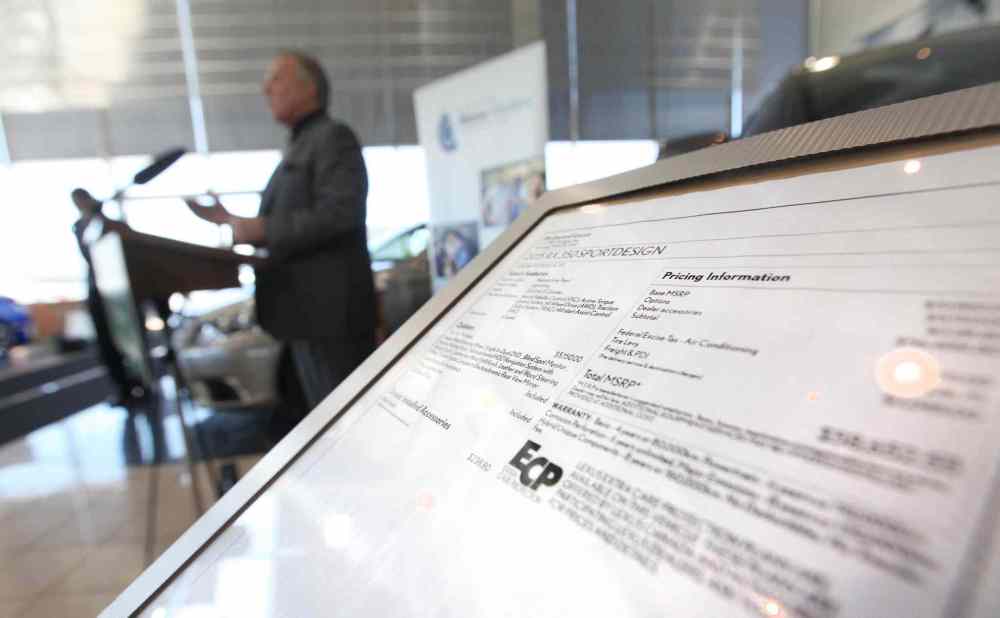
“People feel that there is not enough clarity and there is not enough openness with regards to pricing,” Lemieux said. “Manitobans want to get what they are paying for and they want to know in clear terms actually what they’re exactly going to have to pay for. They don’t want pricing to come after the fact.”
He said the regulations will give car buyers clear and truthful information.
“They don’t want to feel like they have been ripped off not knowing all the prices,” Lemieux said.
The province said current vehicle advertising practices, such as omitting additional fees, charged or conditions from sticker prices, are sometimes misleading or confusing to consumers.
Lemieux said the new regulations will change that. The new regulations take effect June 1 and cover dealership advertising in print and online. It will not cover private auto sales in print or online.
Steve Chipman, chairman of the Canadian Automobile Dealers Association, said the changes will level the playing field for dealers and car buyers.
Chipman said the association has been working with government for about seven years on the new rules.
“We want to make sure that consumers as well as dealers are on an equal footing,” he said.
Chipman said additional, perhaps federal legislation, is required to deal with vehicle manufacturer advertising, which not covered by provincial rules.
“If you see an advertisement on TV or in the newspaper, that’s a national ad,” he said. “That price may be different. It may not include freight and pre-delivery inspection which has to be included in our prices. It may not include a block heater, but everybody in Manitoba puts a block heater in their car.”
Chipman added most car buyers are well-informed before they step into the showroom as they’ve done their homework comparing prices on the Internet.
“We find that 85 to 90 per cent of people have done some homework ahead of time,” he said. “There is so much transparency today because everybody is on the Internet. Everybody does research. They come in here and pull out their mobile phone checking out prices elsewhere. So no one can hide anything. Our customers are very well educated. They come in here almost knowing a lot more about a particular model than the salesperson, who’s selling 30 different models.”
He said buyers are so educated, there are now fewer tire kickers in the car lot.
“Our actual traffic coming in is dropping, but the closing ratios are higher. When people come in now, they buy. They’re not shopping. They’ve done the shopping themselves already.”
Chipman also said there will be no additional cost to dealers with the new advertising rules.
“We just have to be more careful,” he said. “We just have to make sure it includes everything on that vehicle. I don’t think it’s onerous on any dealer.”
The province’s new regulations state that a vehicle dealer must make sure that all advertisements indicate the total price of a vehicle, including all additional charges, (except for provincial and federal taxes).
Advertisements must also state that used vehicle is indeed a used vehicle.
Dealers can only advertise a vehicle they have on the lot or in inventory and specify the time period applicable to limited time offers.
The rule changes also forbid false advertising.
The Selinger government first announced they were beefing up consumer protection laws on vehicle purchases in late 2012.
Premier Greg Selinger said then that the government wanted to make it crystal clear that the sticker price you see for a new car is the price you pay.
The government has already introduced legislation that would penalize any new- or used-car dealer who uses false advertising when selling vehicles.
The legislation also requires dealers to disclose the model year of the vehicle and if it was ever declared salvage or used as a short-term rental or emergency vehicle.

The province’s Consumer Protection Office will have the authority to issue compliance orders against offenders and can impose administrative penalties.
Beatrice Dyce, acting directing of the province’s Consumer Protection Office, said for a first offence the maximum penalty is $5,000 and the maximum penalty for a third offence is $20,000.
Dyce said the office will check compliance by monitoring newspaper advertising and customer complaints.
Quebec, Ontario, Alberta and British Columbia have similar legislation.
bruce.owen@freepress.mb.ca
History
Updated on Thursday, May 21, 2015 2:41 PM CDT: Updated