

She’s been working on the railroad

Advertisement
Read this article for free:
or
Already have an account? Log in here »
To continue reading, please subscribe:
Digital Subscription
One year of digital access for only $1.44 a week*
- Enjoy unlimited reading on winnipegfreepress.com
- Read the E-Edition, our digital replica newspaper
- Access News Break, our award-winning app
- Play interactive puzzles
*Billed as $5.77 plus GST every four weeks. After 52 weeks, price increases to the regular rate of $19.95 plus GST every four weeks. Offer available to new and qualified returning subscribers only. Cancel any time.
To continue reading, please subscribe:
Add Free Press access to your Brandon Sun subscription for only an additional
$1 for the first 4 weeks*
- Enjoy unlimited reading on winnipegfreepress.com
- Read the E-Edition, our digital replica newspaper
- Access News Break, our award-winning app
- Play interactive puzzles
*Your next Brandon Sun subscription payment will increase by $1.00 and you will be charged $17.95 plus GST for four weeks. After four weeks, your payment will increase to $24.95 plus GST every four weeks.
Read unlimited articles for free today:
or
Already have an account? Log in here »
Hey there, time traveller!
This article was published 08/03/2016 (3740 days ago), so information in it may no longer be current.
Today is International Women’s Day, a day earmarked “to celebrate the social, economic, cultural and political achievements of women.” And, no doubt because it’s 2016, this year’s theme/call to action is gender parity.
But this isn’t a column about Prime Minister Justin Trudeau’s gender-balanced cabinet and what a great start that is, nor is it a column about meritocracies and quotas. This isn’t even a column about a workplace that has achieved gender parity, though that would be news indeed. In the spirit of International Women’s Day, this is a column about one field that is taking small steps forward — and the achievements of a couple of the women who represent the changing face of the trades.
That’s how I came to find myself in a hard hat and goggles on Monday morning, touring CN’s Transcona Shops with director Heather Lamb. Lamb, 55, runs the show here, and she effortlessly rocks both steel-toe boots and a hot-pink manicure. She’s been working at Canadian National Railway for 37 years, almost directly out of high school. She was an agile typist, able to type 92 words per minute — “I didn’t have the nails then, eh,” she says with a laugh — and had her pick of administrative roles at various businesses (including the Free Press). She chose CN, and worked her way from the admin pool to various management positions in various departments, including in purchasing and planning, before becoming a director five years ago.
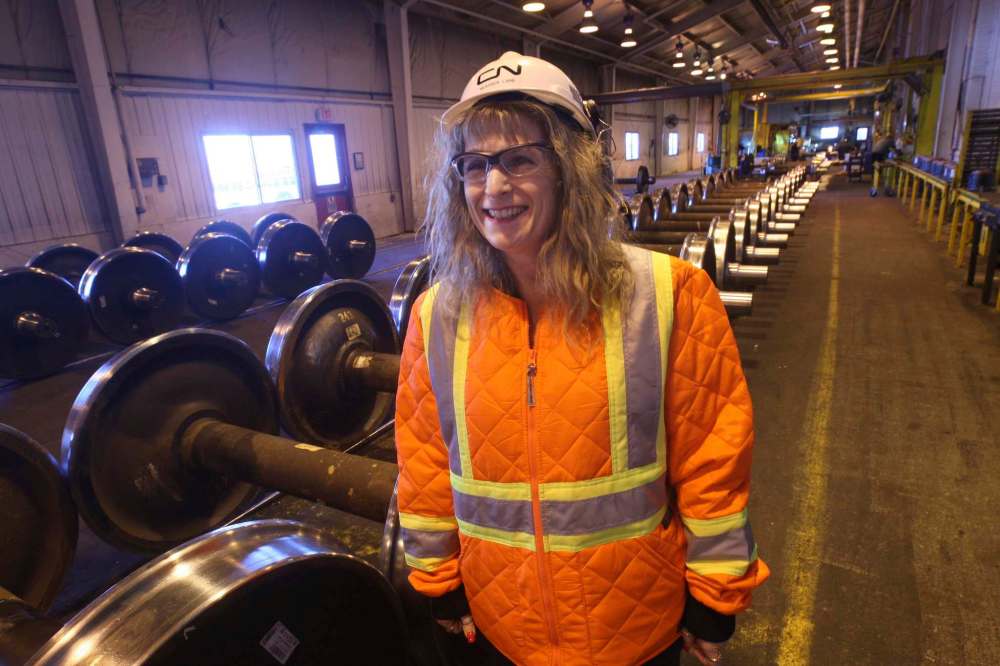
In her nearly four decades working on the mechanical side of the rail industry, she’s seen attitudes and corporate norms change. She says that currently, roughly four per cent of the Transcona Shops employees are women, and they are working as heavy-duty mechanics, electricians and car mechanics. “I’d like to see more, but it’s day by day,” she says. “I never thought I’d have as many (women) as I do. It’s baby steps on this road. This isn’t just a man’s world. It’s changing.”
But that kind of change doesn’t happen on its own. It happens in large part because of women such as Lamb. As we talked in her office about getting women into the trades and the importance of women in leadership roles, I kept thinking about a very recent quote I read from folk legend Buffy Sainte Marie. The Globe and Mail asked her what she thought was the biggest misunderstanding about being a woman right now. “I think there’s still an almost global lack of understanding of the value of feminine wisdom about just about everything — banking, politics, philosophy, philanthropy,” Sainte Marie said.
And she’s not wrong. Women’s wisdom is often discounted and discredited, to the detriment of all of us. Lamb certainly dropped plenty of feminine wisdom during the course of our 40-minute conversation. For her part, she doesn’t subscribe to the idea that women need to act more like men in order to ascend in male-dominated fields. She says good leadership is about remembering who you are, as well as having a thick skin and a strong vision. She’s worked to change the culture in small ways — such as cleaning up the potty-mouth language on the work floor — and large. Her leadership ethos is about team-building and positive thinking. She encourages people to work smart and to work safe. A question she often asks herself when dealing with members of her team: “Did I support you to be the best you can be?”
When I ask her if there’s ever been pushback to having a woman in charge, she snort-laughs. “Of course there’s pushback. Some people have some issues you have to work through with that. But I think having a trusting environment and one in which you can connect with people, eventually those barriers will come down. And I’ve seen those barriers come down.
“You get the right people in the right mix and we can do great things together — but you need to have women in that mix, otherwise I don’t believe it works,” she says.
Getting women into that mix is something CN has been focused on over the past few years. In 2012, CN’s Society of Women in Engineering launched its Aspire program, which helps to encourage girls in Grades 11 and 12 to explore careers as railroaders. As well, in 2014, CN launched the Women in Operations Council, which works to develop skill-building and professional growth initiatives for employees.
Heidi Rowley, 41, has been a heavy-duty mechanic for CN for nine years and is now co-chairing the health and safety committee. When she was hired, she was the only female mechanic at the Transcona Shops. “We hired a few more in fairly short order,” she says. “There’s a good handful of electricians — six or seven that I’m for sure aware of. We’re nowhere near parity for sure, but there has been growth.”
As an academically gifted kid, Rowley was pushed toward university — the pernicious stereotype that “smart kids don’t go into the trades” rearing its head. In fact, she regrets not pursuing the trades sooner. “I have a fantastic career that’s very stable as well as financially and professionally rewarding,” Rowley says.
When it comes to gettting more women working in skilled trades, perhaps the question isn’t ‘how do we get girls interested?’ but rather ‘how do you let girls know it’s OK to be interested?’
“The notion that girls just aren’t interested is silly,” she says.

“They need to know it’s possible. They need to know they don’t have to blaze the trail anymore. The road is already made.”
To extend that metaphor further, that road isn’t necessarily smooth — even if women can no longer be the first or the only.
Women such as Rowley and Lamb are just two examples of women who are creating workplaces that support women by challenging biases and leading by example.
Lamb is retiring in June. And when she leaves the Transcona Shops behind, they’ll be more inclusive than when she got there.
jen.zoratti@freepress.mb.caTwitter: @JenZoratti
Jen Zoratti is a columnist and feature writer working in the Arts & Life department, as well as the author of the weekly newsletter NEXT. A National Newspaper Award finalist for arts and entertainment writing, Jen is a graduate of the Creative Communications program at RRC Polytech and was a music writer before joining the Free Press in 2013. Read more about Jen.
Every piece of reporting Jen produces is reviewed by an editing team before it is posted online or published in print – part of the Free Press‘s tradition, since 1872, of producing reliable independent journalism. Read more about Free Press’s history and mandate, and learn how our newsroom operates.
Our newsroom depends on a growing audience of readers to power our journalism. If you are not a paid reader, please consider becoming a subscriber.
Our newsroom depends on its audience of readers to power our journalism. Thank you for your support.
Jen Zoratti is a columnist and feature writer working in the Arts & Life department, as well as the author of the weekly newsletter NEXT. A National Newspaper Award finalist for arts and entertainment writing, Jen is a graduate of the Creative Communications program at RRC Polytech and was a music writer before joining the Free Press in 2013. Read more about Jen.
Every piece of reporting Jen produces is reviewed by an editing team before it is posted online or published in print – part of the Free Press‘s tradition, since 1872, of producing reliable independent journalism. Read more about Free Press’s history and mandate, and learn how our newsroom operates.
Our newsroom depends on a growing audience of readers to power our journalism. If you are not a paid reader, please consider becoming a subscriber.
Our newsroom depends on its audience of readers to power our journalism. Thank you for your support.
Advertisement Advertise With Us
Advertisement Advertise With Us