

Marijuana producer eager to expand
Awaits legalization of recreational pot
Advertisement
Read this article for free:
or
Already have an account? Log in here »
To continue reading, please subscribe:
Digital Subscription
One year of digital access for only $1.44 a week*
- Enjoy unlimited reading on winnipegfreepress.com
- Read the E-Edition, our digital replica newspaper
- Access News Break, our award-winning app
- Play interactive puzzles
*Billed as $5.77 plus GST every four weeks. After 52 weeks, price increases to the regular rate of $19.95 plus GST every four weeks. Offer available to new and qualified returning subscribers only. Cancel any time.
To continue reading, please subscribe:
Add Free Press access to your Brandon Sun subscription for only an additional
$1 for the first 4 weeks*
- Enjoy unlimited reading on winnipegfreepress.com
- Read the E-Edition, our digital replica newspaper
- Access News Break, our award-winning app
- Play interactive puzzles
*Your next Brandon Sun subscription payment will increase by $1.00 and you will be charged $17.95 plus GST for four weeks. After four weeks, your payment will increase to $24.95 plus GST every four weeks.
Read unlimited articles for free today:
or
Already have an account? Log in here »
Hey there, time traveller!
This article was published 14/06/2016 (3674 days ago), so information in it may no longer be current.
The politicking goes on in Ottawa about how and when to legalize recreational marijuana use.
Meanwhile, existing licensed medical marijuana producers continue to operate within a costly compliance environment, and are forced to grapple with the challenges of being left outside of the mainstream of the capital markets.
The industry is looking toward a massive increase in demand when recreational use is legalized, but its ability to scale up in anticipation of that demand can be challenging.
Delta 9 Biotech, the only licensed producer in Manitoba, is a case in point.
John Arbuthnot of Delta 9 said the company is on the verge of closing a financing, but has been struggling to come up with the right formula with which to approach investors.
Delta 9 has been operating for more than two years, and was one of the original group of 13 producers Health Canada licenced in 2014 (there are now 31, with most of them in Ontario and British Columbia.)
Prime Minister Justin Trudeau has promised to legalize marijuana and his government plans to introduce legislation next spring. In the House of Commons Monday, the government said it will not decriminalize it before a task force reports in the spring.
It’s just more uncertainty for an industry that was forced to invest heavily in security and standard operating procedures in order to comply with Health Canada standards to become licensed.
But the ongoing uncertainty continues to create challenges.
“Access to capital is difficult,” said Arbuthnot, who is still weighing options that may include an initial public offering or a reverse takeover to get a public listing.
“Many of our competitors have had success going public,” he said. “The other option is staying private, which for us is more difficult than most because the banks won’t lend to our industry.”
The licensed medical marijuana producers have also seen their market — which has grown to more than 55,000 patients across the country with more and more doctors prescribing medical marijuana to treat a number of ailments — compromised by a recent influx of black market dispensaries, mostly in Ontario and B.C.
Last year, about 65 per cent of Delta 9’s shipments were to Ontario, but that volume has now decreased to about 35 per cent. Arbuthnot figures at least some of that is the result of retail dispensaries eating into its market.
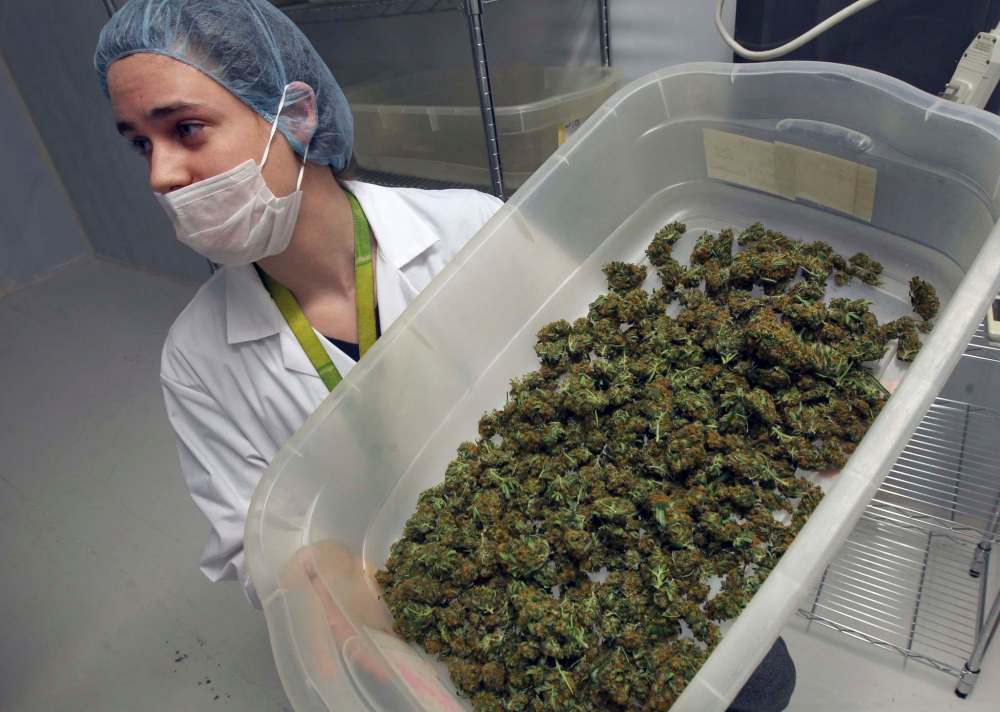
The industry estimates even if the current licensed producers increase their output by 10 times, it still won’t meet the demand expected to materialize once recreational use of marijuana is legalized.
Despite its funding challenges, Delta 9 is energetically planning to expand. It is currently in the process of switching its production methodologies to hydroponics, which Arbuthnot said will create more efficiencies.

It is also testing the use of shipping containers for the growing environments, which, among other things, will allow Delta 9 to double its production space to 150,000 square feet by double-stacking containers.
“We remain bullish,” Arbuthnot said. “We believe we are positioned over the long term to be one of the country’s premium producers and distributors of marijuana and medical marijuana products.”
While Delta 9 is in the process of finalizing a capital raise, earlier this year it entered into a partnership with a company in Ottawa called GrowPros Cannabis Ventures Inc. Delta 9 will have the chance to earn about $2 million by assisting GrowPros in achieving a number of milestones.
GrowPros is in the process of building a production facility in Quebec, and is about to file its licence application with Health Canada.
martin.cash@freepress.mb.ca