

Little Brown Jug’s big story
Chance meeting led to founding of new microbrewery
Advertisement
Read this article for free:
or
Already have an account? Log in here »
To continue reading, please subscribe:

Digital Subscription
One year of digital access for only $205*
- Enjoy unlimited reading on winnipegfreepress.com
- Read the E-Edition, our digital replica newspaper
- Access News Break, our award-winning app
- Play interactive puzzles
*First annual payment billed as $205.00 + GST for one year. This annual subscription will automatically renew at $233.00 + GST every 52 weeks (10% off the regular annual price of $259.35). Offer available to new and qualified returning subscribers only. Cancel any time.
To continue reading, please subscribe:
Add Free Press access to your Brandon Sun subscription for only an additional
$1 for the first 4 weeks*
- Enjoy unlimited reading on winnipegfreepress.com
- Read the E-Edition, our digital replica newspaper
- Access News Break, our award-winning app
- Play interactive puzzles
*Your next Brandon Sun subscription payment will increase by $1.00 and you will be charged $17.95 plus GST for four weeks. After four weeks, your payment will increase to $24.95 plus GST every four weeks.
Read unlimited articles for free today:
or
Already have an account? Log in here »
Hey there, time traveller!
This article was published 19/12/2016 (3575 days ago), so information in it may no longer be current.
It was a chance meeting on the street last year that led to the recent conversion of a century-old office/retail building in the West Exchange District into one of the city’s newest microbreweries.
The meeting was between Kevin Selch — founder of the Little Brown Jug microbrewery and taproom — and the building’s co-owner, Brian Sharfstein.
Scharfstein and his wife and business partner, Pam Cipryk, own Canadian Footwear. They bought the 1½-storey building at 336 William Ave. about two years ago because they wanted to expand their footprint in the downtown and because it was located immediately behind their main retail outlet, on Adelaide Street.
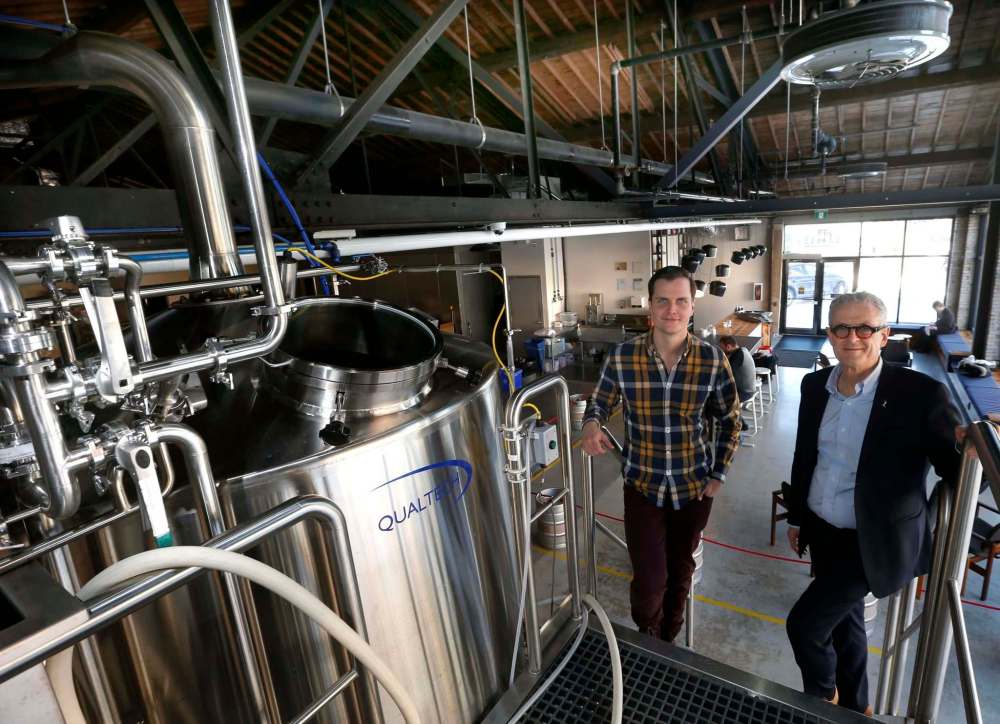
At the time, Selch was working as an economist with the federal government in Ottawa. But he was planning to quit that job and move back to his hometown of Winnipeg to start up a new microbrewery in the city’s Exchange District. All he needed was the right building to lease. His real estate agent suggested he check out the William Avenue building, whose tenants over the years have included the Red River Motor Coach Company, Western Paint’s wallpaper store and, most recently, a local design company.
When he and Scharfstein bumped into each other in the parking lot in May of last year, Selch didn’t know Scharfstein owned the building, and Scharfstein didn’t know Selch was interested in leasing it.
“But I believe in fate,” Scharfstein said during a recent interview. “We just started talking, and we realized we had a shared vision for what we could do with the building. There was a chemistry there, no question.”
“I think we also both shared a vision for what the downtown is becoming, and we saw this (the restoration and revitalization of the building) as a city-building activity to create the kind of city we both want to live in,” Selch added. “This would be one piece to help do that.”
They were also in agreement that while extensive upgrades and renovations would be needed, it was important to preserve as many of the building’s original architectural features as possible. That included exposing the original interior brick walls, the steel support beams and ceiling joists and the original wooden roof.
To preserve the original roof, a new roof was installed on top of it. All the building’s old mechanical systems were also replaced, some window openings that had been covered over were reopened and new windows were installed throughout the building.
A new, reinforced concrete floor that could bear the weight of the brewery equipment also had to be installed, and a mezzanine floor in the back half of the building was removed to create a single, large and open space that would be big enough to house all of the brewery equipment plus a taproom, where customers could come to pick up their jugs of beer, or sit down, enjoy a beer and watch the product being made.
Selch also wanted the brewery to be as green as possible. So to reduce energy costs, he installed an energy-recovery system that enables him to capture and reuse heat and energy from the brewery’s boiler to heat new water coming into the building, as well as the building itself.
He will also be able to capture the heat that comes off a large compressor and a large chiller and use it to help heat the building. During the summer, the excess heat will be vented out of the building to keep the interior cooler.
Within the next two years, Selch also plans to install a waste-water-management system in the basement, which will allow him to treat the brewery’s waste water before it goes into the city sewers. He also arranged for a local farmer to come and take away the leftover grain from the brewing process, which the farmer uses to feed his livestock.
Selch said Manitoba Hydro has been invaluable in helping him design the new energy-recovery and waste-management systems. He said while Little Brown Jug isn’t the first brewery to install the systems, it’s unusual for a startup company to go to these lengths because of the costs involved.
“But we’re just trying to do the right thing and to take a long-term vision for our footprint here,” he added.
Scharfstein wouldn’t say exactly how much he and his wife have spent on refurbishing and upgrading their 10,000-square-foot building.
“We’re talking hundreds of thousands of dollars. We ended up spending a couple of hundred thousand more than we anticipated, but we believe it was money well-invested.”
He said they wanted to create an iconic building that would add to the ongoing efforts to revitalize the downtown. He noted four years ago, they also spent about $600,000 on renovations and upgrades to their Canadian Footwear building. Initially called the North Star Cold Storage Company building, that structure dates back to the 1940s and was originally two buildings that were combined into one.
He said Little Brown Jug was exactly the kind of tenant they had hoped to land for their William Avenue property.
“Kevin’s vision and plan for what he wanted to do here really excited us. We really believe in what he is doing.”

He said not only will the brewery and taproom help to attract people to the Exchange, but they also create new jobs for the area. The brewery currently employs three people, including Selch, but that’s expected to grow to 10 to 12 employees within the next two to three years.
“And these are good-paying jobs we’re creating here,” Selch added.
Selch was an economist with the federal government for 10 years before deciding to shift gears and pursue his dream of owning his own microbrewery.
“After studying small business and what makes them succeed from a policy perspective, it’s been interesting to try my own hand at it,” he added.
murray.mcneill@freepress.mb.ca