

Loewen not leavin’
Octogenarian business innovator happy to keep working until successor found
Advertisement
Read this article for free:
or
Already have an account? Log in here »
To continue reading, please subscribe:
Digital Subscription
One year of digital access for only $1.44 a week*
- Enjoy unlimited reading on winnipegfreepress.com
- Read the E-Edition, our digital replica newspaper
- Access News Break, our award-winning app
- Play interactive puzzles
*Billed as $5.77 plus GST every four weeks. After 52 weeks, price increases to the regular rate of $19.95 plus GST every four weeks. Offer available to new and qualified returning subscribers only. Cancel any time.
To continue reading, please subscribe:
Add Free Press access to your Brandon Sun subscription for only an additional
$1 for the first 4 weeks*
- Enjoy unlimited reading on winnipegfreepress.com
- Read the E-Edition, our digital replica newspaper
- Access News Break, our award-winning app
- Play interactive puzzles
*Your next Brandon Sun subscription payment will increase by $1.00 and you will be charged $17.95 plus GST for four weeks. After four weeks, your payment will increase to $24.95 plus GST every four weeks.
Read unlimited articles for free today:
or
Already have an account? Log in here »
Hey there, time traveller!
This article was published 19/01/2018 (3068 days ago), so information in it may no longer be current.
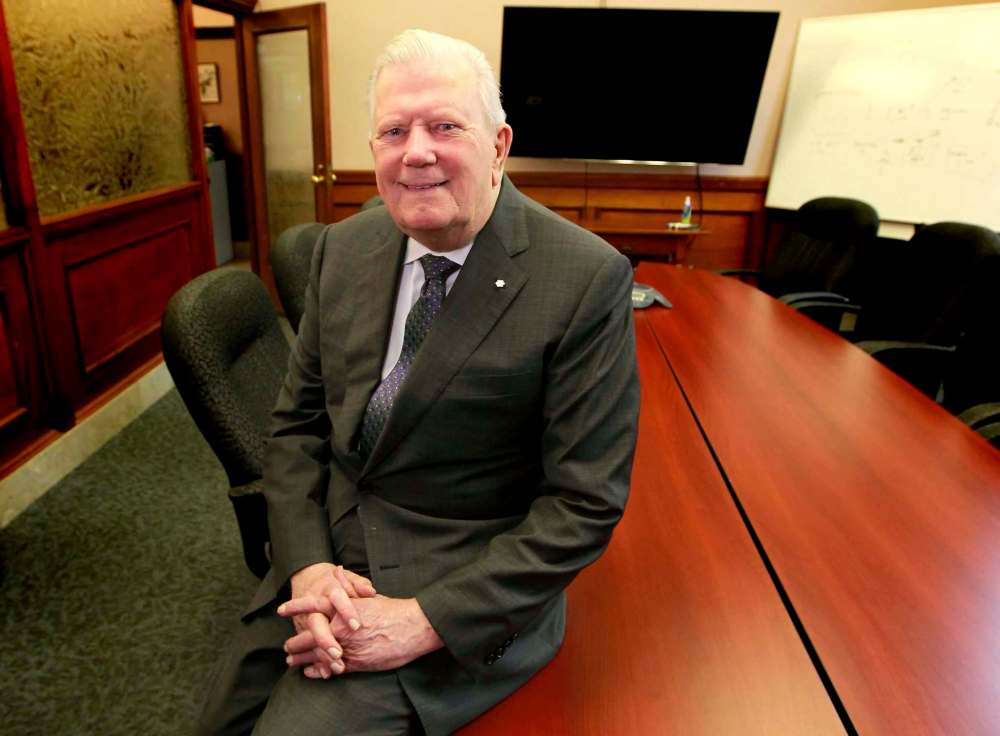
Bill Loewen may have the demeanour of a kindly gentleman, but he’s also an incessant innovator who’s always been just a little ahead of his time, even this year, the 50th anniversary of the start of his first business, Comcheq Inc.
At 87 years old, he acknowledges he’d leave his position next month as president of his bill payment company, Telpay Inc., if he found the right person to succeed him.
That’s the thing. After 50 years in the business, he has so much institutional knowledge of the particular niche of the financial services industry he operates in, he will always be hard to replace.
His nephew and former colleague, John Loewen, laughs when asked how long Bill has been saying he’s looking for the right person to succeed him.
“No one knows the business better than him,” said John Loewen, the former provincial cabinet minister who was briefly the president of Telpay after he left politics about 10 years ago. “One of the challenges for an entrepreneur or someone who invented an industry is that no one knows it as well as them. So it’s hard to find someone who can do the job better than him.”
When the Comcheq transaction was being completed, Bill Loewen kept ownership of Telpay, a novel direct bill payment business that was in startup mode at the time. The idea was people could pay bills using a touch-tone phone. No one else had such a system and, in its early days, many of the large banks in the country contracted with Telpay to provide a direct bill-paying service for their customers.
Eventually, the banks learned how to do it themselves and they brought that business in-house, prompting Telpay to launch a few civil suits against the banks for breach of contract.
“After a while, we had to decide if we wanted to be a legal firm or a bill payment firm,” Bill Loewen said recently in his Telpay office in a downtown Winnipeg heritage building. So the company pivoted and is marketed primarily as a service to businesses.
Now Telpay is a thriving business, with 50 employees whose platform completed 15 million transactions last year with about $20 billion changing bank accounts. About 12,000 businesses now pay a $15 monthly software subscription and a mere 50 cents per transaction to use Telpay’s platform to make direct deposits to pay their bills. The company has signed up more than 100,000 billers across the country, by far the most of anyone in the industry.
In the era of technology disruption, Telpay isn’t necessarily immune, but it may very well have such a solid foundation, albeit in a small industry niche, that it still has plenty of potential to develop its business. For instance, its experience in the trust business — handling massive sums of money for very brief periods of time — is seen as a benchmark for potential federal government guidelines.
Loewen is comfortable and used to the role of the slightly maverick outsider working on the fringe of a business dominated by massive corporations.
When he started Comcheq, it was one of the first independent outsourced payroll companies in the country that could use one bank account, as it were, to issue payroll cheques for many different companies. He’s always been comfortable with technology, but that’s not necessarily what’s driven his innovations.
In his early career as a chartered accountant, Loewen was always looking for ways to get payrolls done more efficiently.
“I realized that if you had a bunch of payrolls to run, and had to run them on all from individual bank accounts, that’s pretty inefficient,” he said. “But if you could run a whole bunch of them as a production line, and draw them all from the same bank account and print them all on one form, then it would become very efficient.”
He believes that’s what made Comcheq a success.
“Just that one simple thing and it had more to do with how you pay the employees than how the computer might do it,” he said.
When he sold Comcheq to CIBC in 1992 — it was one of the largest businesses of its kind with about $20 million in revenue — the process of direct deposit was just coming into widespread use.
He’s rueful today about the sale, partly acknowledging he may indeed have been ahead of his time. At the time, he was worried about the credit risk that direct deposits posed.
“When we were paying employees by cheques, if companies’ cheques bounced, then we would bounce the employees’ cheques and then the companies and their banks got together and they figured out how to fix things. But when you do direct deposit, you can’t pull the direct deposit back. So that safety net disappeared.”
Loewen now says “it was bad judgment on my part” to sell Comcheq when he did, because that credit risk has not hurt others in the business. He also acknowledges he was paid well for the company, but it’s not hard to tell that Loewen does not care that much about the trappings of success.

Telpay’s office has the interior design features of “an old-fashioned accounting office,” said a longtime admirer of Loewen’s business style, complete with plastic film across what looks like the original heritage window for extra protection in the winter months.
Loewen does not seem to be self-conscious about his age. He said he is serious about efforts to find a successor and is in the process of restructuring the business to make it more manageable.
Asked if loved ones or colleagues tell him he should let it go, he replied with a deadpan, “Not to my face.”
martin.cash@freepress.mb.ca