

Rail backlog ‘a crisis’ requiring federal action: farmers
Advertisement
Read this article for free:
or
Already have an account? Log in here »
To continue reading, please subscribe:
Digital Subscription
One year of digital access for only $1.44 a week*
- Enjoy unlimited reading on winnipegfreepress.com
- Read the E-Edition, our digital replica newspaper
- Access News Break, our award-winning app
- Play interactive puzzles
*Billed as $5.77 plus GST every four weeks. After 52 weeks, price increases to the regular rate of $19.95 plus GST every four weeks. Offer available to new and qualified returning subscribers only. Cancel any time.
To continue reading, please subscribe:
Add Free Press access to your Brandon Sun subscription for only an additional
$1 for the first 4 weeks*
- Enjoy unlimited reading on winnipegfreepress.com
- Read the E-Edition, our digital replica newspaper
- Access News Break, our award-winning app
- Play interactive puzzles
*Your next Brandon Sun subscription payment will increase by $1.00 and you will be charged $17.95 plus GST for four weeks. After four weeks, your payment will increase to $24.95 plus GST every four weeks.
Read unlimited articles for free today:
or
Already have an account? Log in here »
Hey there, time traveller!
This article was published 01/03/2018 (3016 days ago), so information in it may no longer be current.
OTTAWA — Grain farmers say a railway backlog is on track to repeat the billions of dollars lost four years prior, and want Ottawa to put up emergency help to prevent a devastating blow to the Prairies.
“We have a crisis happening in the grain situation, and I think it’s time that the rest of Canada understands this story,” Ron Bonnett, head of the Canadian Federation of Agriculture (CFA), told reporters Thursday.
Bonnett was flanked by partner groups from the Prairies, including the Manitoba group Keystone Agricultural Producers (KAP), warning of a dire economic hit this spring.
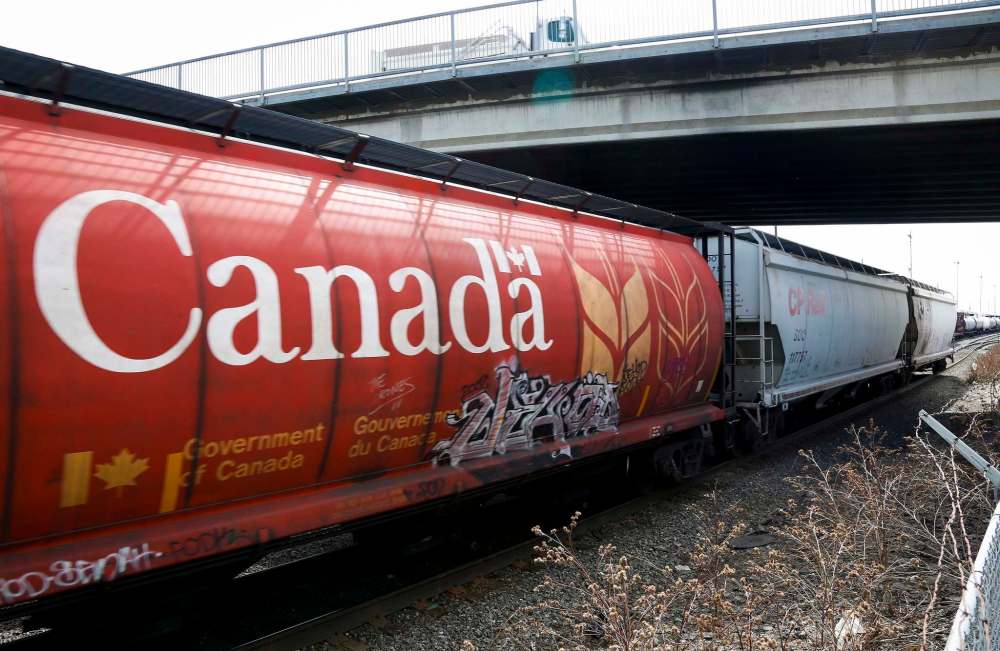
Canada’s largest grain harvest came in 2013, but billions of dollars in profit were scuttled in early 2014, as railways bungled communication between various areas, and faced frigid temperatures that slowed and stopped shipments near the Rockies.
KAP president Dan Mazier said Canada seems on track to replicate those problems, after the second-largest harvest on record.
According to weekly figures from the Ag Transport Coalition, Canadian National Railway (CN) provided just 17 per cent of ordered cars last week, a number that has dropped for six consecutive weeks. Canadian Pacific (CP) has been filling roughly two-thirds of requested cars.
Mazier said the number has been closer to six per cent for Manitoba farmers.
The farmers want interim help, like a legislative order that would prioritize grain shipments to avoid a similar fiasco, but Ottawa doesn’t seem likely to oblige.
Transport Minister Marc Garneau embedded a reform of grain-transportation rules within Bill C-49, a sweeping overhaul of Canada’s transportation system. But the massive legislation has crawled slowly through Parliament. It includes everything from the first commercial-airline passenger bill of rights, to requiring recorders in some locomotives.
The Senate transportation committee is still studying the bill, and its members expect that to continue for at least a month. That’s why Mazier and his provincial counterparts are asking for interim solutions, like those put in place by the former Conservative government during the last crisis.
In March 2014, ministers issued a formal decree known as an Order in Council, compelling CN and CP to meet weekly quotas of grain or face millions in fines.
“This is Garneau’s baby; he can handle it. He has lots of tools available to him, so step up,” Mazier said. “It does stop with him.”
He recalled speaking with the Free Press about this issue last October. “We saw this coming.”
Bonnett said the uncertainty is taking a toll on Canada’s reputation among commodity buyers abroad, and putting a mental-health toll on farmers.
“It’s not just about the farmers, but the farmers’ families, it’s about people in the communities. This is hitting all of Western Canada; it’s hitting the dockworkers in British Columbia,” he said. “This is a human story.”
Mazier said Manitoba farmers are two months away from planting seeds, and are having difficulty planning how much and what varieties they should grow. “Things are moving ahead on the farm, but they’re not moving ahead in the transportation agency.”
Agriculture Minister Lawrence MacAulay riled delegates Wednesday at the CFA’s annual policy meeting when he suggested grain flow was “not real serious at the moment,” though he backtracked on those comments. He said CN had assured him cars would be moving “very shortly.”
On Thursday, MacAulay would not speak to whether interim help was coming, and instead said he and Garneau have spoken with CN “to express our concerns.”
“Our government is fully aware of the serious issues facing grain farmers,” MacAulay wrote in an email, with few specifics.
“Our government is urging the senate to pass Bill C-49,” which he noted was introduced last May.
The federal Conservatives joined forces Thursday with the NDP outside the House of Commons, calling for an emergency committee study to look at how Ottawa can avoid a catastrophe.
“This is an issue that is of the utmost seriousness, and it demands action across party lines,” NDP MP Alistair MacGregor said.
The Liberals have avoided Tory calls to split Bill C-49 to expedite parts about rail shipments of grain. MacAulay defended that decision, telling reporters the bill is a long-term fix to multiple issues. He wouldn’t say whether the Liberals would consider any interim measures.
In a detailed email, CN Rail said it’s moved more grain out of Manitoba than the same time last year, and it’s cleared up inventory and space at its Winnipeg railyard.
“We recognize that challenging conditions, together with high demand across all commodities this year, have had a real impact on our performance and the service we’ve provided in recent weeks in Western Canada overall,” spokeswoman Kate Fenske wrote. “As weather continues to improve, so is our network fluidity.”

But Mazier said those later deliveries will be hampered by Manitoba’s springtime road restrictions, which lower the weight allowed on smaller roads, because thawed ground and pavement wears down easier.
“They’re shifting even the wear and tear on the infrastructure onto individual provinces. So we’re paying, again, through the taxpayers because of railway’s economic inactivity,” he said.
In 2012, the former Conservative government disbanded the Canadian Wheat Board’s (CWB) monopoly. Some analysts claim the CWB would have better managed rail capacity, but others say a historically large harvest and harsh winter conditions would have posed the same problems.
dylan.robertson@freepress.mb.ca