

Soil health is key to farm sustainability
Specialist promotes practices to keep land nourished
Advertisement
Read this article for free:
or
Already have an account? Log in here »
To continue reading, please subscribe:

Digital Subscription
One year of digital access for only $205*
- Enjoy unlimited reading on winnipegfreepress.com
- Read the E-Edition, our digital replica newspaper
- Access News Break, our award-winning app
- Play interactive puzzles
*First annual payment billed as $205.00 + GST for one year. This annual subscription will automatically renew at $233.00 + GST every 52 weeks (10% off the regular annual price of $259.35). Offer available to new and qualified returning subscribers only. Cancel any time.
To continue reading, please subscribe:
Add Free Press access to your Brandon Sun subscription for only an additional
$1 for the first 4 weeks*
- Enjoy unlimited reading on winnipegfreepress.com
- Read the E-Edition, our digital replica newspaper
- Access News Break, our award-winning app
- Play interactive puzzles
*Your next Brandon Sun subscription payment will increase by $1.00 and you will be charged $17.95 plus GST for four weeks. After four weeks, your payment will increase to $24.95 plus GST every four weeks.
Read unlimited articles for free today:
or
Already have an account? Log in here »
Hey there, time traveller!
This article was published 10/11/2018 (2834 days ago), so information in it may no longer be current.
It’s a dirty business, teaching farmers about soil — enough to drive Jay Fuhrer to eating cheese balls.
As the “soil health specialist” prepared his show and tell before a Saskatoon audience recently, he joked the only reason he buys cheese balls at his local grocer’s is because they come in a perfectly sized jar for the tests he was about to perform.
His point? You don’t need to be a scientist with a fully equipped laboratory to assess the health of your soil or measure the impacts of management practices on a farmer’s most important resource.
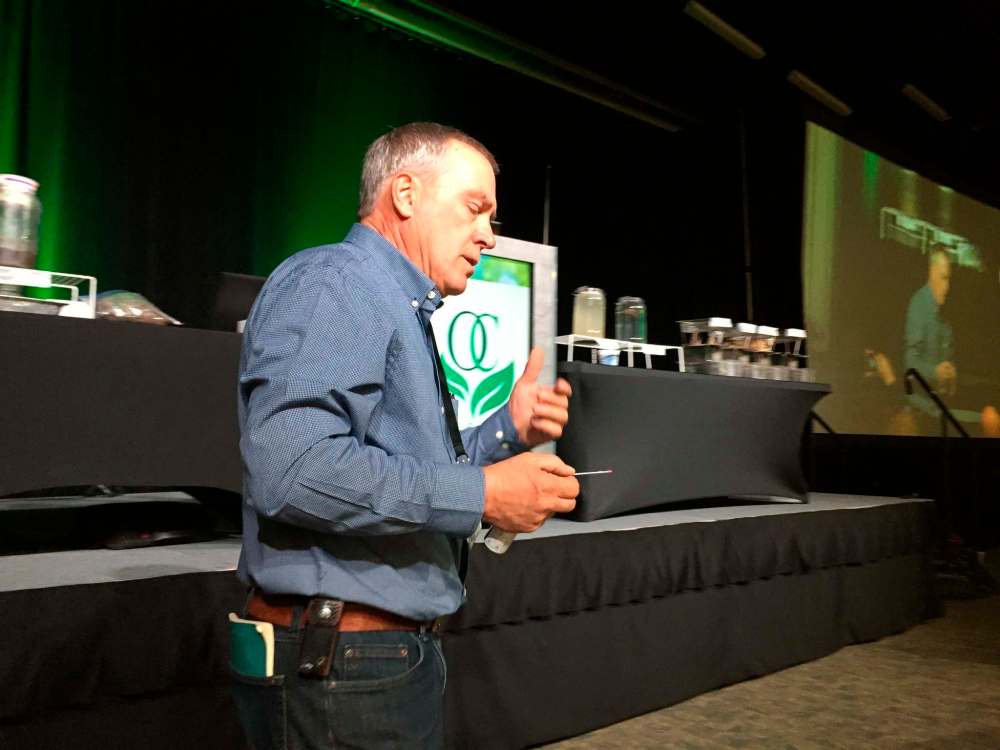
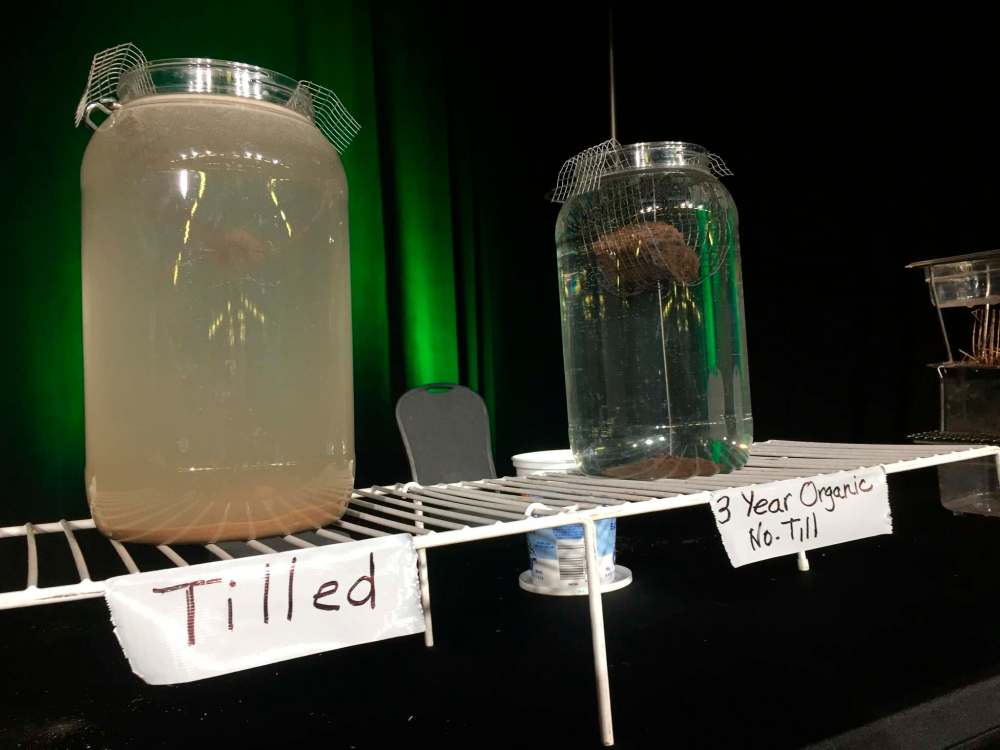
With the aplomb of a magician, Fuhrer poured water over two clumps of soil suspended by netting in the cheese ball jars. One came from a field that sees regular tillage, the other from a field that had seen no tillage for three years.
The clump of soil from a tilled field quickly disintegrated, turning the water muddy. The water’s surface quickly became coated with a scum-like film, which Fuhrer later described as the “glue” or glomalin produced by fungi that holds healthy soils together.
The clump of soil in the other jar remained intact, even after an hour sitting in water. The water remained clear with no evidence of breakdown or scum.
Fuhrer later conducted another test in which he measured the levels of nitrate in water after it had been poured through soil that was tilled and soil that wasn’t. There were much higher levels of nitrate, a major contaminant of rural water systems, in the runoff water from the tilled soil.
These were simple, visual demonstrations that left no doubt about how tillage breaks down soil over time, leaving it devoid of living organisms, incapable of absorbing water and vulnerable to erosion. He encouraged the 300 farmers in the room to go home and try these tests and others on their own farms to see for themselves.
Fuhrer, who works for the U.S. Department of Agriculture’s Natural Resources Conservation Service in Bismarck, N.D., is speaking to sellout crowds in meeting rooms across the Northern Great Plains these days — not so much because he’s bringing new revelations to the discussion, but because of his ability to digest the complicated world of soil science into simple concepts with practical applications.
Although he was speaking to organic farmers in Saskatoon, Fuhrer is agnostic on the debate over which farming system is best.
He knows full well that economics drive farmers’ decision-making, and he understands how approaches that involve short-term pain for long-term gain can be a hard sell. He struggled with that himself over the past 38 years, working with farmers in soil and water conservation.
“For me, the economics of the whole thing depends on how long you want to farm,” he says.
He talks to lots of farmers who say their grandfathers were great farmers, their dads did OK and they are struggling. He says the answer to that riddle lies in their soil.
Many of the ills plaguing modern crop farmers — erosion, salinity, declining fertility, water-quality issues, the occurrence of droughts and floods in the same year — are “classic symptoms” of degraded soils, he says.
“If you have more carbon entering your soil than leaving, your children will likely farm your land,” Fuhrer says. “If you have more carbon leaving than entering, then it is likely that they won’t.”
It’s a simple concept with complicated implications. Everything that farmers do in annual cropping — whether it is the crops they choose to grow, removal of seed, removing the straw or land management practices — is about extracting resources.

“What it comes down to is what you are willing to do to offset that loss.”
He promotes practices based on the basic principles of soil health: soil armour, minimal soil disturbance, plant diversity, continual living roots in the soil, and integrating livestock.
His ability to draw an audience suggests more farmers are listening and putting his methods to work. Some of those farmers are from Manitoba and are featured in the award-winning film From Seed to Seed, airing this weekend at Cinematheque.
For more information go to: winnipegfilmgroup.com/product/from-seed-to-seed.
Laura Rance is editorial director at Glacier FarmMedia. She can be reached at 204-792-4382 or lrance@farmmedia.com.