

Political uncertainty sends North American markets spiralling
Advertisement
Read this article for free:
or
Already have an account? Log in here »
To continue reading, please subscribe:

Digital Subscription
One year of digital access for only $205*
- Enjoy unlimited reading on winnipegfreepress.com
- Read the E-Edition, our digital replica newspaper
- Access News Break, our award-winning app
- Play interactive puzzles
*First annual payment billed as $205.00 + GST for one year. This annual subscription will automatically renew at $233.00 + GST every 52 weeks (10% off the regular annual price of $259.35). Offer available to new and qualified returning subscribers only. Cancel any time.
To continue reading, please subscribe:
Add Free Press access to your Brandon Sun subscription for only an additional
$1 for the first 4 weeks*
- Enjoy unlimited reading on winnipegfreepress.com
- Read the E-Edition, our digital replica newspaper
- Access News Break, our award-winning app
- Play interactive puzzles
*Your next Brandon Sun subscription payment will increase by $1.00 and you will be charged $17.95 plus GST for four weeks. After four weeks, your payment will increase to $24.95 plus GST every four weeks.
Read unlimited articles for free today:
or
Already have an account? Log in here »
Hey there, time traveller!
This article was published 26/12/2018 (2835 days ago), so information in it may no longer be current.
North American markets plunged to their lowest levels of the year as political uncertainties sent the Dow Jones industrial average to its worst-ever Christmas Eve trading session.
The market moved on ongoing concerns about a trade skirmish between China and the U.S. and political negativity coming from the United States, says Allan Small, senior investment adviser with HollisWealth.
That includes a partial U.S. government shutdown, tweets by U.S. President Donald Trump, rumours that he has asked about firing the Federal Reserve chairman and weekend calls by the Treasury secretary to the heads of the largest U.S. banks.
Just when markets open higher and appear to be ready to stage a rally, someone in the administration says something that hurts market sentiment, Small said in an interview.
“It just seems like there’s nothing positive happening,” he said, pointing to Trump’s tweets as predominately negative.
“I think a lot of his tweets, unfortunately, right now are causing more anxious moments than positive moments.”
The S&P/TSX composite index closed down 155.25 points at 13,780.19 after hitting a low of 13,776.88 for the year in very light trading. The Toronto Stock Exchange closed at 1 p.m. Monday and reopens Thursday after a two-day holiday.
U.S. stock markets suffered their steepest Christmas Eve decline in decades Monday, defying the best efforts by the Trump administration to instil confidence, and coming very close to ending a record 10-year upward run.
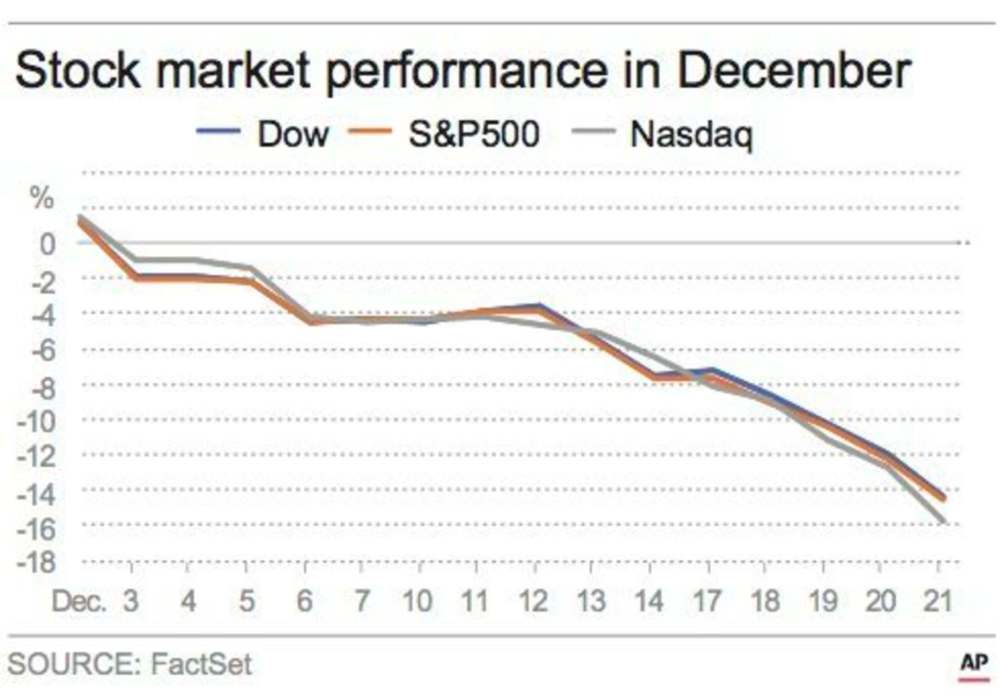
By the end of Monday’s shortened holiday trading session, the great bull market that began in the lows of March 2009 lay lifeless, capping a three-week, 16 per cent sell-off of the S&P 500.
Trump and administration officials faced intense scrutiny of their unorthodox attempts to steady nervous markets. Treasury Secretary Steven Mnuchin’s Sunday phone calls to major U.S. banks further stoked anxiety among traders, while Trump’s Monday tweet attacking the Federal Reserve for not having “a feel for the Market” appeared to exacerbate the day’s sell-off.
Investors have been shaken by recent economic and political developments, including the abrupt resignation of Defence Secretary Jim Mattis, a partial federal government shutdown, an interest rate hike by the Federal Reserve, speculation that Trump might seek to fire Fed chairman Jerome Powell, Mnuchin’s unusual calls to U.S. banks and Trump’s sudden decision to withdraw U.S. troops from Syria against the counsel of his national security team.
Democratic leaders attributed the stock market declines to Trump.
“It’s Christmas Eve and President Trump is plunging the country into chaos. The stock market is tanking and the president is waging a personal war on the Federal Reserve — after he just fired the Secretary of Defence,” House Minority Leader Nancy Pelosi and Senate Minority Leader Charles Schumer said in a joint statement shortly after markets closed Monday.
Amid the flurry of events, Mnuchin and acting White House chief of staff Mick Mulvaney had sought to calm investors Sunday by insisting that the fundamentals of the economy remain strong.
But their efforts were unsuccessful, as market nervousness was on full display Monday. The Dow Jones industrial average smashed its century-old record for a Christmas Eve percentage drop, falling 653 points, or just under three per cent.
On Tuesday, Trump said he has confidence in Mnuchin, calling him a “very talented guy” and a “very smart person.”
In Trump-land, this usually means Mnuchin’s days are numbered.
Trump reiterated his view that the Federal Reserve is raising interest rates too fast, but called the independent agency’s rate hikes a “form of safety” for an economy doing well.
“I can’t tell you the last time a percentage fall came in that short a time,” said Scott Wren, global equity strategist at the Wells Fargo Investment Institute. “Just three weeks ago, we were still looking at a successful 2018. Stocks then fell off a cliff.”
The slide spread to Asia on Tuesday morning, with Japan’s Nikkei 225 share index down more than five per cent at midday and Shanghai’s main share index down nearly 2.5 per cent by 11 a.m. The dollar hit a four-month low of 110.05 against the yen in Tokyo, extending a seven-day losing streak. Traders and experts there talked of a “Black Christmas” and the “Powell shock.”
December is usually a healthy month for stocks, but this one has been the worst since 1931.
The tech-heavy Nasdaq Composite that was key to the bull market declined 140 points Monday, about 2.2 per cent on the day, to sink deeper into bear territory. A bear market is 20 per cent off recent highs.

The S&P 500 was down 65 points, or 2.71 per cent, to close at 2,351. All 11 sectors of the S&P were down and are negative for 2018.
Investors are still grasping onto hopes of a last-minute recovery. Since 1950, stocks have rallied 1.3 per cent on average during the last five days of the year and the first two days of the new year.
As blue chips sank even deeper into the red, Trump inserted himself into the conversation. Ensconced at the White House and, in his own telling, “all alone” on Christmas Eve, Trump took to Twitter to assign sole blame for the sell-off to the Federal Reserve. He likened the central bank to a golfer who “can’t putt.”
“The only problem our economy has is the Fed,” the president said in a tweet. “They don’t have a feel for the Market, they don’t understand necessary Trade Wars or Strong Dollars or even Democrat Shutdowns over Borders. The Fed is like a powerful golfer who can’t score because he has no touch — he can’t putt!”
— from Free Press wire services
Related Articles
TSX heading to worst year in a decade
Advertisement Advertise With Us
Advertisement Advertise With Us