

Den Oudsten took a flyer and made it soar
Advertisement
Read this article for free:
or
Already have an account? Log in here »
To continue reading, please subscribe:

Digital Subscription
One year of digital access for only $205*
- Enjoy unlimited reading on winnipegfreepress.com
- Read the E-Edition, our digital replica newspaper
- Access News Break, our award-winning app
- Play interactive puzzles
*First annual payment billed as $205.00 + GST for one year. This annual subscription will automatically renew at $233.00 + GST every 52 weeks (10% off the regular annual price of $259.35). Offer available to new and qualified returning subscribers only. Cancel any time.
To continue reading, please subscribe:
Add Free Press access to your Brandon Sun subscription for only an additional
$1 for the first 4 weeks*
- Enjoy unlimited reading on winnipegfreepress.com
- Read the E-Edition, our digital replica newspaper
- Access News Break, our award-winning app
- Play interactive puzzles
*Your next Brandon Sun subscription payment will increase by $1.00 and you will be charged $17.95 plus GST for four weeks. After four weeks, your payment will increase to $24.95 plus GST every four weeks.
Read unlimited articles for free today:
or
Already have an account? Log in here »
Hey there, time traveller!
This article was published 19/03/2019 (2732 days ago), so information in it may no longer be current.
Jan den Oudsten was so attached to the Winnipeg bus company he salvaged from the edge of the scrap heap in the mid-80’s that when New Flyer Industries was sold in 2004 by the private equity firm that he had partnered with he couldn’t bear to stay in Winnipeg if it meant he was not going to be able to be part of the company he built.
Den Oudsten, now 88, is back in Winnipeg this week being honoured by Red River College marking the renaming of the college’s Heavy Equipment Transportation Centre to the Jan den Oudsten Vehicle Technology & Research Centre (VTRC) after den Oudsten and his wife and partner, Maria, donated $1.5 million to Red River College, one of the college’s largest ever gifts from an individual donor.
This week he’s also receiving the Pioneer award from the Canadian Manufacturers & Exporter at a gala dinner on Thursday.
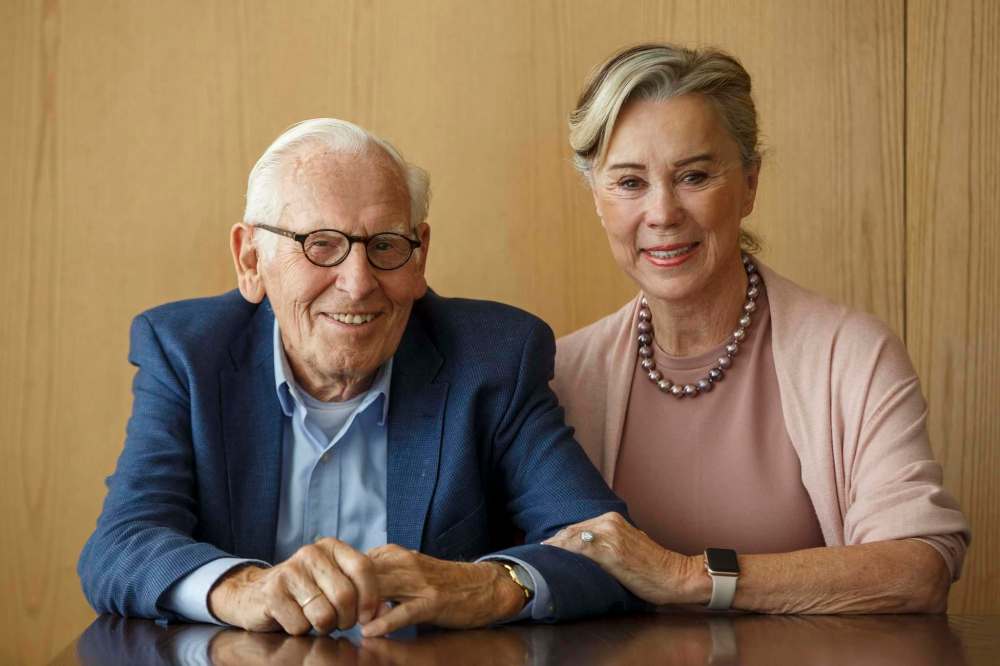
Although slowed down a little with some health issues — den Oudsten now leans heavily on a cane — he’s still sharp and engaged.
“I’m very happy the company is still doing well,” he said of New Flyer Industries.
When he acquired Flyer Industries from the Manitoba government in the mid-’80s for about $1 million there were a couple of hundred employees and a very uncertain future.
But den Oudsten knew a lot about buses — his family owned a bus company in The Netherlands — and he had some very specific ideas about how to improve the company, that he renamed New Flyer, whose graphic wing logo was the same as that of his family’s Dutch company, Den Oudsten Bussen.
He is credited with bringing low floor technology to the North American market that is now standard in the industry and was involved in other innovations like the early development of hydrogen fuel cell technology applications and the 60-foot articulated diesel-electric hybrid bus.
He said he believes that electric buses are the technology of the future — “But you still have to figure out how to deal with the batteries,” he said — and remembered that the company built electric trolley buses when he was at the helm.
He admits he is not intimately knowledgeable about the goings on at the company, which was recently renamed NFI Group Inc., but said he believes the drop in share price — NFI shares have lost about half their value over the course of the last 12 months — is probably more about some previous over-exuberance than anything specific to the company or its market.
When they left Winnipeg, den Oudsten and his wife moved to Bragg Creek, in the foothills of the Rockies just west of Calgary where they lived for several years. They also did a stint in Vancouver and recently moved to Toronto to be close to their son as well as travelling to The Netherlands and to their winter home in Curacao.
Both he and Maria say their time in Winnipeg was among their happiest. Maria has founded a charitable fund raising organization themed around snowmen after learning to love the snow during her residency in Winnipeg.
Den Oudsten has already been inducted into both the Canadian Urban Transit Association’s and American Public Transit Association’s Hall and Fame.

He grew up in the bus business, the 10th child of 14. His move to Canada and acquisition of Flyer in 1985 came about because of his belief that the family business was too small and would not be able to continue to innovate.
Depending on the global economic environment, any growing business will have its ups and downs. After the economic gyrations caused by the Y2K scare and the bursting of the dot.com bubble, the banks were getting antsy and despite the fact that New Flyer’s business was going well new equity was required.
That’s when KPS Special Situation Fund came in to partner with den Oudsten. But the deal required den Oudsten to tender his shares when KPS sold, which came about only 18 months later. They made about 10 times return on that short investment, which meant den Oudsten also walked away a wealthy man.
But unlike most of us who would gladly take the money and run, den Oudsten did so with a heavy heart leaving behind a company he built from 150 employees when he started less than 20 years earlier to one that had 2,000 employees.
martin.cash@freepress.mb.ca