

Labour lost
Brexit may curb immigration but also automate jobs
Advertisement
Read this article for free:
or
Already have an account? Log in here »
To continue reading, please subscribe:

Digital Subscription
One year of digital access for only $205*
- Enjoy unlimited reading on winnipegfreepress.com
- Read the E-Edition, our digital replica newspaper
- Access News Break, our award-winning app
- Play interactive puzzles
*First annual payment billed as $205.00 + GST for one year. This annual subscription will automatically renew at $233.00 + GST every 52 weeks (10% off the regular annual price of $259.35). Offer available to new and qualified returning subscribers only. Cancel any time.
To continue reading, please subscribe:
Add Free Press access to your Brandon Sun subscription for only an additional
$1 for the first 4 weeks*
- Enjoy unlimited reading on winnipegfreepress.com
- Read the E-Edition, our digital replica newspaper
- Access News Break, our award-winning app
- Play interactive puzzles
*Your next Brandon Sun subscription payment will increase by $1.00 and you will be charged $17.95 plus GST for four weeks. After four weeks, your payment will increase to $24.95 plus GST every four weeks.
Read unlimited articles for free today:
or
Already have an account? Log in here »
Hey there, time traveller!
This article was published 01/06/2019 (2676 days ago), so information in it may no longer be current.
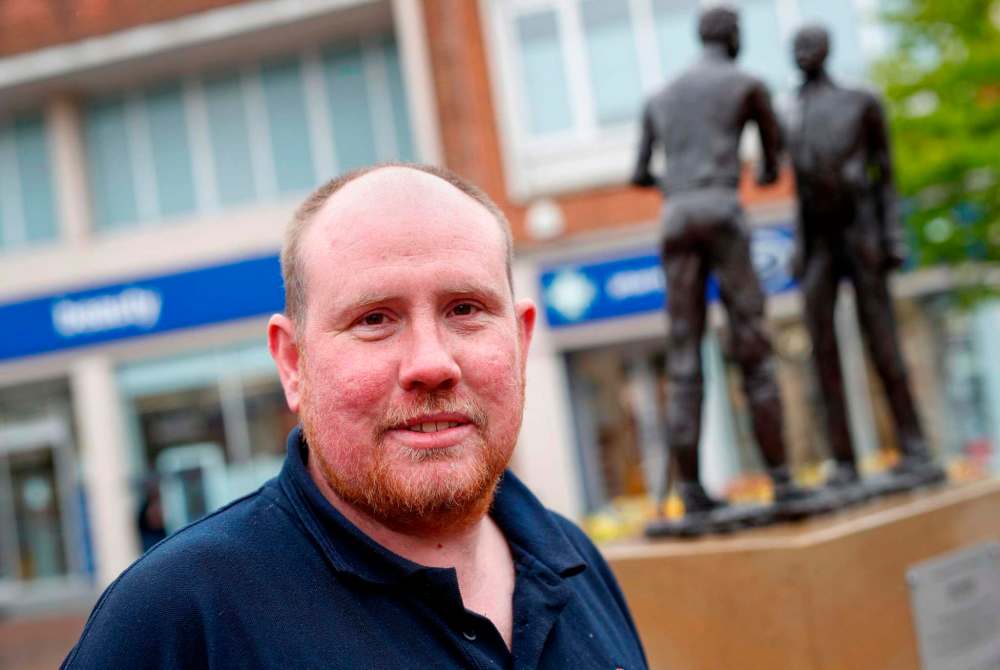
It’s 5 p.m. on a wet Wednesday afternoon in the English market town of Spalding and Simon Bradshaw and his partner, Sharna, are taking their daughter to see a new statue commemorating 19th-century hiring fairs for farmers and shepherds.
Their visit says less about a keen interest in agrarian history and more about the Britain of today in the most ardently pro-Brexit region. They say the bronze structure is being vandalized by people from eastern Europe. Sharna, a stay-at-home carer, complains immigrants made the town dangerous and overcrowded. “They’ve no respect,” she said.
From Donald Trump’s America to Italy and Hungary, the vilification of immigrants is hardly new nowadays. But the flip side to the resentment in the U.K. is that for people who saw Brexit as a defensive wall against newcomers, the threat isn’t human, it’s robot.
Bradshaw, 38, works as a forklift driver at a local food distribution company. Manual jobs like his are commonplace in the county of Lincolnshire, and many of them were filled by eastern European migrants in recent years. The irony for those who believed the influx of cheap labour was jeopardizing their livelihoods is that they now face having their jobs automated if Brexit yields some of the economic dividend its supporters say it will while curbing immigration.
Britain currently has the lowest density of robots in manufacturing among the Group of 10 countries, partly because businesses opted to use a cheap and expanding migrant labour force in the past decade rather than buy new machinery to boost efficiency.
Companies initially could use robots to fill labour shortages, but in the longer term, the threat is that they end up stealing jobs, too.
Indeed, the slow pace of adoption is a long-standing problem for Britain’s international competitiveness and productivity. In 2017, Britain had just 85 robots per 10,000 employees, compared to 106 on average across Europe, according to the International Federation of Robotics. About half of Britain’s robots are used in car manufacturing. The food industry is only just beginning to use them for cutting, moving and packaging products.
But Britain’s low robot density also makes it ripe for investment, with 1.5 million jobs at high risk of having some tasks automated, according to the Office for National Statistics. Regions most at risk of losing jobs to robots are also those that voted for Brexit, based on Bloomberg analysis of ONS data.
The area around Spalding had the greatest concentration of eastern European migrants in the 2011 census, and was also the biggest vote of anywhere in the U.K. for Brexit.
“The robots won’t get sick and the robot doesn’t need a visa,” said Thijs Geijer, senior economist at bank ING Groep. He has found that Britain has four per cent of the robots used in Europe’s food and drink industry, with Germany and Italy being the continent’s main markets.
Robots most threaten “the three Ds,” Business Minister Andrew Stephenson told the U.K. Parliament last month, jobs that are “dangerous, dirty or dull.” He said the government is working with individual industries to ensure they use automation in a way that boosts profits and productivity without harming workers. There will be jobs lost to robots, though, he said.
Curbing immigration remains top of the list for many Britons who want to leave the EU. That particularly poses a challenge for food and drink companies, which make up the U.K.’s biggest manufacturing industry. They have relied on EU migrants for almost a third of their combined workforce.
With politicians in Westminster still unable to agree when, how or even if the U.K. should leave the EU, that’s becoming harder. Net migration from the EU has fallen to its lowest in a decade.
“Businesses are having to ensure they use their workforce effectively and find alternative ways of performing tasks for which they do not have labour,” says Mike Wilson, chairman of the British Automation and Robot Association. “Robot automation being an obvious solution.”
With Brexiteer-in-chief Nigel Farage’s new party polling ahead of all rivals before European Parliamentary elections on May 23, Lincolnshire encapsulates the disillusionment with the government 160 kilometres away in London more than most places.
In places like this, workers feel immigration is something that happens to them, rather than something they can be part of, said John Curtice, professor of politics at the University of Strathclyde. “They feel culturally isolated,” he said.
About a third of Britain’s food touches Lincolnshire in some way, according to the local government. The countryside is an expanse of potato, rapeseed and tulip fields, interspersed with truck stops and food manufacturers like canning factory Princes Ltd. sitting alongside the wide roads.
Spalding was where barcodes were first trialled in a British supermarket in the 1979, but the town certainly doesn’t look like it’s on the brink of an industrial and political revolution that could alter it for good.
The statue that piqued the interest of Bradshaw and his family stands amid 18th-century houses and a pub that boasts it once hosted the philosopher Jean-Jacques Rousseau, interspersed with new stores catering to the town’s more recent Polish and Lithuanian arrivals.
Despite high employment, just 17 per cent of people in South Holland, the area around Spalding, have specialist training for technical roles or management, less than half the U.K. average. Gross weekly pay is 12 per cent lower than the British mean.
For the food and drink companies that populate the area, there’s a perfect storm of tightening profit margins caused by the growth of discount retailers and now a U.S.-China trade spat that’s pushing up the cost of raw materials.
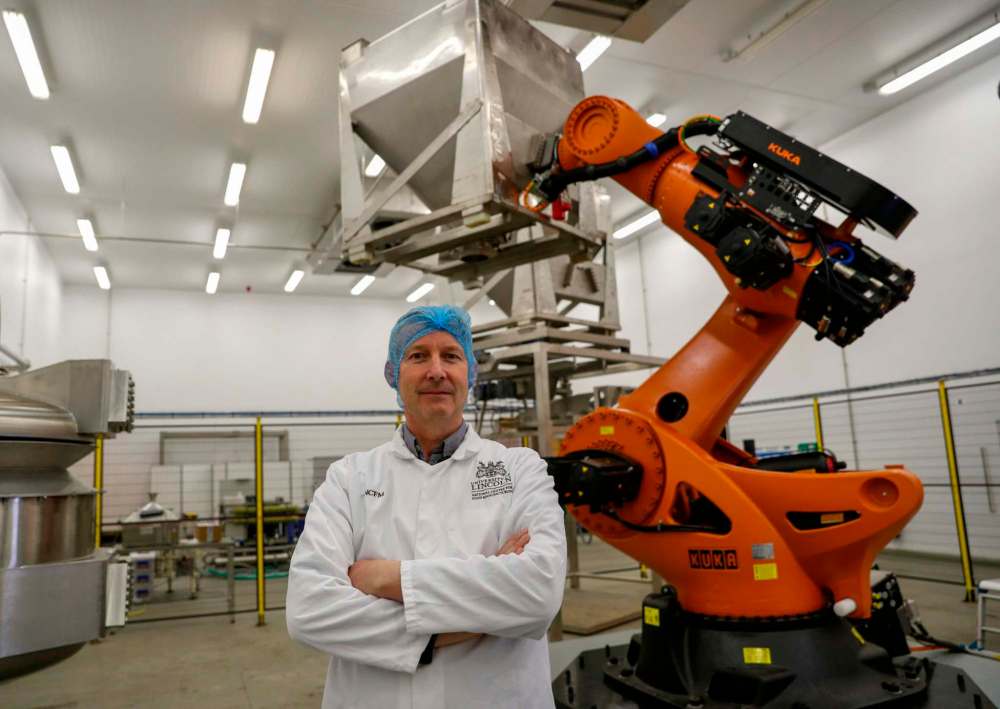
“With no investment and prices always being driven down, there was no room for investment,’’ said Chris Brooks, a product development chef at Olympus Automation Ltd., which is working with local companies and the University of Lincoln to test its “robotic chef.”

The aim is to replicate the work of humans on an industrial scale and with extreme accuracy, but without needing breaks or making mistakes. “Companies have got to a breaking point where it’s a case of ‘which way do I go? I either go under or I invest,’” Brooks said.
Liam Fox, the pro-Brexit minister in charge of overseas trade, has said such technology could drive another revolution in manufacturing, boosting Britain’s woeful productivity level, which lags about 20 per cent behind peers in the Group of Seven countries.
Chinese automaker BYD is already selling driverless forklifts to Volkswagen, General Motors and Toyota. But Bradshaw reckons his job as a forklift driver in Spalding is safe because a robot couldn’t do the same work. It requires a human to pick and mix the right pallets of products, he said.
“One pallet would be apples and another would be chocolate biscuits and a robot wouldn’t be able to tell the difference,” Bradshaw said. “You’ve got to check everything is different, and with robots, everything is the same.”
— Bloomberg