

North Carolina chosen for supersonic passenger jet plant
Advertisement
Read this article for free:
or
Already have an account? Log in here »
To continue reading, please subscribe:

Digital Subscription
One year of digital access for only $205*
- Enjoy unlimited reading on winnipegfreepress.com
- Read the E-Edition, our digital replica newspaper
- Access News Break, our award-winning app
- Play interactive puzzles
*First annual payment billed as $205.00 + GST for one year. This annual subscription will automatically renew at $233.00 + GST every 52 weeks (10% off the regular annual price of $259.35). Offer available to new and qualified returning subscribers only. Cancel any time.
To continue reading, please subscribe:
Add Free Press access to your Brandon Sun subscription for only an additional
$1 for the first 4 weeks*
- Enjoy unlimited reading on winnipegfreepress.com
- Read the E-Edition, our digital replica newspaper
- Access News Break, our award-winning app
- Play interactive puzzles
*Your next Brandon Sun subscription payment will increase by $1.00 and you will be charged $17.95 plus GST for four weeks. After four weeks, your payment will increase to $24.95 plus GST every four weeks.
Read unlimited articles for free today:
or
Already have an account? Log in here »
Hey there, time traveller!
This article was published 26/01/2022 (1704 days ago), so information in it may no longer be current.
RALEIGH, N.C. (AP) — A Colorado-based aviation company announced Wednesday that it has chosen a North Carolina airport as the manufacturing site for next-generation supersonic passenger jets. If successful, the investment could create more than 2,000 jobs in the region over the next decade while cutting flight times significantly for a post-Concorde generation of air travelers.
Boom Supersonic announced that Piedmont Triad International Airport in Greensboro will be the home for its first full-scale manufacturing plant, including the final assembly line, testing and delivery center for its proposed Overture supersonic airliner. Boom estimates it will create over 1,750 jobs by 2030, with a goal of reaching more than 2,400 jobs by 2032.
State and local governments have offered $230 million in financial incentives to make the project a reality, including money for airport improvements, which the legislature approved in November, and other sweeteners approved Wednesday.
As with most such projects, some of the incentives going to Boom Technology Inc., the company’s parent, will be canceled if it doesn’t meet job-creation and investment goals. The anticipated capital investment is $500 million.
Jacksonville, Florida, and Greenville-Spartanburg, South Carolina, were also in the running for the plant, according to a state Commerce Department official who publicly briefed an incentives committee prior to the announcement. The project had been known to recruiters as “Project Thunderbird.”
The Overture plane is designed to carry 65 to 88 passengers, consume sustainable aviation fuel and cruise at 60,000 feet (18,290 meters) at 1,300 mph (2,090 kph) — twice the speed of today’s passenger jets. Many technical and manufacturing hurdles still must be overcome before the aircraft becomes a practical option for airlines, however.
In a news release Wednesday, the company said the new factory will begin production in 2024, with the first Overture aircraft rolled out in 2025, flying in 2026 and carrying its first passengers by 2029.
“Selecting the site for Overture manufacturing is a significant step forward in bringing sustainable supersonic air travel to passengers and airlines,” Boom Supersonic CEO Blake Scholl said in the release. He said North Carolina’s ready aerospace workforce, easy access to technical schools and proximity to aerospace suppliers were factors influencing the company’s decision to locate here.
The Piedmont Triad airport is already the headquarters of Honda Aircraft Co. and the production site for its seven-passenger HondaJet Elites.
“Boom is confident that Greensboro will emerge as the world’s supersonic manufacturing hub,” Scholl said.
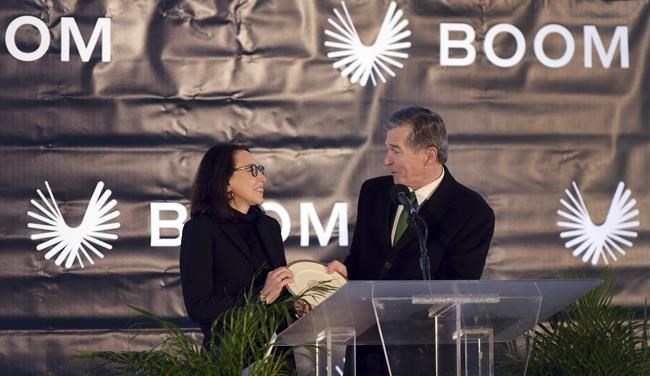
Gov. Roy Cooper and other elected leaders and recruiters gathered in Greensboro for the announcement. It came less than two months after Toyota said it would build an electric vehicle battery plant in the region, which is a roughly 90-minute car trip west from Raleigh.
Cooper made a reference to the crowd about North Carolina’s “First in Flight” designation — it was on the Outer Banks that the Wright brothers’ completed the first powered self-propelled flights in December 1903.
“This afternoon, we’re launching the future of flight,” Cooper said. “We are ready with the education, the diverse workforce, with the transportation, with the good economy and with the quality of life necessary for success.” The average salary for plant employees is expected to be almost $69,000 annually.
Boom is one of several companies trying to revive supersonic passenger travel, which died with the grounding of the Concorde nearly two decades ago. Boom has built a one-third-size demonstrator aircraft called the XB1, but now it faces the daunting challenge of bulking that up.

Boom boasts of “pre-orders” from several potential customers. United Airlines also announced last year an agreement to buy 15 copies of the Overture and take options for another 35. United, however, said any orders hinge on Boom meeting certain financial and operational targets, which it declined to describe in any detail.
Skeptics say that if supersonic passenger travel were really feasible, Boeing and Airbus would be building the planes instead of leaving the market to startups like Boom.
The Concorde flew over the Atlantic and was barred from many overland routes because of the sonic booms, and any new supersonic planes will face the same hurdles. Another factor that helped kill the Concorde was its high cost of operation. Scholl has said technology will help solve both of those challenges, and tickets should be in the range of current-day business-class fares.
___
Associated Press airlines writer David Koenig in Dallas contributed to this report.