

Go go gratuities
New data confirms what many of us know: as we venture out more often, we are leaving larger and larger tips
Advertisement
Read this article for free:
or
Already have an account? Log in here »
To continue reading, please subscribe:

Digital Subscription
One year of digital access for only $205*
- Enjoy unlimited reading on winnipegfreepress.com
- Read the E-Edition, our digital replica newspaper
- Access News Break, our award-winning app
- Play interactive puzzles
*First annual payment billed as $205.00 + GST for one year. This annual subscription will automatically renew at $233.00 + GST every 52 weeks (10% off the regular annual price of $259.35). Offer available to new and qualified returning subscribers only. Cancel any time.
To continue reading, please subscribe:
Add Free Press access to your Brandon Sun subscription for only an additional
$1 for the first 4 weeks*
- Enjoy unlimited reading on winnipegfreepress.com
- Read the E-Edition, our digital replica newspaper
- Access News Break, our award-winning app
- Play interactive puzzles
*Your next Brandon Sun subscription payment will increase by $1.00 and you will be charged $17.95 plus GST for four weeks. After four weeks, your payment will increase to $24.95 plus GST every four weeks.
Read unlimited articles for free today:
or
Already have an account? Log in here »
Hey there, time traveller!
This article was published 07/05/2022 (1585 days ago), so information in it may no longer be current.
It’s safe to say we’re a grateful bunch to be out and about again — at sporting events, concerts and, of course, in-person dining.
It’s been a long hiatus due to the coronavirus and, according to a recent survey on tipping, we’re indeed showing our gratitude with our dollars.
Payment processor Square compiled data on how much Canadians are tipping, finding we’re giving more than ever for in-person service in the first three months of 2022.
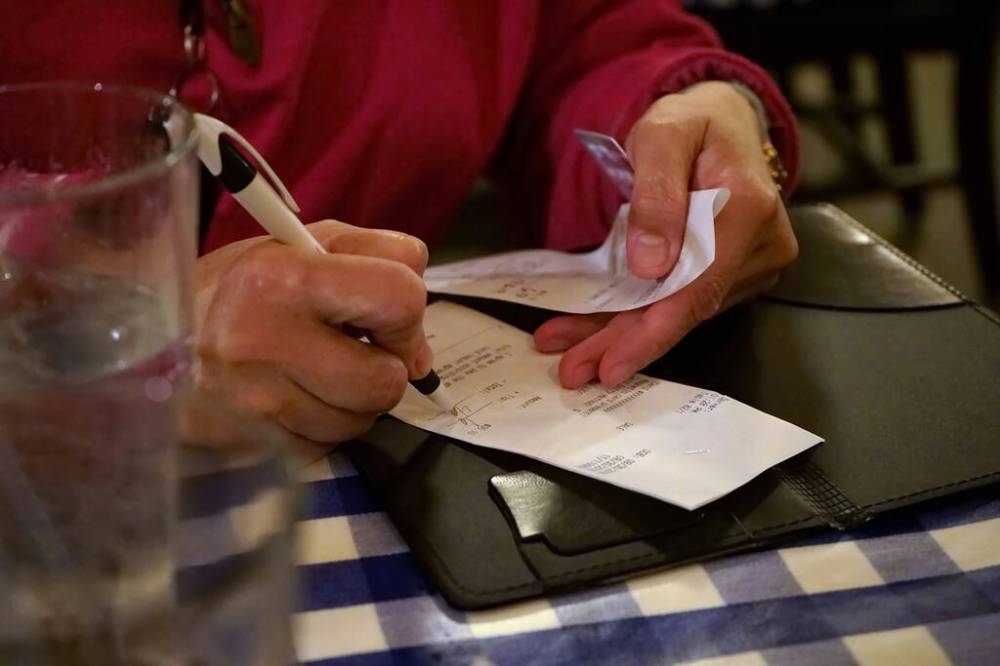
“For Canadians, they’re tipping 17.9 per cent for face-to-face purchases and that’s up from 16.6 per cent before the pandemic,” says Laura Jones, head of Square global product marketing in San Francisco.
Americans are tipping even more — 21.1 per cent, up from 19.8 per cent pre-pandemic.
“I am not actually surprised to see that data given my own behaviour,” Jones adds. “I have certainly increased my tipping over the course of the pandemic.”
Amid higher than normal inflation, it’s not entirely surprising Canadians are tipping more.
For that matter, tipping has, like all other expenses, increased over time from a standard of 10 per cent to 15 per cent to now generally 20 per cent for a good tip, says Ryan Whibbs, chair of the school of hospitality and culinary arts at Red River College Polytechnic.
“I even think the standard tip percentage has kind of gone away,” he says. “It started before the pandemic, but people feel they understand more and more how difficult restaurant work is.”
Still, 15 to 25 per cent remains a “good range, but in the smaller value places like a breakfast restaurant, you might be looking at a 30 per cent tip because people just want to support the service and workers in the industry.”
Indeed the industry has struggled.
According to Restaurants Canada — which represents the industry — foodservice businesses experienced their lowest level of sales in two decades when the pandemic struck in spring 2020.
Owner of Mixmasters Bartending Academy, Avery Ross, in Winnipeg can speak to the hardships.
“People know COVID-19 hit our industry really, really hard. It pretty much destroyed me,” says Ross, who has worked for several years in the service industry as a bartender. “We’re just getting back into the fight now.”
For him, tipping has always “been a mixed bag” that can vary depending on the context — from the people being served to the time of day to the venue.
But regardless of when or where, tips are an important source of income.
“When you have that extra $60 to $100 in your pocket every day, that’s what you live off of,” says Avery, who no longer works directly in the industry.
In the U.S, tips are typically higher because many Americans recognize tips’ importance, particularly given that labour rules allow food industry businesses in many states to pay below minimum wage, says Dr. William Michael Lynn, a professor in food and beverage management at Cornell University and expert on tipping trends.
“And so people often tip more the lower the wage is that servers are allowed to be paid.”
More broadly tipping and its history reflect a divide in socioeconomic status between those with economic power seeking to compensate individuals serving them, and those said servers, who may lack similar wherewithal.
Lynn says many theories exist about tipping’s origins from English nobles providing goods and money to servants when visiting other lords and ladies to 17th-century coffeehouses where customers seeking good service put coins in a jar ‘to insure promptitude’ … or ‘to insure providence,’” he says.
Another theory suggests its origins were in the Netherlands where “people would tap coins on glasses to alert servers that they wanted another drink, and then hand the coins to the servers to get the refill,” Lynn adds.
In the 19th century, tipping of African Americans — often freed slaves — working as railway porters became commonplace in large part because these individuals’ wages were so low they needed tips to survive. That’s according to Politico, providing historical background for a 2019 feature article on proposed U.S. legislation to increase the minimum wage and eliminate the subminimum tipped wage rule.
Regardless of tipping’s roots, it has evolved today into a widely standardized economic activity, accounting for more than $40 billion annually in the U.S, according to some estimates.
Lynn adds he believes consumers today have four general motivations to tip: “to reward good service, to help the server out, to get better service in the future, and to show off.”
He posits the last two reasons are essentially competitive and could be what have driven tipping higher over time.

Economists call these “‘externalities,” he adds.
In this instance, once the server starts giving high-tipping customers preferential attention, “it puts pressure on other people to start tipping more,” Lynn says.
Of course, the more recent bump in tipping, as revealed in the Square study data, is likely due to growing recognition of the conditions of work for servers, given that even though we’ve returned to in-person dining, conditions are anything but normal, says Whibbs.
“The hospitality industry is a very human industry, and that has been driven home during the pandemic,” he says.
“It’s been so difficult on these workers, and so we definitely do see the public is moving away from the standard amounts to making more of a statement with a tip.”
Related Articles
Premier deflects call to hike Manitoba minimum wage
Advertisement Advertise With Us
Advertisement Advertise With Us