

Manitoba researchers, industry groups need to be more vocal on national stage
Advertisement
Read this article for free:
or
Already have an account? Log in here »
To continue reading, please subscribe:

Digital Subscription
One year of digital access for only $205*
- Enjoy unlimited reading on winnipegfreepress.com
- Read the E-Edition, our digital replica newspaper
- Access News Break, our award-winning app
- Play interactive puzzles
*First annual payment billed as $205.00 + GST for one year. This annual subscription will automatically renew at $233.00 + GST every 52 weeks (10% off the regular annual price of $259.35). Offer available to new and qualified returning subscribers only. Cancel any time.
To continue reading, please subscribe:
Add Free Press access to your Brandon Sun subscription for only an additional
$1 for the first 4 weeks*
- Enjoy unlimited reading on winnipegfreepress.com
- Read the E-Edition, our digital replica newspaper
- Access News Break, our award-winning app
- Play interactive puzzles
*Your next Brandon Sun subscription payment will increase by $1.00 and you will be charged $17.95 plus GST for four weeks. After four weeks, your payment will increase to $24.95 plus GST every four weeks.
Read unlimited articles for free today:
or
Already have an account? Log in here »
Hey there, time traveller!
This article was published 03/06/2022 (1563 days ago), so information in it may no longer be current.
An Edmonton-based organization called the Canadian Agri-Food Automation and Intelligence Network (CAAIN) announced a $5 million funding opportunity on Thursday focused on encouraging the expansion of a national network of smart farms.
CAAIN has been around since 2019 and has disbursed $36 million of the $49.5 million it received from the federal government’s Strategic Innovation Fund.
CAAIN’s mandate is to champion agricultural technology collaborations across the country, particularly in the areas of robotics & automation, data-driven decision-making and the development of smart farms where the first two subject areas can be validated and demonstrated.
The idea of CAAIN’s original founders, which was organized by Alberta Innovates, was to bring together the private sector, academia and research institutions to develop the kind of technologies that will help the Canadian agri-food industry to efficiently produce more sustainable, healthy food that the world is going to need.
It’s also a growing commercial opportunity. Precision farming’s global market size was estimated to be $7 billion US in 2020 and is expected to grow to $12.8 billion US by 2025.
The organization’s CEO Kerry Wright said it is particular in its due diligence and has some specific requirements for funding to be approved, including having at least two small- or medium-sized enterprises involved.
That’s a good idea because those are the kind of companies that dominate Canadian industry and in CAAIN’s case, they also include actual farmers.
Government funding to promote technological development is often disabused as being inefficient or politically self-serving, but considering the crucial challenges facing the country and the world regarding issues like climate change and global food security there’s probably not enough assistance.
However, national programs need to be truly national.
There were eight original founders of CAAIN with representation from every province west of the Maritimes except Manitoba.
When asked, the leaders of Manitoba’s technology and food processing industries had never heard of it.
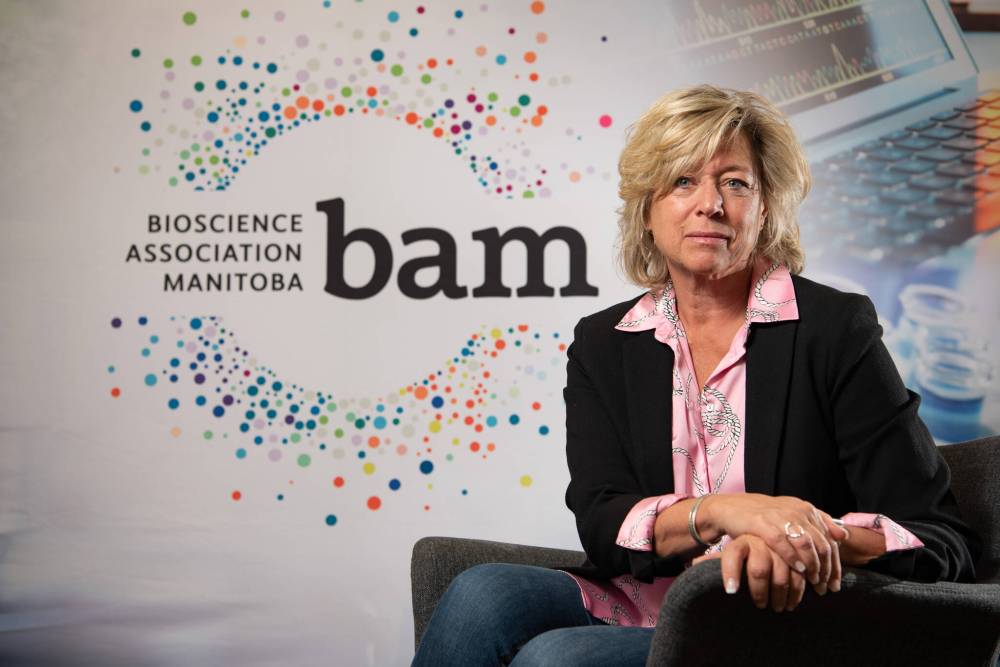
Kim Kline, the CEO of Biomedical Association of Manitoba (BAM) was invited to a meeting with Wright a couple of weeks ago. That was the first she’d heard of it.
Obviously, Manitoba has reputation as having a progressive agri-food sector including applications in automation and robotic companies. In the last year two large vegetable protein manufacturers started operations after hundreds of millions of dollars of investment both with offerings that are unique in the global marketplace.
Regardless of its less than stellar stock performance, Winnipeg-based Farmers Edge was one of the very first independent precision farming companies in North America.
There have been two Manitoba companies that have have received funding from CAAIN for technology developments, including MacDon, whose parent company, Linamar Corp., was one of the founders of CAAIN.
Wright said CAAIN wants to do a better job of “amplifying” its presence across the country.
“That’s what we are here for,” she said in an interview. “We want to bridge the gap between agriculture and technology and bring the two value chains together.”
Technology is not the only means to solve all of the world’s challenges but it is not likely it is going to become less important.
Somehow or other there is an element in this province that believes Manitoba does not need to be on the cutting edge and that it’s OK to let innovations take place elsewhere and capitalize after its been proven out.

A recent well-attended roundtable discussion about the development and use of artificial intelligence was recently organized by Tech Manitoba, Economic Development Winnipeg and the University of Manitoba’s Industry-Academia Partnership.
A follow-up public event will happen later this month.
There needs to be more discussion about technology development, the actual commercial opportunities for the province and the possibilities for collaboration — a key element of survival for the economy of a small province.
And Manitoba researchers and industry organizations need to become more vocal and active on the national stage especially when it comes to the industries that are already in our wheelhouse.
martin.cash@freepress.mb.ca
History
Updated on Friday, June 3, 2022 5:35 AM CDT: Adds headline