

Winnipeg airport testing autonomous mobility devices
‘Ultimately, this is about the future’
Advertisement
Read this article for free:
or
Already have an account? Log in here »
To continue reading, please subscribe:
Digital Subscription
One year of digital access for only $1.44 a week*
- Enjoy unlimited reading on winnipegfreepress.com
- Read the E-Edition, our digital replica newspaper
- Access News Break, our award-winning app
- Play interactive puzzles
*Billed as $5.77 plus GST every four weeks. After 52 weeks, price increases to the regular rate of $19.95 plus GST every four weeks. Offer available to new and qualified returning subscribers only. Cancel any time.
To continue reading, please subscribe:
Add Free Press access to your Brandon Sun subscription for only an additional
$1 for the first 4 weeks*
- Enjoy unlimited reading on winnipegfreepress.com
- Read the E-Edition, our digital replica newspaper
- Access News Break, our award-winning app
- Play interactive puzzles
*Your next Brandon Sun subscription payment will increase by $1.00 and you will be charged $17.95 plus GST for four weeks. After four weeks, your payment will increase to $24.95 plus GST every four weeks.
Read unlimited articles for free today:
or
Already have an account? Log in here »
Hey there, time traveller!
This article was published 28/07/2022 (1402 days ago), so information in it may no longer be current.
With airport and airlines experiencing increasing numbers of wheelchairs per flights and labour shortages in the industry exacerbating the post-pandemic recovery, a Winnipeg company and its Japanese parent believes it has the solution for in-terminal transit for the mobility impaired — an autonomous mobility service.
Scootaround Personal Transportation Solutions — whose signage is now featured on a suburban office building in Linden Ridge — was acquired by WHILL Inc., a Tokyo-based manufacturer of innovative mobility devices in 2019.
With Scootaround now managing WHILL’s North American operations, the company is now testing the devices in two airports — Narita International Airport in Tokyo and Winnipeg’s Richardson International Airport.
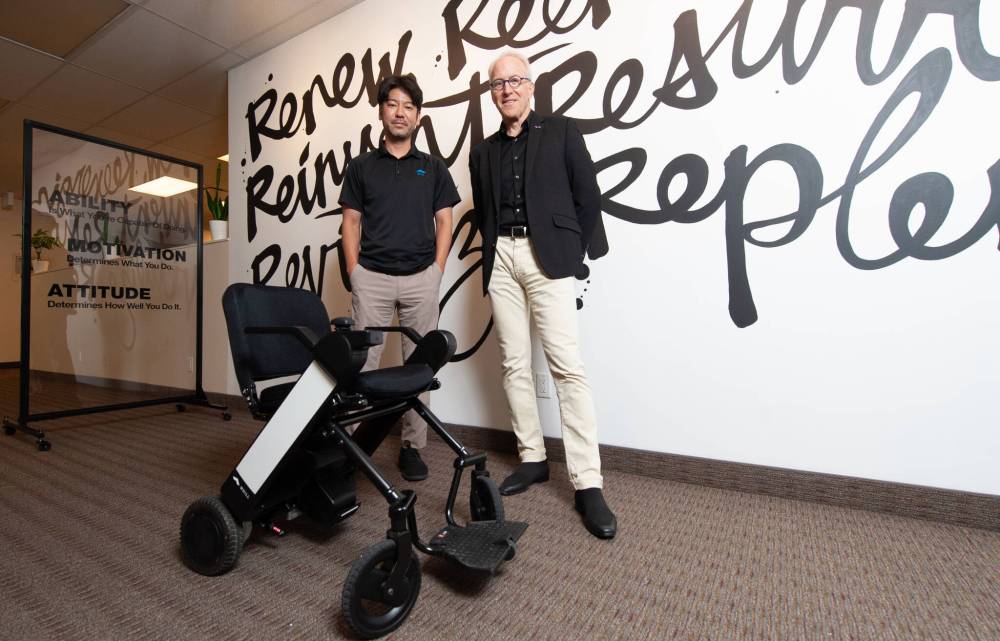
Kerry Renaud, CEO of Scootaround/WHILL’s North American operation said, “Ultimately, this is about the future, about providing a higher quality of customer service in airports. Maybe I’m naive but I think airports will recognize that.”
There are already 24 units in the Tokyo airport, and WHILL CEO Sugie Satoshi said, “So far so good.”
That trial started in the midst of the pandemic when the airport was almost empty but gave the company time to work out the bugs. For instance, it is now in the process of integrating with elevator companies to be able to bring people to multiple levels.
While the Tokyo trial is an important showcase, Satoshi, who was in Winnipeg this week, said the North American market, with scores of airports, will be the important market.
“That is why the Winnipeg trial is of top priority for us,” he said.
There was a demonstration of the technology at the airport in 2019, and now the company is gearing up for potentially a full commercial rollout across North America as early as next year.
Scott Marohn, vice-president of marketing and product innovation at the Winnipeg Airports Authority, said “After that trial we are now in a partnership with WHILL. We are just in the process of signing an agreement to expand the trial that would take the traveller from check-in, through security, along to the correct departure gate and then the machine would make its way back to the check-in counter, all autonomously.”
Renaud and Satoshi say the technology is working properly and now it is a matter of convincing airports that it’s a good idea to have autonomous vehicles rolling through busy airport terminals.
Satoshi said, it may be a little easier introducing it in Tokyo, where such technology is becoming more common.
“People already see robots in the shopping centres,” he said.
In addition to Winnipeg, the company has already undertaken demonstrations of the devices in airports in Dallas/Fort Worth, San Francisco and Haneda International Airport, also in Tokyo.
The initiative leverages Scootaround’s commercial concept of mobility as a service, which was one of the reasons WHILL acquired the company.
Scootaround currently has a fleet of more than 4,000 manually driven mobility devices that are deployed throughout North America — at cruise ship terminals, four of the largest convention centres in the U.S. and often at airports where customers would order ahead to rent the devices. (Scootaround also is contracted to provide repair and servicing on behalf of many of the largest airlines in North America for devices that get damaged during flights. In the U.S. it is a law that airlines must stow personal mobility devices as luggage, free of charge.)
In the past airlines — or sometimes the airport — would provide wheelchair service for travellers in the airport. Labour shortages is making that service more difficult to perform.
“The whole manual wheelchair push system is a broken system,” Renaud said. “ It is antiquated and overwhelmed. They can’t meet the labour requirements.”
Marohn agrees. He said autonomous devices are a chance to mitigate the amount of labour required to provide the service.
“You can see what is happening in the industry. The labour shortage is going to get deeper in that customer service segment in the airport,” he said.
It also provides greater flexibility for the traveller. For example, an airline staffer might push a traveller in a wheelchair to their gate but then they would leave the traveller there to wait to board, unable to go anywhere else in the terminal
“In this chair, it would take you though security and if there was time you could push the Starbucks button and it would take you there,” Marohn said. “You are free to do what you couldn’t do in the past because of the labour requirements of the airline.”
“We are all about individual independence,” Renaud said. “Sugie and we at Scootaround both started our companies for that reason.”

The question of who would pay for the service is still being determined. Scootaround/WHILL is teaming up with a German software company that specializes in airport asset management to illustrate the labour cost savings.
Renaud believes it will be able to make an economic case for the airports to pay for it.
Marohn, who said they hope to see the model expand to curbside to gate, said discussions are underway.
He said there are economies of scale that the airports already deploy such as management of automatic ticketing kiosks, which was once the responsibility of each individual airline.
martin.cash@freepress.mb.ca