

Conference Board bullish on Manitoba economy

Advertisement
Read this article for free:
or
Already have an account? Log in here »
To continue reading, please subscribe:

Digital Subscription
One year of digital access for only $205*
- Enjoy unlimited reading on winnipegfreepress.com
- Read the E-Edition, our digital replica newspaper
- Access News Break, our award-winning app
- Play interactive puzzles
*First annual payment billed as $205.00 + GST for one year. This annual subscription will automatically renew at $233.00 + GST every 52 weeks (10% off the regular annual price of $259.35). Offer available to new and qualified returning subscribers only. Cancel any time.
To continue reading, please subscribe:
Add Free Press access to your Brandon Sun subscription for only an additional
$1 for the first 4 weeks*
- Enjoy unlimited reading on winnipegfreepress.com
- Read the E-Edition, our digital replica newspaper
- Access News Break, our award-winning app
- Play interactive puzzles
*Your next Brandon Sun subscription payment will increase by $1.00 and you will be charged $17.95 plus GST for four weeks. After four weeks, your payment will increase to $24.95 plus GST every four weeks.
Read unlimited articles for free today:
or
Already have an account? Log in here »
Hey there, time traveller!
This article was published 24/08/2022 (1487 days ago), so information in it may no longer be current.
Manitoba is set to be among Canada’s leaders in economic growth this year, a Conference Board of Canada report projects.
Manitoba’s real gross domestic product could rise 4.2 per cent this year, 2.8 per cent next year and 1.9 per cent in 2024, the board’s three-year outlook suggests.
“All told, after growing by just 1.2 per cent in 2021, we expect Manitoba’s real GDP to be in much better shape over the next two years,” the think tank’s report, released Wednesday, reads.
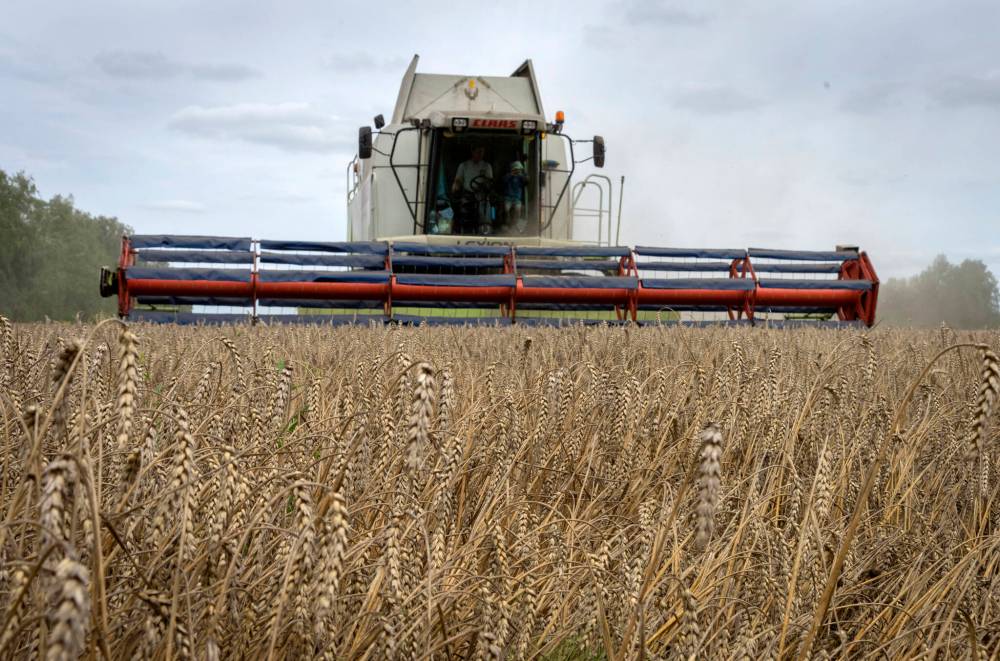
FILE - A harvester collects wheat in the village of Zghurivka, Ukraine, Tuesday, Aug. 9, 2022. A ship approached Ukraine on Friday, Aug. 12, 2022, to pick up wheat for hungry people in Ethiopia, in the first food delivery to Africa under a U.N.-brokered plan to unblock grain trapped by Russia’s war and bring relief to some of the millions worldwide on the brink of starvation. (AP Photo/Efrem Lukatsky, File)
It expects the keystone province’s real GDP to hit $69.8 billion in this year’s fourth quarter.
It’s the long-term forecast where one Manitoba economist sees some trouble on the horizon.
The board largely attributes the growth to agricultural recovery. It’s also partially because growth lagged last year, said Sean Adams, a board economist.
“Manitoba still has… (a) rebound ahead of it,” Adams said. “That has passed already at the national level.”
The non-profit predicts national GDP growth of 3.5 per cent by the end of the year.
“Manitoba’s economy limped through 2021” largely due to decreased farm exports, the board wrote in its August report.
Drought strained crop production last summer.
“It is a completely different year than last year,” said Bill Campbell, president of Keystone Agricultural Producers.
Crops that have survived 2022’s weather “generally look pretty good,” and most producers are satisfied with their yields, Campbell said.
Still, farmers couldn’t seed 750,000 acres due to significant weather, he said. It’s unclear how current yields will compare to last year’s until harvest finishes.
Manitoba’s goods-producing sector is projected to expand by 7.8 per cent, according to the board. It reports the service side will see a “healthy growth” of 2.6 per cent.
The board expects Manitoba manufacturing to boom, particularly in food and chemical sectors.
A full year of operation from Roquette and expanded Maple Leaf Foods plants will lead food manufacturing growth, while a better crop year in the Prairies — and a need for fertilizers and pesticides — will propel the chemical side, according to the board.
Healthy economic growth hovers around the three per cent mark, said Greg Mason, a University of Manitoba economics professor.
The forecast dip below two per cent in 2024 is “just not good enough, frankly.”
“Our growth is not going to be good enough to maintain our lifestyle,” Mason said. “(It’s) going to have pretty serious consequences as we try and reform health care, as we try and recover and put a lot more money into infrastructure.”
He called slow growth a long-term problem for Canada in general.
“A technical recession (for Canada) — imprecisely, two consecutive quarters of negative output growth — is not embedded in our outlook, though the risks of a recession are there,” the board’s report reads.
Instead, a more likely future involves a growth plateau nationally, spurred by consumers’ response to rising interest rates, before picking up in 2023.
The Bank of Canada increased its key interest rate 2.25 percentage points between March and July to fight inflation (which hit a high of 9.4 per cent year over year in Manitoba in June).
Further rate hikes may come later this year.
“High employment and job vacancy rates, which support wage levels, will be a cushion to the downsides of moderating consumer and business sentiment,” the board wrote.
It called Manitoba’s job market “red-hot.”
The province set its own record low unemployment rate in July at 3.5 per cent.
Manitoba could add 13,400 jobs this year; the average unemployment rate might hover at 4.8 per cent, the board predicts.
However, job growth could lag in the future, especially in sectors experiencing slowdowns from inflation and interest rates, like real estate and insurance.
Despite the rising rates, Manitoba’s real estate market is “chugging along,” the board wrote.
It estimates housing starts — the number of homes being built — to grow by 3.3 per cent this year, a departure from Canada’s predicted 10 per cent decrease.
Housing markets across the country, in provinces like Ontario, are poised for correction, said Adams.
Overall investment in Manitoba “will be booming this year,” jumping 7.7 per cent, the board projects.
Government investment will jump by 15.2 per cent, but the growth will be short lived, the board predicts.
Higher interest rates will lead to scaled back growth, with investments dropping to an increase of one per cent in 2023 and 0.7 per cent in 2024, the report says.

Canadians will likely grip their purse strings tighter as 2022 progresses — notably in the housing sector, as interest rates are higher, the board predicts.
“Once consumers have exercised their repressed travel bugs this summer, they will pull back on heavier and more discretionary items through the rest of the year,” the board wrote.
It projects Saskatchewan will lead the country with real growth of 7.6 per cent this year. Alberta will see a 4.9 per cent gain, according to the forecast.
The board attributes oil and gas prices, and agricultural output, to the rise.
gabrielle.piche@winnipegfreepress.com
Gabrielle Piché reports on business for the Free Press. She interned at the Free Press and worked for its sister outlet, Canstar Community News, before entering the business beat in 2021. Read more about Gabrielle.
Every piece of reporting Gabrielle produces is reviewed by an editing team before it is posted online or published in print — part of the Free Press‘s tradition, since 1872, of producing reliable independent journalism. Read more about Free Press’s history and mandate, and learn how our newsroom operates.
Our newsroom depends on a growing audience of readers to power our journalism. If you are not a paid reader, please consider becoming a subscriber.
Our newsroom depends on its audience of readers to power our journalism. Thank you for your support.
Gabrielle Piché reports on business for the Free Press. She interned at the Free Press and worked for its sister outlet, Canstar Community News, before entering the business beat in 2021. Read more about Gabrielle.
Every piece of reporting Gabrielle produces is reviewed by an editing team before it is posted online or published in print — part of the Free Press‘s tradition, since 1872, of producing reliable independent journalism. Read more about Free Press’s history and mandate, and learn how our newsroom operates.
Our newsroom depends on a growing audience of readers to power our journalism. If you are not a paid reader, please consider becoming a subscriber.
Our newsroom depends on its audience of readers to power our journalism. Thank you for your support.
Related Articles
Prairie provinces leading on economic growth, a new report says
Advertisement Advertise With Us
Advertisement Advertise With Us