

Turkish leader to United Nations: Be ‘much more influential’
Advertisement
Read this article for free:
or
Already have an account? Log in here »
To continue reading, please subscribe:

Digital Subscription
One year of digital access for only $205*
- Enjoy unlimited reading on winnipegfreepress.com
- Read the E-Edition, our digital replica newspaper
- Access News Break, our award-winning app
- Play interactive puzzles
*First annual payment billed as $205.00 + GST for one year. This annual subscription will automatically renew at $233.00 + GST every 52 weeks (10% off the regular annual price of $259.35). Offer available to new and qualified returning subscribers only. Cancel any time.
To continue reading, please subscribe:
Add Free Press access to your Brandon Sun subscription for only an additional
$1 for the first 4 weeks*
- Enjoy unlimited reading on winnipegfreepress.com
- Read the E-Edition, our digital replica newspaper
- Access News Break, our award-winning app
- Play interactive puzzles
*Your next Brandon Sun subscription payment will increase by $1.00 and you will be charged $17.95 plus GST for four weeks. After four weeks, your payment will increase to $24.95 plus GST every four weeks.
Read unlimited articles for free today:
or
Already have an account? Log in here »
Hey there, time traveller!
This article was published 20/09/2022 (1410 days ago), so information in it may no longer be current.
UNITED NATIONS (AP) — Turkey’s leader, overseeing a nation encircled by regional disputes, used his speech at the U.N. General Assembly on Tuesday to shine a spotlight on Turkish maneuvering in conflicts that span from Syria to Ukraine.
President Recep Tayyip Erdogan’s speech comes as Turkey is beset by staggeringly high inflation — officially at 80%, but more than double that, analysts say.
Erdogan blamed inflation on globally high food and energy prices rather than his government’s economic policies. His speech, however, focused more on laying out his view of Turkey’s role in the world. He said Turkey is “trying to be part of the solution” in conflicts around the world.
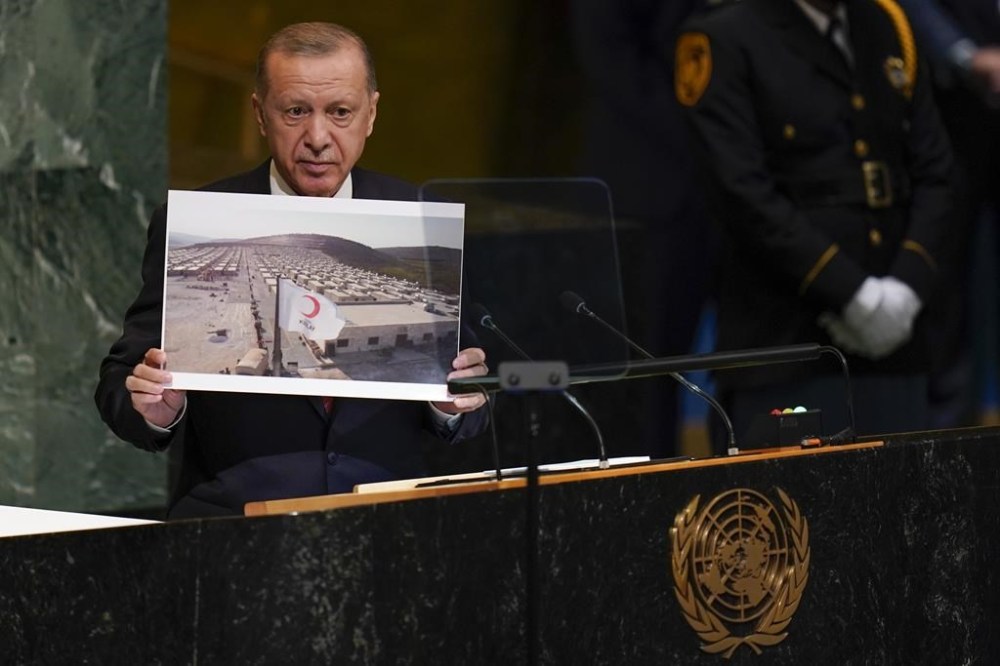
Touching on multiple hot -button issues, he spoke about the need for stability in Iraq, fair elections in Libya, food security in the Horn of Africa, the need for Palestinian statehood, the rights of Rohingya Muslims in Myanmar and Uighur Muslims in China, and standing up to anti-Muslim sentiment globally.
His remarks also highlighted Turkey’s role in these many conflicts, either directly or indirectly. This includes direct attacks in northern Syria against U.S.-backed Kurdish fighters, high-level diplomacy in Ukraine, a troop presence in Libya backing the Tripoli-based government, long-simmering tensions with Cyprus and Greece, and staunch support for Azerbaijan in its conflict with Armenia.
“All these disasters affecting millions of people show the United Nations will have to be much more effective, much more influential,” he said.
Erdogan has emerged as a key player in the Ukraine conflict. Turkey is a NATO member and has supplied Ukraine with lethal drones targeting Russian troops, but Erdogan has also met multiple times with Russian President Vladimir Putin and Turkey was a broker alongside the United Nations in securing the safe passage of Ukrainian grains exports through the Black Sea.
Turkey, he noted, has also hosted 4 million Syrian refugees in that country’s long-running war. At one point during his speech, Erdogan held up a photo of dead Syrian refugee children to emphasize the need for continued support.

He said the United Nations needs to be more inclusive — and the Security Council should be more democratic and functional.
“The world is greater than five,” he said, referring to the Security Council’s five permanent members.
Erdogan, 68, has led the country for almost 20 years, first as prime minister and then as president. Support for him and his party, however, has declined due to the cost-of-living crisis. He survived an alleged coup in 2016, unleashing in its wake a widespread crackdown against government critics, journalists, politicians and activists.
___
Aya Batrawy, a Dubai-based correspondent for The Associated Press, is on assignment at the U.N. General Assembly. Follow her on Twitter at http://twitter.com/ayaelb.
Related Articles
One year later, growing global perils as Biden returns to UN
Advertisement Advertise With Us
Advertisement Advertise With Us