

Knives out
From hobby to business: Graeson Fehr forges ahead to create his art
Advertisement
Read this article for free:
or
Already have an account? Log in here »
To continue reading, please subscribe:

Digital Subscription
One year of digital access for only $205*
- Enjoy unlimited reading on winnipegfreepress.com
- Read the E-Edition, our digital replica newspaper
- Access News Break, our award-winning app
- Play interactive puzzles
*First annual payment billed as $205.00 + GST for one year. This annual subscription will automatically renew at $233.00 + GST every 52 weeks (10% off the regular annual price of $259.35). Offer available to new and qualified returning subscribers only. Cancel any time.
To continue reading, please subscribe:
Add Free Press access to your Brandon Sun subscription for only an additional
$1 for the first 4 weeks*
- Enjoy unlimited reading on winnipegfreepress.com
- Read the E-Edition, our digital replica newspaper
- Access News Break, our award-winning app
- Play interactive puzzles
*Your next Brandon Sun subscription payment will increase by $1.00 and you will be charged $17.95 plus GST for four weeks. After four weeks, your payment will increase to $24.95 plus GST every four weeks.
Read unlimited articles for free today:
or
Already have an account? Log in here »
Hey there, time traveller!
This article was published 15/01/2023 (1366 days ago), so information in it may no longer be current.
Graeson Fehr is as sharp as what he creates.
At 23 years old, he is already and astute and experienced knifemaker. Combining his background in business, eye for artistry, and mathematical mind, he’s pursuing a career that combines advanced, high-tech machinery and time-honoured, skillful, and patient handiwork.
The blacksmith and bladesmith behind Fehr Forgeworks, speaking with a reporter on a recent crisp winter morning at his shop at North Forge Fabrication Lab in Winnipeg’s Exchange District, shared his story, from making his first knife 10 years ago to establishing a line of high-quality hunting and culinary knives he sells to customers all over the world.
RUTH BONNEVILLE / WINNIPEG FREE PRESS
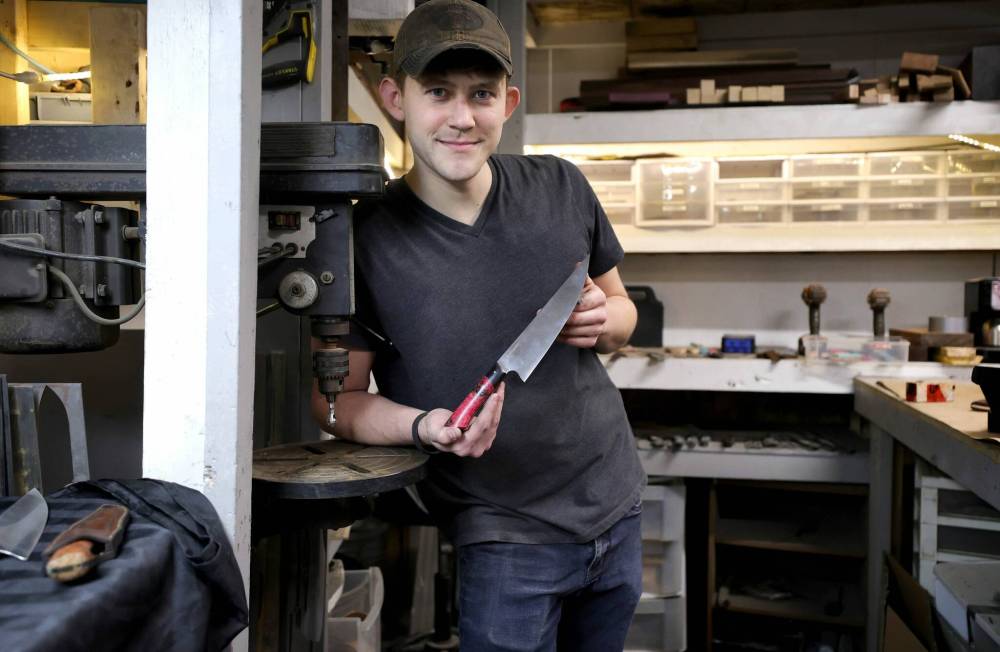
Graeson Fehr shows off one of his creations in his shop Fehr Forgeworks at North Forge Fabrication Lab in the Exchange District. Fehr began making hunting knives but has branched out, now creating culinary knives.
“That’s what I really enjoy is the constant blending of the artistic side — like let’s make it look cool and then also functional — and all of the science to it,” Fehr said. “I have to blend those two sides of my personality together and I really enjoy that challenge.”
Combining his artisan’s eye and scientist’s brain led to selling 700 knives in 2022, online, at craft and trade shows, and in seven retail stores around the province.
“There’s so many different steps of (knifemaking) that are quite satisfying to watch,” he said, from grinding to acid etching. “If you’re a bit of a perfectionist, it’s good.”
It all started, funnily enough, with a crappy store-bought knife.
Originally from Winkler and part of an outdoorsy family, at age 12, Fehr had painstakingly saved $60 to buy a hunting knife.
“I used it for the first time and the edge completely folded and cracked, and completely got destroyed. I was pretty upset about that and said ‘well I’m not going to waste my money on that anymore,’ and decided to make one.”
He spent a winter researching how to make a charcoal-fired wood and brick forge — a hearth used for heating and forming metals — and after putting it together, started forging a knife.
“The first one I had made —it was a big hunting knife — and I took it and I chopped it through that knife that I had bought.”
Fehr’s family moved to West St. Paul when he was a youngster and he had plenty of space at his disposal when he decided, after making that first knife, to keep blacksmithing. Both of his grandfathers, knowledgeable men good with their hands, encouraged him.
His paternal grandfather, Henry Fehr, died soon after his grandson started but gave him tools he still uses today. His maternal grandfather, Jake Falk, also visited regularly from Winkler to give him equipment and help set up his smithy.
RUTH BONNEVILLE / WINNIPEG FREE PRESS
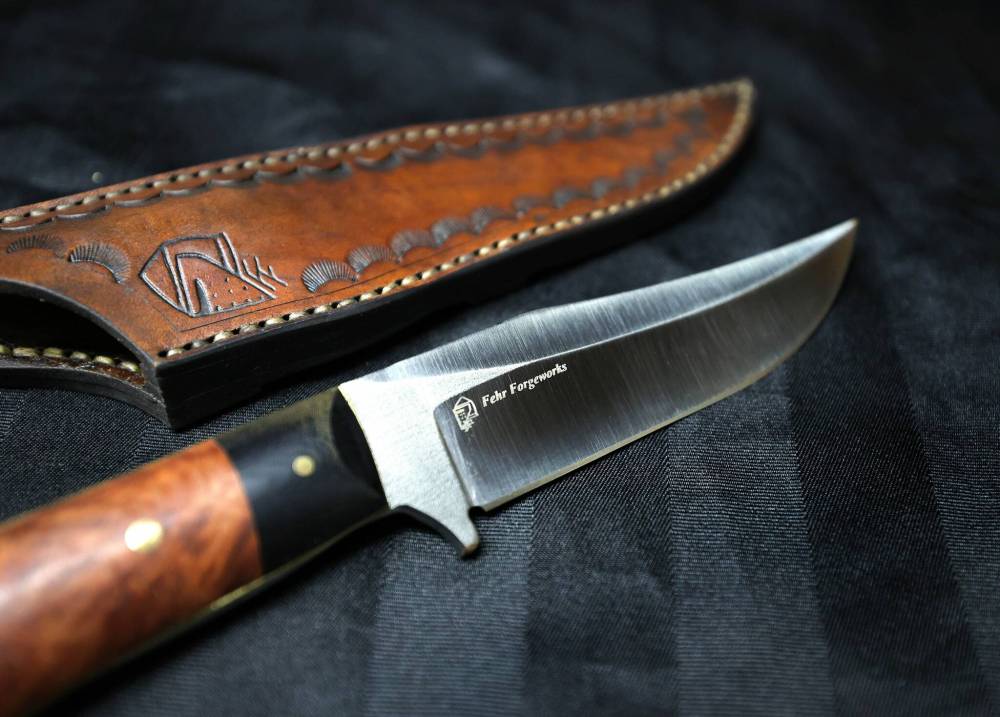
Fehr hopes to get his knives into more Manitoba retail stores ‘just so people start knowing my name and start knowing my products.’
For the first few years, Fehr mainly made basic three or four-inch hunting knives out of his parents’ garage, which they allowed him to occupy half of. “(The shop) was very tiny but that was all I needed and made a lot of knives there,” he said. He started selling a few on Etsy while also doing artistic blacksmithing like forging railroad spikes.
It was when he sold a knife to someone in Alaska he realized his hobby could become a business.
About four years ago, he realized his skills and the scope of his operation had outgrown his ad-hoc shop. He became a member at North Forge after hearing about it from a fellow knifemaker.
“I started to just have demand that just started to go up way faster than I could produce it. Instead of producing five knives a week, I needed to do 40,” Fehr said.
“At the time too, I was like ‘what do I want to do with my life?’ And I really liked making knives because it’s a form of art, but it’s useful and there’s so much you can do with it.”
One can certainly do a lot at North Forge — it offers entrepreneurs access to advanced equipment and computer numerical control (CNC) machines.
CNCs process materials — in Fehr’s case, steel and wood — to exact specifications by adhering to coded and programmed instructions the user inputs. No manual control or operator is needed (a 3D printer is an example of a CNC.)
“The labour is killer in making knives,” Fehr said. As a result, he added, “there’s very few people who make knives full time and I wanted to take up that challenge.”
CNCs automate mundane things that take forever to do by hand and also ensure no materials are wasted. The added precision and increased productivity they allow — they can save hours that would be spent doing a banal task like putting holes in handles — have opened up a whole new world of possibilities for Fehr.
RUTH BONNEVILLE / WINNIPEG FREE PRESS
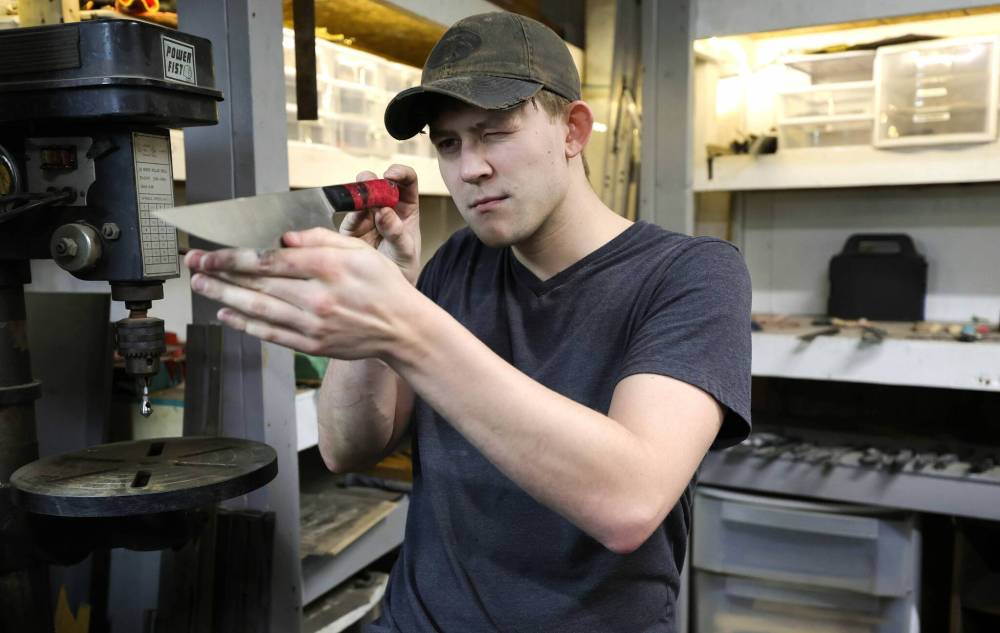
When Graeson Fehr sold a knife to someone in Alaska while working out of his parents’ garage, he figured he may have a business here. He sold 700 knives this past year, online and in stores and trade shows.
He used to be able to make five knives per week, but at North Forge, he can make 50. He spends between 50-60 hours a week at the shop, in addition to pursuing a Bachelor of Commerce at the University of Manitoba. He’s just entered his final semester.
It’s also much safer to work at North Forge than in a garage, Fehr said. There’s less dust and fumes to inhale and a lesser chance of a fire.
Blacksmithing can be perilous, Fehr said, adding people may not realize that when watching television shows such as Forged in Fire.
“Any material I use is dangerous,” he said. “When I grind stainless steel, the chromium is highly toxic and if you breathe that in you can have a lot of neurological problems. The wood, a lot of it is septic, so if you breathe in the dust, you can go into sepsis, the carbon fibre is extremely carcinogenic.”
Fehr was in a few dangerous situations at his old shop he doesn’t feel inclined to repeat. One time, when he was learning, he discovered how quickly carbon monoxide forms out of a forge that’s in a poorly-ventilated space. Another time, when he was grinding without a properly-angled grinder, sparks shot into his face and his respirator caught fire. He passed out but was able to drag himself out and to the hospital.
After doing custom work for about six years — which was helpful for learning precision, since he had to make something to his customer’s exact specifications, but also daunting when he had hundreds of custom orders at once — he switched his focus to establishing a permanent line of production blades.
In 2022, he focused on his culinary line — an eight-knife selection that includes chef’s knives, steak knives, paring knives, cheese knives, and cleavers.
Customers who used his hunting knives wanted knives for cooking too, he said. More people cook than break down an animal carcass, he added, so it made sense to expand his customer base.
Culinary knives came with a learning curve as they require a higher level of precision.

RUTH BONNEVILLE / WINNIPEG FREE PRESS
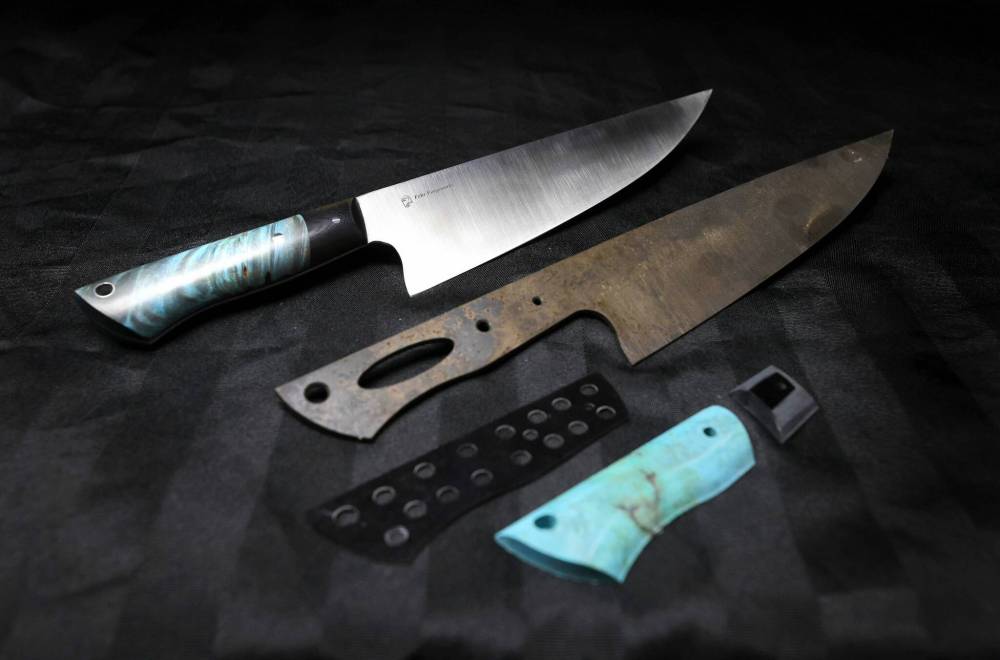
Process involves cutting steel, cleaning up and sharpening, making wooden handles and fine finishing.
“It was like learning a whole new craft, like right from bare bones. It was like I’d never made knives, almost. That’s how different those types of knives were,” he said.
“Getting the edge geometry and heat treatment right took a lot of work, a lot more than hunting knives,” he said, as the edges on hunting knives can be more rustic and the angles don’t have to be as precise.
“The kitchen knives have to be just bang-on in order to perform. If I’m going to be charging the high dollars, they’ve got to be a high-performing blade.” Fehr’s knives start at around $65 and go as high as $400. The testing to see how culinary knives held up over time and what they’re best for cutting also took time, he said.
Fehr, in the past few years, has become a perfectionist, whereas in the past he described himself as a “procrastinator slash good-enough-er.” He’s trying to find a balance between perfection and production.
“You can make the perfect knife, but if it takes you three weeks to make it, how are you going to do anything?” he asked.
He still does a few custom orders for corporate clients. One knife that tested his drive for perfection is a recent corporate custom job for the RCMP in collaboration with Staff Sgt. Shayne Smith, a Pimicikamak Cree Nation member.
The 40 hunting knifes Fehr made for the order of a specialty steel that requires extreme cold to be heat-treated, have Manitoba maple handles, are engraved with the RCMP horse and rider logo, and come with hand-stitched leather sheaths. The RCMP gifted them to Indigenous chiefs a few months ago on the National Day for Truth and Reconciliation.
They took a year to design and make; he’s particularly proud of them.
“(For) anybody up north, (hunting) is huge in the way of life,” Fehr said. To make “a meaningful, useful gift (of) high-grade materials, something to cherish,” and working with Staff Sgt. Smith was a special experience, he added.
RUTH BONNEVILLE / WINNIPEG FREE PRESS
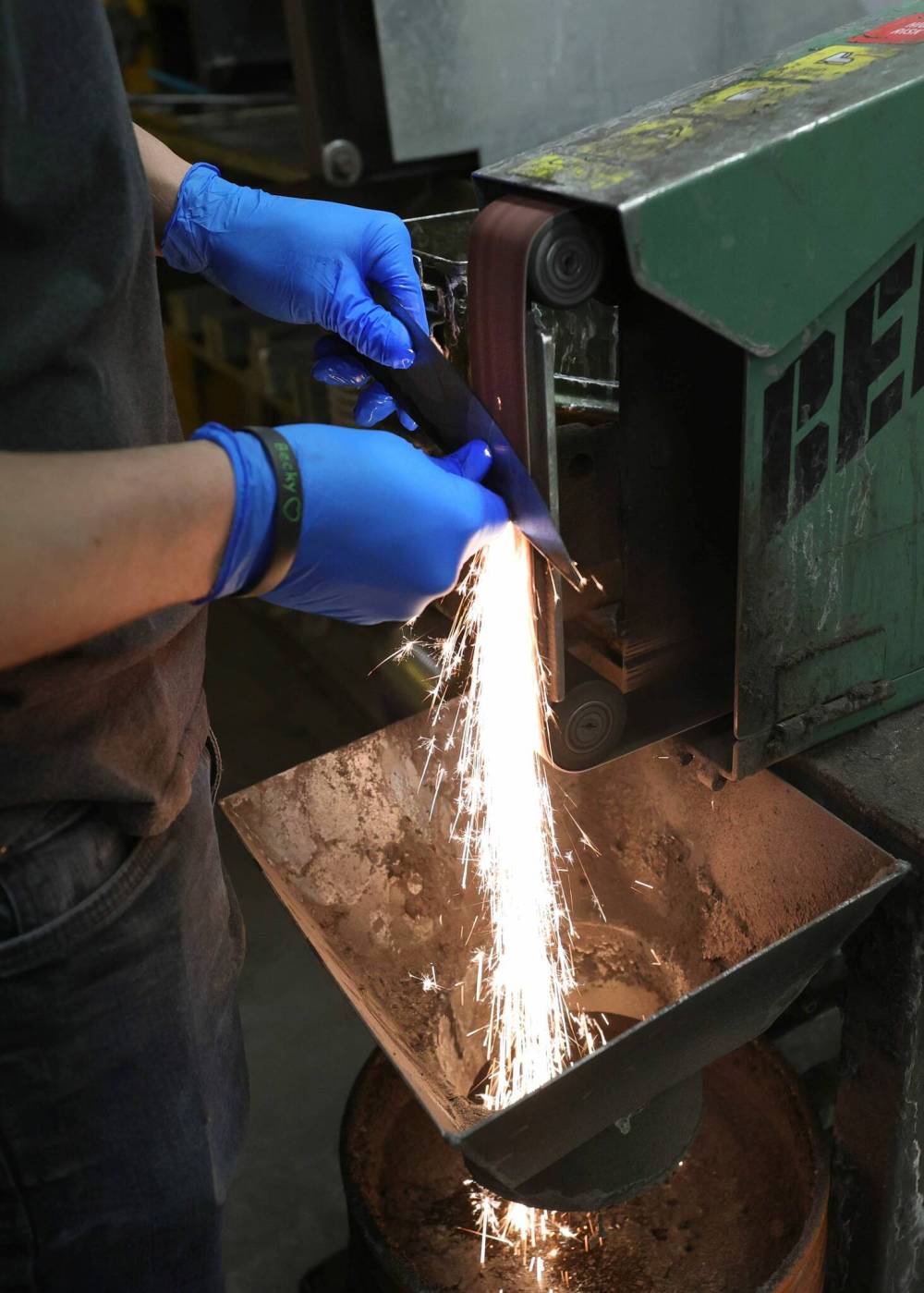
Fehr sharpens one of his new creations. And you can believe they’re sharp — as one customer who got into a tussle with a wild boar attests.
Feedback from customers and users has been validating, Fehr said.
This past Christmas especially, he received a lot of positive messages about his culinary knives. “A lot of people said they were beyond thrilled and that just means a lot when people really enjoy and like your work,” he said.
He’s recently had customers tell him they bought some of his first knives almost a decade ago and are now coming back for more. He’s also received encouragement from those who want to see a young guy keep advancing.
“It’s kind of crazy to have customers that have been with me that long that are continually buying them. Sometimes people send me (pictures of) their collections and that’s meaningful to be able to see…” even though he looks back at the older knives and thinks some of them aren’t great.
“Some of them, really… oof, that’s not a good knife,” he said he sometimes thinks when viewing old photos.
In some cases, customers have shared wild stories.
“One guy got attacked by a wild boar and he used one knife as he was getting attacked and it was too short and it wasn’t doing anything,” Fehr related. “So he took out my knife that he had on him as well and he was able to kill the boar that was mauling him… I get lots of crazy and interesting feedback.”
Just as important as creating a good quality knife — one capable of saving one’s life, potentially —is being a good businessperson. Fehr has taken his university program in six years rather than four to be able to study and make knives at the same time. “I didn’t want to be just doing school,” he said. “I wanted to be able to learn and apply it.”
Part of his long-term strategy is to get his knives into more retail stores. “Really refine my Manitoba base, that’s the goal right now,” he said. “I kind of went big and now I’m really trying to get a deeper penetration in the Manitoba market just so people start knowing my name and start knowing my products.”
RUTH BONNEVILLE / WINNIPEG FREE PRESS
The process of making a knife involves cutting steel, cleaning up and sharpening, making wooden handles and fine finishing.
He speaks of a “start to finish” approach as key to getting shelf space.

“You can’t just present a knife to a store,” he said. His knives come with an information tag, a sheath, and a retail-style presentation gift box. He considers the minutia on these matters, from the moisture content of the box, to the knives’ warranty, to where the knives are located in any given store.
In the year ahead, Fehr is excited to work more with Damascus steel, which is quite sought-after and expensive, but a pleasure to work with, he said. Original Damascus steel swords date back as far as 900 CE.
He has the drive to make Fehr Forgeworks a lifelong vocation and to keep evolving.
“Whatever I can learn, I enjoy. This is a constant learning process, especially learning how to make things and make them better,” he said. “I have books and books at home about heat treatment, edge geometry, historical knives — how they look, how they function. There’s lots of learning you can always keep doing about this craft.
“You can always get better and there’s always new stuff coming out too, even though it’s an ancient craft.”