

Serbia could become ‘pariah’ over Kosovo, president warns
Advertisement
Read this article for free:
or
Already have an account? Log in here »
To continue reading, please subscribe:
Digital Subscription
One year of digital access for only $1.44 a week*
- Enjoy unlimited reading on winnipegfreepress.com
- Read the E-Edition, our digital replica newspaper
- Access News Break, our award-winning app
- Play interactive puzzles
*Billed as $5.77 plus GST every four weeks. After 52 weeks, price increases to the regular rate of $19.95 plus GST every four weeks. Offer available to new and qualified returning subscribers only. Cancel any time.
To continue reading, please subscribe:
Add Free Press access to your Brandon Sun subscription for only an additional
$1 for the first 4 weeks*
- Enjoy unlimited reading on winnipegfreepress.com
- Read the E-Edition, our digital replica newspaper
- Access News Break, our award-winning app
- Play interactive puzzles
*Your next Brandon Sun subscription payment will increase by $1.00 and you will be charged $17.95 plus GST for four weeks. After four weeks, your payment will increase to $24.95 plus GST every four weeks.
Read unlimited articles for free today:
or
Already have an account? Log in here »
Hey there, time traveller!
This article was published 02/02/2023 (1363 days ago), so information in it may no longer be current.
BELGRADE, Serbia (AP) — Serbia’s populist president warned during a chaotic parliamentary session on Thursday that the Balkan nation could become a European “pariah” state if it rejects a Western plan for normalizing relations with Kosovo.
President Aleksandar Vucic faced a hostile reception from the right-wing opposition, which urged parliament to reject the plan and accused him of betraying Serbia.
The plan hasn’t been made public formally, but Vucic said it stipulates that Serbia wouldn’t object to Kosovo’s inclusion in international organizations, including the United Nations, though it wouldn’t have to formally recognize its statehood.
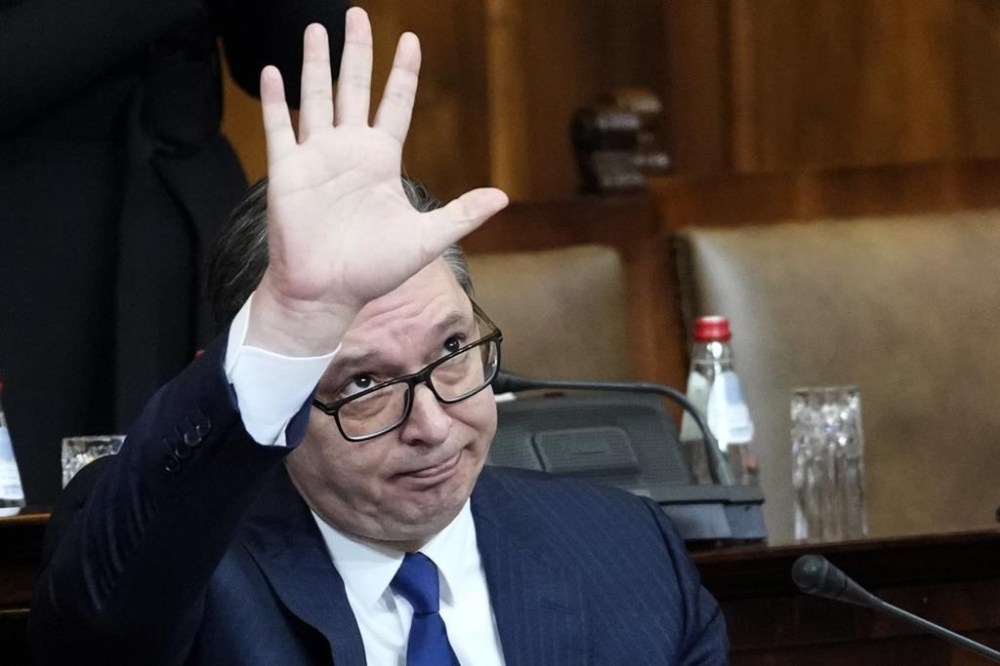
“I haven’t signed anything. I said we will continue with the talks,” Vucic said. “People need to understand … Would we become a European pariah? Yes, we would.”
The session included pushing and shoving, and shouting matches between Vucic’s ruling party and opposition lawmakers. They chanted “Treason, treason” and “We won’t give up Kosovo,” and demanded Vucic’s resignation.
Vucic responded by shouting at the protesting lawmakers that they are “thieves and traitors.”
The sovereignty of Kosovo, a former province of Serbia that declared independence in 2008, isn’t recognized by the Serbian government.
The dispute between Serbia and Kosovo has been a source of tension in the Balkans since the war in 1998-99 that ended when a NATO bombing campaign forced Serbia to pull out of the former Serbian province. The United States and the European Union recently have stepped up efforts to solve the problem, fearing instability as Russia’s war rages in Ukraine.
In Kosovo on Thursday, Prime Minister Albin Kurti set conditions for the formation of an association of Serb-majority municipalities, which is supported by both the U.S. and the EU. Kurti said the association can only be formed as part of an overall agreement on normalization of relations, which Serbia has rejected in the past.
Kosovo authorities fear that a community of Serb-dominated municipalities — first agreed at EU-led talks in 2013 — would eventually undermine the country’s statehood with the help of Belgrade. Kurti instead urged Belgrade to dismantle any Serbia-backed institutions among the Kosovo Serb community, who overwhelmingly reject Kosovo independence.
Vucic said that Western envoys told him last month that Serbia’s accession process into the EU would be halted and economic investment stopped if Belgrade decides to reject the latest Western bid to reach a solution.
As Vucic spoke in parliament, right-wing lawmakers held up banners accusing the Serbian president of treason over Kosovo, which many in Serbia consider the cradle of national identity.
The hard-line pro-Russia opposition lawmakers in parliament described the Western plan for Kosovo as an “ultimatum.” They said it would mean Serbia would have to recognize Kosovo’s independence as a condition of eventually joining the European Union.
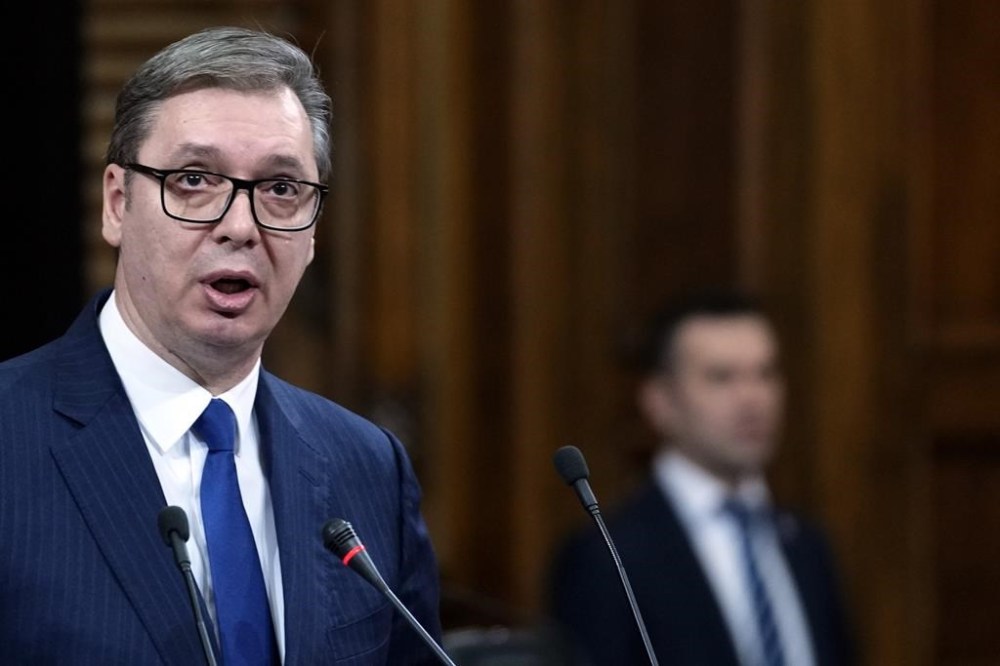
“We don’t see a single reason why we should accept this Western ultimatum,” said Bosko Obradovic of the far-right Dveri party, urging the assembly to vote to reject it.
Serbia has relied on support from Russia and China in its rejection of Kosovo’s independence. This is one of the reasons why Belgrade hasn’t imposed any sanctions on Moscow over the war in Ukraine.

Vucic said it is of “vital interest” for Serbia to continue with the accession process into the EU, but reiterated that the country wouldn’t join NATO. Rejection of Western efforts would result in “complete isolation,” he warned. “You cannot function alone.”
Decades-long, simmering tensions between Serbia and Kosovo occasionally explode into violence, particularly in the north of the country that borders Serbia and which is populated mostly by ethnic Serbs.
The war in 1998-99 erupted when separatist ethnic Albanians launched a rebellion against Serbia’s rule, and Belgrade responded with a brutal crackdown. About 13,000 people died, mostly ethnic Albanians.
___
Dusan Stojanovic in Belgrade, Serbia, and Llazar Semini in Tirana, Albania contributed to this report .
Related Articles
US to send Ukraine longer-range bombs in latest turnaround
Advertisement Advertise With Us
Advertisement Advertise With Us