

Fire that destroyed fish plant puts livelihoods in jeopardy
Advertisement
Read this article for free:
or
Already have an account? Log in here »
To continue reading, please subscribe:

Digital Subscription
One year of digital access for only $205*
- Enjoy unlimited reading on winnipegfreepress.com
- Read the E-Edition, our digital replica newspaper
- Access News Break, our award-winning app
- Play interactive puzzles
*First annual payment billed as $205.00 + GST for one year. This annual subscription will automatically renew at $233.00 + GST every 52 weeks (10% off the regular annual price of $259.35). Offer available to new and qualified returning subscribers only. Cancel any time.
To continue reading, please subscribe:
Add Free Press access to your Brandon Sun subscription for only an additional
$1 for the first 4 weeks*
- Enjoy unlimited reading on winnipegfreepress.com
- Read the E-Edition, our digital replica newspaper
- Access News Break, our award-winning app
- Play interactive puzzles
*Your next Brandon Sun subscription payment will increase by $1.00 and you will be charged $17.95 plus GST for four weeks. After four weeks, your payment will increase to $24.95 plus GST every four weeks.
Read unlimited articles for free today:
or
Already have an account? Log in here »
Hey there, time traveller!
This article was published 13/06/2023 (1183 days ago), so information in it may no longer be current.
A fire that destroyed the fish plant at Misipawastik Cree Nation (formerly called Grand Rapids) has put the livelihoods of about 90 people in the small community 400 kilometres north of Winnipeg in jeopardy.
The community of about 700 people relies heavily on the earnings from the pickerel, whitefish and jackfish fishers.
The fire occurred about a week ago right at the very start of this year’s fishing season and the destruction of the 2,000-square-foot fishing shed means that fishers will need to truck their catch about 180 kilometres away to the next closest operation at Lake St. Martin.

Supplied
The Grand Rapids fish processing shed burned down a week ago.
Kevin Ault, one of the board member of the Grand Rapids Fisherman’s Co-op that operates the small processing facility, said he made the trip on the weekend.
“I left around 10 and was out on the lake around 2 in the afternoon, did not get off until 9. Then I drove to Lake St. Martin and did not get home until 2 in the morning,” Ault said.
As gruelling a day as that is, many of the Grand Rapids fishers are not able to do that because many do not have vehicles or even a driver’s license.
Alex Ross, president of the co-op, said, “Everyone was excited about the fishing season starting, but now many are not even putting out their nets because they can’t travel with their catch.”
Freshwater Fish Marketing Corp. (FFMC), the federal Crown corporation, is sending up trailers with ice twice a week, but the fish still require weighing and proper packing — with the heads and guts removed — before they can be shipped.
The Co-op has put a proposal together looking for about $125,000 from Indigenous Services Canada to establish a temporary facility. But a letter sent a week ago has not been acknowledged.
Niki Ashton, the NDP MP for the region, said she spoke with Indigenous Services Canada’s Ottawa office on Monday.
She said it “is absolutely critical” for the federal government to step in.
“The fishery is one of the main economic drivers for Grand Rapids,” Ashton said. “Grand Rapids is a community that, not unlike other First Nations, has high levels of unemployment. These are jobs that sustain families and the entire community. The loss of the fish shed means the difference for many fishers between poverty and some economic security in difficult times.”
The proposal to Indigenous Services Canada includes the purchase of two Sea Can refrigerated trailers that go for about $14,500 each.
The Co-op estimates that the fishery generates about $1.5 million in economic activity over the course of a year.

In addition to the 90 fishers — who operate in about 50 boats — each would employ two or three part time assistants. The processing operation would employ another five or six people and there are a couple of dozen retirees who would fish temporarily.
FFMC used to have a monopoly to buy all the fish caught in Lake Winnipeg. But a couple of years ago that monopoly was partially ended and an Ontario-based fish marketing operation called Presteve Foods Ltd. set up some facilities in Manitoba and provided somewhat more competitive pricing.
But Ault said many of the veteran members of the Co-op wanted to stay with FFMC.
“Presteve makes a competitive offer, FFMC comes back with another offer but it’s usually only a few pennies per kilogram difference,” he said.
martin.cash@freepress.mb.ca
Related Articles
Freshwater Fish Marketing Corp. sues steel firm after explosion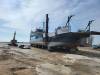
Advertisement Advertise With Us
Advertisement Advertise With Us